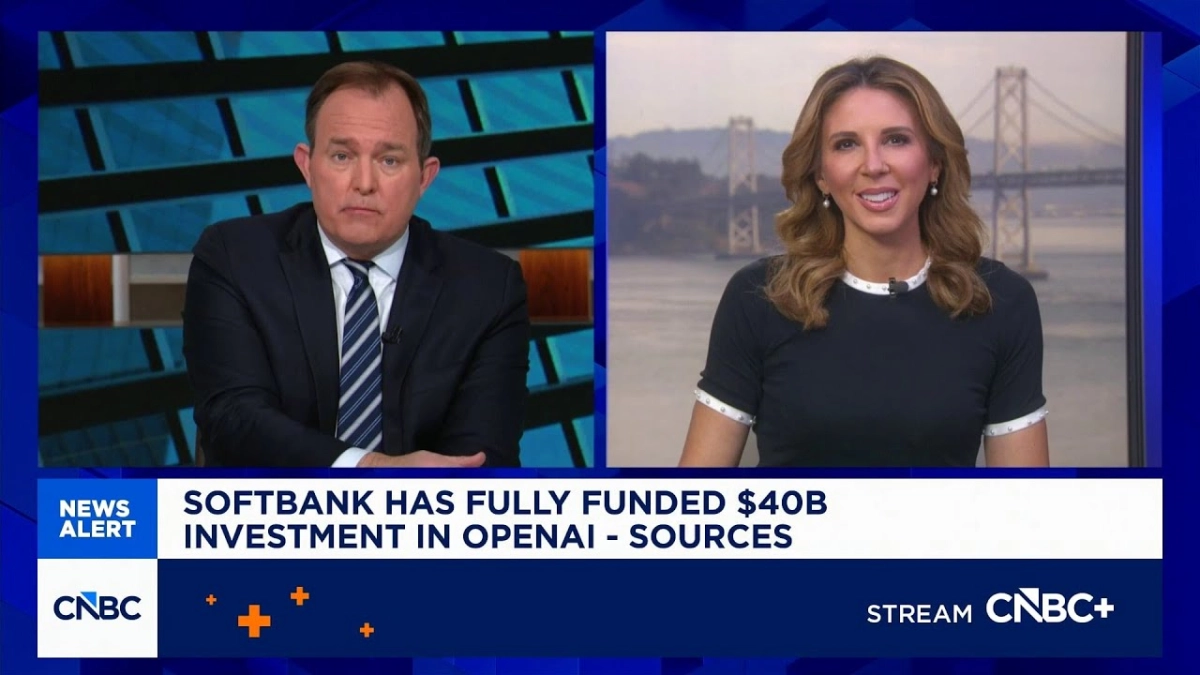
The completion of SoftBank's $40 billion funding commitment to OpenAI solidifies the notion that the pursuit of artificial general intelligence is now a hyper-capitalized, trillion-dollar infrastructure game, requiring audacious deployment strategies that few global firms can match. This final tranche of funding, reported by CNBC’s MacKenzie Sigalos, eases prior investor anxieties regarding the fulfillment of massive AI funding promises while cementing OpenAI’s position at an almost unbelievable valuation and revealing SoftBank’s dramatic pivot away from component suppliers toward platform ownership.
Sigalos detailed the specifics of the complex transaction, noting that SoftBank funded $30 billion of the total round, with the balance coming from co-investors. The result is that SoftBank now owns more than 10% of OpenAI, establishing a substantial stake in a company that achieved a $260 billion pre-money valuation. This valuation is particularly striking as the startup’s value has nearly doubled since January, reflecting the exponential growth trajectory demanded by the AI sector's compute requirements and market dominance ambitions.
The scale of this investment necessitated significant internal maneuvering at SoftBank. The firm executed a profound strategic shift to generate the necessary liquidity, liquidating its entire stake in Nvidia just last month. This sale, estimated to be worth nearly $6 billion, was not merely a portfolio adjustment but a direct funding mechanism for the OpenAI deal. SoftBank, long known for its Vision Fund’s sprawling, often scattershot investments, chose to exit its position in the chipmaker, the quintessential AI proxy investment, to place a highly concentrated wager directly on the application layer champion.
Sources informed CNBC that the Nvidia sale "would specifically help fund this very investment," illustrating a clear redirection of capital. Rather than treating Nvidia as its AI proxy, SoftBank is now betting directly on OpenAI’s success, viewing Sam Altman’s firm as the ultimate long-term winner in the platform economy. This move signals a critical consensus among top-tier financial players that the true value capture in the coming decade will reside not just in the silicon that powers AI, but in the proprietary models and services built atop that infrastructure.
The capital inflow is not merely dry powder; it is earmarked for the physical buildout required to sustain AI’s escalating computational needs. A significant portion is allocated to Stargate, the immense AI infrastructure joint venture established between OpenAI, Oracle, and SoftBank. The Stargate project, currently valued at $500 billion, is not just a collection of data centers but a bespoke ecosystem designed to train and deploy future generations of massive models. This initiative reflects a realization across the industry that current cloud capabilities, while vast, are insufficient for the next leap in AI capabilities, forcing the creation of dedicated, hyperscale compute clusters.