

• StartupHub.ai
    StartupHub.aiAI Intelligence
Discover
  • Home
  • Search
  • Trending
  • News
Intelligence
  • Market Analysis
  • Comparison
  • Market Map
Workspace
  • Email Validator
  • Pricing
Company
  • About
  • Editorial
  • Terms
  • Privacy
  • v1.0.0
  1. Home
  2. News
  3. Seeing The Future From Ai Companions To Personal Software
Back to News
Ai video

Seeing The Future from AI Companions to Personal Software

S
StartupHub Team
Nov 5, 2025 at 7:20 PM4 min read
Seeing The Future from AI Companions to Personal Software

AI is just an app on your phone. It should not be that way.
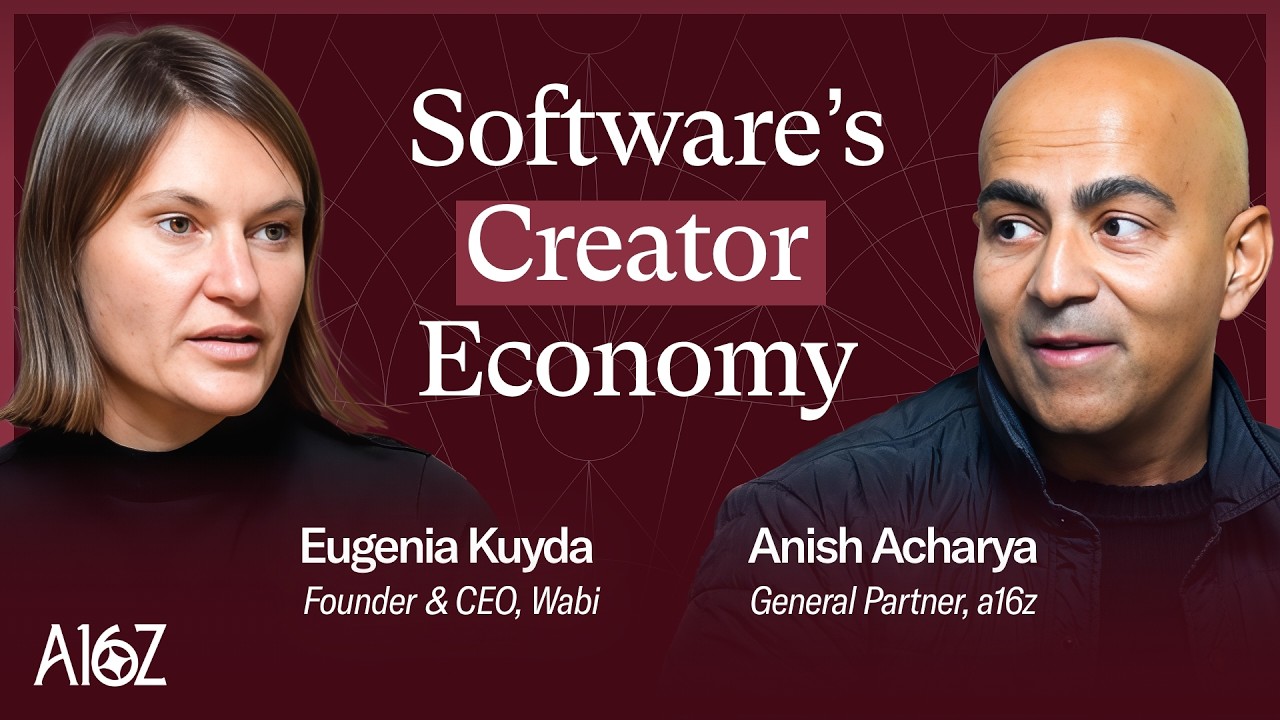
Eugenia Kuyda, CEO of Wabi and AI pioneer behind Replika, joined Erik Torenberg, Anish Patel, and Justine Moore on the a16z Podcast to discuss the future of personal software and how AI is transforming it from a developer-centric medium to a creative platform accessible to everyone. Kuyda articulated a vision where AI interfaces evolve beyond rudimentary command lines, drawing a parallel between current AI interfaces and the early days of MS-DOS, suggesting that a more intuitive and user-friendly approach is imminent.

"It must be an interface problem," Kuyda stated, highlighting the core challenge in making AI tools accessible. She elaborated on the potential for mini-apps to become as shareable as TikToks, envisioning a future where users can seamlessly create and distribute personalized software. This shift, she argued, would democratize app creation, enabling individuals to build custom solutions in minutes. Kuyda's journey, spanning a decade from training language models in 2012 to building a platform where anyone can create custom apps, underscores this transition.

A significant insight from the discussion was the concept of "Software 3.0," which Kuyda described as a paradigm shift towards deep personalization driven by shared context. This personalization is not merely about individual preferences but about creating a shared understanding and environment for users. She explained how this evolution is fueled by the increasing ability to share prompts and interact with AI in more nuanced ways, fostering a more collaborative and creative ecosystem.

Kuyda also touched upon the evolution of AI since 2012, noting the significant advancements in language models. She shared anecdotes from her time working with OpenAI during its early days, painting a picture of a nascent industry still finding its footing. Despite the rapid progress, she cautioned against the prevalent focus on voice-first devices, stating, "Voice-first devices completely miss the point." She argued that while voice interfaces have their place, they are not the optimal interface for all interactions, particularly when it comes to the complexity and nuance of personal software creation.

The conversation also delved into the creator economy on Wabi, where users can not only consume but also create and share their AI-powered applications. Kuyda emphasized the potential to "100x the world's meaningful software," suggesting that by empowering more people to create, the collective impact of AI-driven applications can be significantly amplified. This democratization of software creation, she believes, will lead to a more diverse and personalized digital landscape, where individual needs and creativity can be directly translated into functional tools.

Furthermore, Kuyda highlighted the importance of "software as content," drawing parallels to how platforms like YouTube transformed video creation and consumption. She posited that Wabi aims to achieve a similar transformation for software, making it a more accessible and engaging medium for everyone. The ability for users to share their creations, much like sharing a TikTok video, fosters a sense of community and collective innovation, driving the evolution of personal software.

Related Reading

  • Orchestrator Agents and Model Context Protocol: The Future of AI Automation
  • Shopify president: We're laying the rails for agentic commerce
  • OpenAI's Vertical Stack Ambition Signals AI's Industrial Evolution

The discussion also touched upon the concept of ephemeral versus durable software, with Kuyda suggesting that while some applications might be transient, others will gain durability through continuous refinement and community contribution. This dynamic approach to software development, she argued, is essential for adapting to the rapidly evolving AI landscape.

In essence, Kuyda's vision for Wabi and personal software centers on empowering individuals to become creators, leveraging AI as a tool for personalized expression and problem-solving. The shift from a developer-monopoly to a creative medium for all is not just a technological advancement but a fundamental change in how we interact with and shape our digital world.

#a16z
#AI
#AI interfaces
#Creator Economy
#Democratizing App Creation
#Eugenia Kuyda
#Personal Software
#Wabi

AI Daily Digest

Get the most important AI news daily.

GoogleSequoiaOpenAIa16z
+40k readers