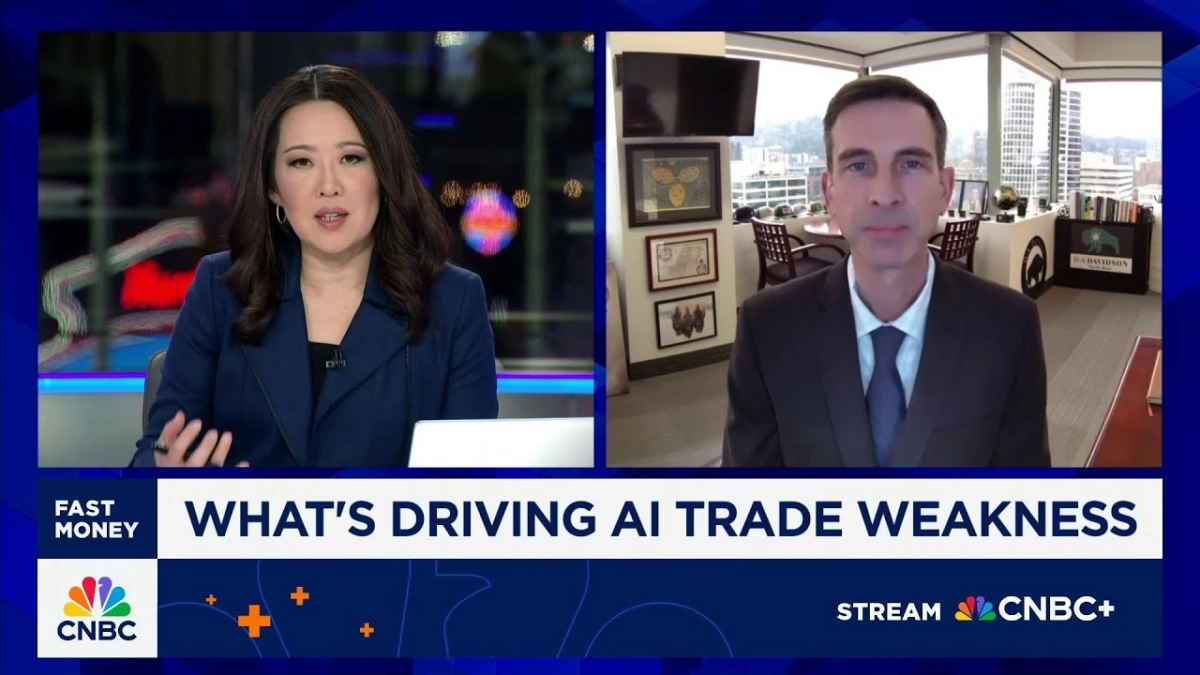
The exuberance surrounding artificial intelligence investment has reached a critical juncture, with certain market players exhibiting what has been termed "bad behavior" that warrants a closer look at the underlying economics. On CNBC's 'Fast Money,' DA Davidson's Head of Technology Research, Gil Luria, spoke with the interviewer about the current state of AI investment, particularly in light of Oracle's recent stock performance and the broader implications for the AI buildout. Luria's sharp analysis dissected the narratives driving AI capacity expansion, drawing a stark contrast between established tech giants and companies like Oracle and CoreWeave.
Luria contends that Oracle and CoreWeave represent "the bad behavior in the AI buildout" because their investment strategies deviate from the healthy, responsible approaches of industry leaders such as Microsoft, Amazon, and Google. These larger players, he argues, possess "all the customers, have cash on hand, and have tremendous cash flow," enabling them to construct data centers with demand already "sold three years in advance." This foresight and existing customer base allow for strategic, pre-committed capital deployment, minimizing speculative risk.
In contrast, Oracle's approach to expanding its AI infrastructure is characterized by what Luria labels "irresponsible investment." The core of this critique lies in Oracle's decision to borrow heavily to build out GPU capacity, primarily for nascent AI startups, without the same level of guaranteed consumption enjoyed by hyperscalers. This strategy creates a precarious financial position where significant capital is expended on infrastructure that may not generate sufficient, high-margin revenue.
A central point of contention for Luria is Oracle's messaging around its AI backlog, specifically concerning its relationship with OpenAI. Oracle initially announced a substantial $300 billion backlog from "several companies," a figure that subsequently garnered significant market optimism. However, Luria reveals that this commitment was largely from OpenAI alone. Furthermore, he states that OpenAI's purported "$1.4 trillion" commitment to Oracle is not a firm, binding obligation but rather a "flexible arrangement" where they "can consume as much as they want," lacking any intention of fully living up to those obligations. This flexibility means that the reported backlog does not translate into guaranteed revenue for Oracle, undermining the perception of robust demand.
This leads to a critical insight: the reported demand for Oracle's AI infrastructure is not "real demand" in the traditional sense. The flexibility granted to a major client like OpenAI means Oracle is building capacity on spec, hoping for future consumption rather than fulfilling firm, non-cancellable orders. This speculative buildout, Luria emphasizes, exposes Oracle to significant risk, as the actual utilization and revenue generation remain uncertain.