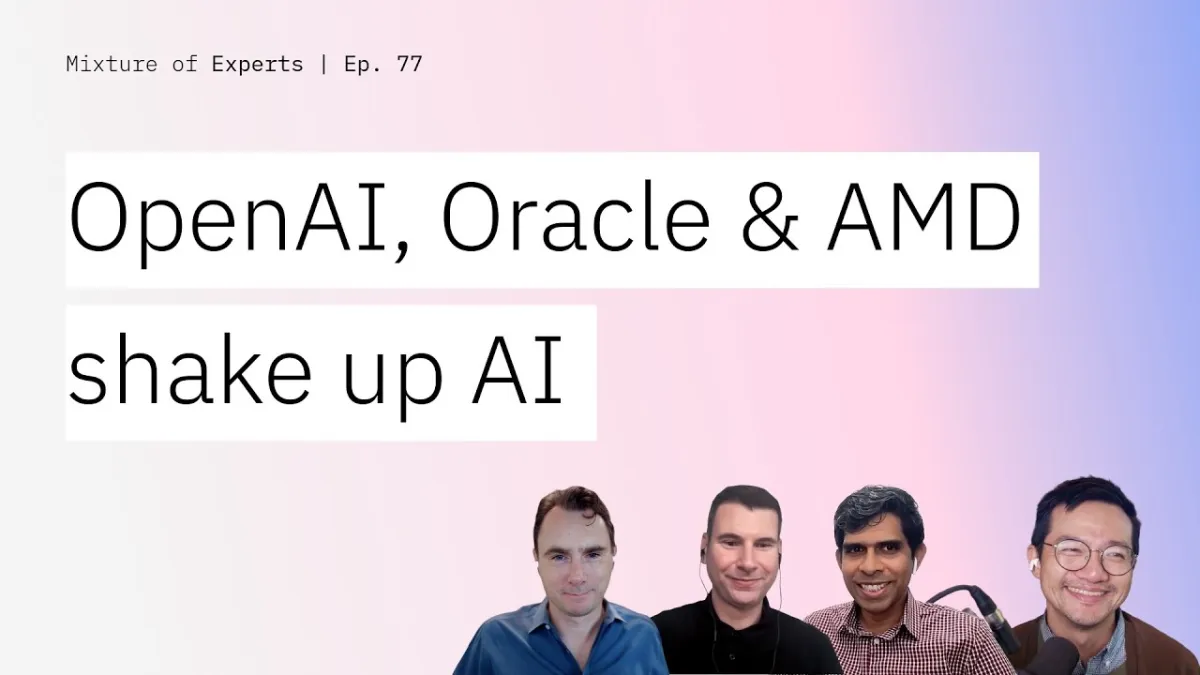
The artificial intelligence landscape is witnessing a profound realignment, challenging established hegemonies and fostering an environment ripe for new contenders. This week on the Mixture of Experts podcast, host Tim Hwang, alongside panelists Volkmar Uhlig (VP, AI Infrastructure), Ambhi Ganesan (Partner, AI & Analytics), and Aaron Baughman (IBM Fellow, Master Inventor), dissected the seismic shifts occurring in the AI chip market, the burgeoning "AI bubble" debate, and the strategic plays of emerging and established players. Their discussion revealed a market in flux, where competition is intensifying, and the very foundations of AI dominance are being re-evaluated.
A central theme emerged from Oracle Cloud's recent announcement to deploy 50,000 AMD chips in the latter half of 2026. This significant commitment signals a deliberate move by a major cloud provider to diversify its AI infrastructure beyond Nvidia's pervasive GPUs. This follows earlier news of OpenAI's own deals with both AMD for processor deployment and Oracle for a substantial five-year cloud deal, potentially worth $300 billion. Volkmar Uhlig astutely observed, "the market is opening up, I think the competitors are going after Nvidia." He suggested that Nvidia's aggressive "new chip every year" strategy is a direct response to this mounting pressure.
This flurry of deals and investments has inevitably sparked discussions about an "AI bubble." Uhlig pointed to the "money going in circles" within the ecosystem, with Nvidia investing in OpenAI, OpenAI dealing with Oracle, and Oracle acquiring AMD chips—a cyclical flow that raises questions about the underlying economic reality. Ambhi Ganesan, however, offered a more tempered perspective, noting that while investments are substantial, they are not yet at the same percentage of GDP as seen during the dot-com era. He posits that the current investment level is commensurate with the potential long-term benefits to the economy. Crucially, Uhlig highlighted a key difference from past bubbles: the almost instantaneous productivity increases observed with AI tools like ChatGPT, which delivered a 43% boost within a year or two, contrasting sharply with the internet bubble's delayed productivity gains. This suggests that the current investment, while perhaps speculative in parts, is underpinned by tangible and rapid value creation.
Nvidia's long-standing dominance has been largely attributed to its proprietary CUDA software platform, often described as an unassailable moat. However, the panelists discussed how this moat is being actively challenged. Uhlig pointed out that "all vendors have decided to build compatibility layers" against CUDA, with AMD's ROCm and OpenAI's Triton emerging as significant open-source alternatives. While Nvidia still holds an advantage in the maturity and adoption of its software stack, the industry is clearly moving towards GPU independence. Aaron Baughman emphasized the sheer scale of Oracle's AMD deployment, noting that 50,000 AMD Instinct MI300X GPUs would consume roughly 50 million kilowatt-hours of power per month, enough to power a small city. This massive energy demand underscores the critical need for cost-efficient hardware, where AMD's lower price per teraflop offers a compelling alternative.
Related Reading
- AI Infrastructure: The Next Frontier Beyond Hyper-Scalers
- Poolside and Coreweave Bet Big on West Texas for AI Infrastructure
- AI's Economic Ripple: Beyond Tech to Main Street and Labor Markets
The conversation also touched upon the CAISI (Center for AI Standards and Innovation) report on DeepSeek's model risks, which found the Chinese open-source model lagging behind US counterparts in performance, cost, security, and adoption. Ambhi Ganesan framed this as a positive, stating that DeepSeek's open weights enabled comprehensive "pressure test and stress test" by the US government, allowing for the identification of security implications and performance metrics. This transparency, he argued, is vital for driving progress and establishing trust in enterprise AI. The emergence of Reflection AI, a US-based "open frontier lab" that recently secured $2 billion at an $8 billion valuation, further illustrates the strategic importance of open-source initiatives. Despite not having released a single model yet, Reflection AI's significant funding and focus on open models signal a strong belief in the democratizing power of open-source AI and the potential to accelerate innovation.
The broader market dynamics, including a VC fund replacing its analysts with AI agents, highlight the disruptive potential of AI across various sectors. Aaron Baughman cautioned about the "execution risk" for new players like Reflection AI, emphasizing that funding alone doesn't guarantee success. Uhlig suggested that the market is at the "tail end of foundation model companies," implying that capital will increasingly flow towards applications built *on* existing models. He stressed that the fundamental infrastructure—chips, data centers, and network capabilities—is now largely in place, accelerating the adoption and impact of AI. The focus is shifting from "do we need another model company" to "what are the applications" that will truly transform industries. This dynamic interplay between hardware, software, open-source initiatives, and strategic investments paints a picture of an AI market that is rapidly evolving, driven by both intense competition and a collective push for greater efficiency and accessibility.