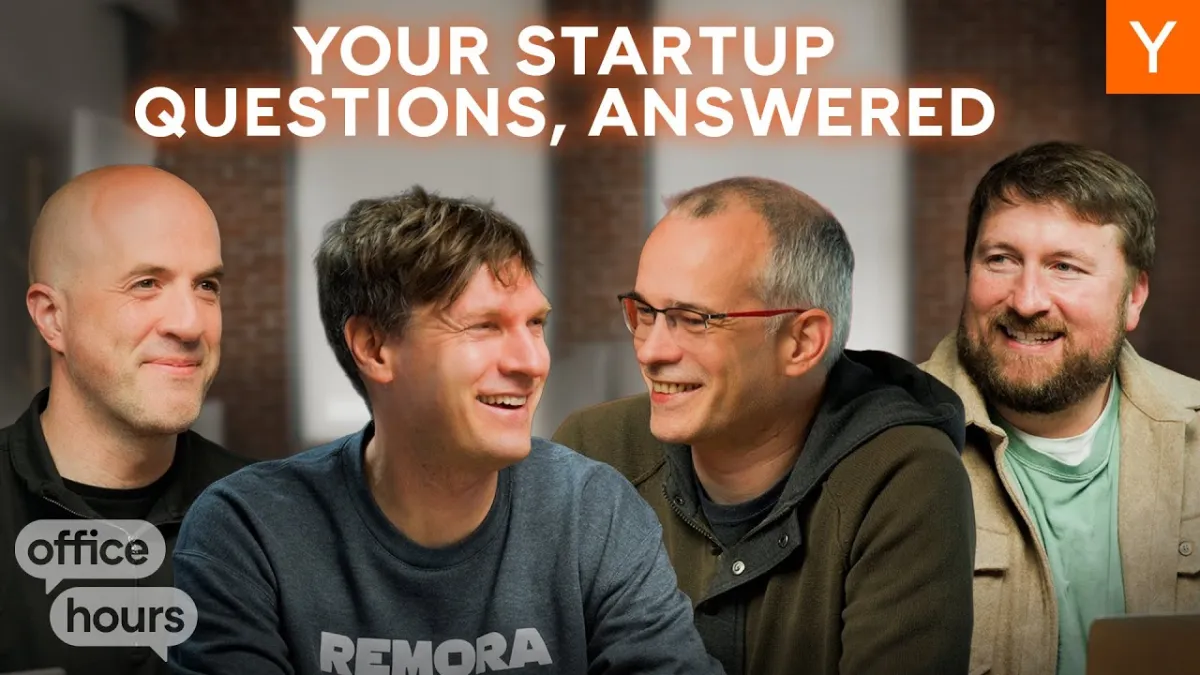
In a recent "Office Hours" session hosted by Y Combinator, General Partners Pete Koomen, Brad Flora, Nicolas Dessaigne, and Gustaf Alströmer offered founders a candid look into the critical decisions that shape a startup's trajectory. The discussion, centered on real-world questions from the YC community, delved into the intricacies of building AI companies, the delicate art of pivoting, and the strategic timing of hiring. As Pete Koomen aptly summarized at the outset, every founder faces "two big magic tricks" they must pull off: discerning "who am I selling to and how do I get their attention?" The conversation underscored that while the AI landscape is dynamic, fundamental startup principles, albeit adapted, remain paramount.
A core insight emerging from the discussion emphasized the **primacy of rapid learning and user feedback**, especially in the nascent stages of an AI venture. When contemplating the market entry for an AI product in a legacy industry, Gustaf Alströmer highlighted three common paths, using the accounting sector as an example. Founders can build AI software to sell to existing firms, establish their own AI-powered full-stack service, or acquire an existing firm to integrate AI. The most common and often most effective YC approach, according to Alströmer, involves building specialized AI software. He stressed identifying "areas within accounting that are most valuable to go after when you're building AI software, that is also reasonable to build in the first, I don't know, couple months or first six months." This narrow focus allows for quicker iteration and direct feedback, accelerating the learning curve essential for product-market fit. Nicolas Dessaigne further pointed out that software founders often hold an inherent advantage in the full-stack model, as their technical acumen allows them to more readily spot automation opportunities. Pete Koomen cited the example of Vesence, an AI legal startup, whose non-legal founders embedded themselves within a law firm to gain invaluable firsthand experience, essentially operating at a "pre-early adopter" stage to build their Minimum Viable Product.

The partners also explored the tension between rapid growth and long-term defensibility, particularly relevant in the current AI gold rush. Brad Flora underscored that for early-stage companies, the **pace of learning** is the single most crucial factor. Chasing large enterprise deals from the outset, unless there's a unique "in," can severely impede this learning by extending sales cycles and delaying critical feedback. Instead, he suggested, "Let's find something smaller that we can wrap our hands around and be really successful with." This could mean targeting the mid-market or even specific users within a larger enterprise, reducing the scope to accelerate iteration and build a robust product foundation. Gustaf reiterated the importance of qualifying potential customers thoroughly, ensuring they are not only receptive to new technology but also empowered and incentivized to adopt and champion it. This selective approach helps avoid lengthy, unfruitful sales efforts and ensures valuable, actionable feedback.
Another significant takeaway revolved around **conviction and the embrace of technical challenges**. Nicolas Dessaigne offered a provocative perspective: if an idea proves "really hard on the technical side," it might actually be "an even better idea." This is because the high barrier to entry discourages competitors, creating a natural moat. He cited Bramante Biologics, a YC company tackling the incredibly complex task of manufacturing drugs with micro-factories. Despite the immense technical difficulty, the founders' visible passion and conviction indicate they are on the right track. This suggests that for teams with the requisite skills and unwavering belief, technically challenging problems can lead to highly defensible and transformative solutions.
The discussion also touched on the often-misunderstood timing of a pivot and the true purpose of hiring. Brad Flora noted that while pivots are typically associated with failure, they can also occur when a startup has "some traction" but it's not strong enough. The critical question then becomes: "When should you consider pivoting if you've got some traction?" Nicolas cited Firecrawl, a company that pivoted despite having significant ARR, realizing their core data extraction technology was more valuable than their initial Q&A product. This was a "big leap of faith" that paid off. Pete Koomen offered a deeply human insight into this decision, suggesting that the ultimate leading indicator for a pivot is often when a founder "just stop[s] believing that what you're working on is going to work out." This emotional connection to conviction highlights the personal toll and courage required for such a strategic shift.
Related Reading
- The Contrarian Compass: Navigating AI's Crowded Future
- AI's Dual Nature: Creature or Machine? The Battle Over Regulation
Regarding hiring, Gustaf Alströmer provided a memorable rule of thumb: "If you have a lot of time to think about this question, it's probably too early." He clarified that hiring should primarily be a reactive measure, triggered by overwhelming operational demands. "The right time to hire when like things are so busy that you can't even find a slot in your calendar to do an interview with a candidate." Hiring, in this context, is not a success metric in itself but a necessary step to prevent the company from "breaking" under the weight of its own growth. Early hires, he noted, often come from a founder's existing network, people who already "know your thing" and require less onboarding. This pragmatic view emphasizes that resources, especially human capital, should be deployed when a clear, undeniable need arises from validated product-market fit.
The YC partners' "Office Hours" provided a multifaceted and grounded perspective on building and scaling startups in the age of AI. Their collective wisdom underscored that while technology evolves, the core challenges of validation, strategic adaptation, and team building remain central, demanding not just technical prowess but profound conviction and a relentless focus on learning from the market.