Meta's SAM 3: Revolutionizing Video Segmentation and Object Tracking

4 min read
Meta's SAM 3:

The arduous, time-consuming task of rotoscoping, once the domain of specialized teams and manual labor, has been profoundly disrupted by Meta's latest offering, the Segment Anything Model 3 (SAM 3). Matthew Berman, in his recent demonstration, showcased a tool that transforms an "extremely manual process that takes a team of dozens of people" into one that "takes seconds." This dramatic leap in efficiency signals a pivotal moment for industries reliant on precise visual data manipulation.

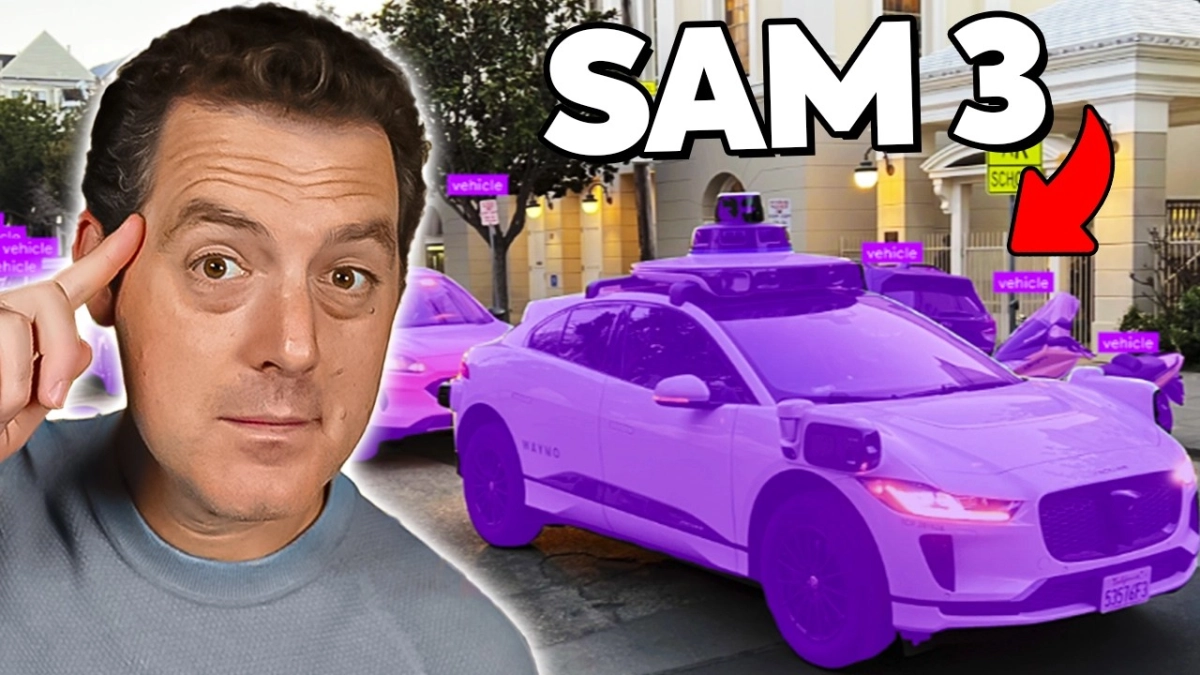
Berman introduced Meta's SAM 3, an open-source, open-weights AI vision model, detailing its capabilities and potential applications. The product distinguishes itself by simplifying object segmentation and tracking within both images and videos through intuitive text prompts or direct clicks. This accessibility, coupled with its advanced intelligence, positions SAM 3 as a significant advancement in computer vision.

The model's core strength lies in its ability to understand context. Unlike simpler tools that might merely detect a general category, SAM 3 discerns specific objects, even differentiating between similar items. Berman illustrated this intelligence with a video of dogs, noting, "It's not just an image. This is actually a full video, and frame by frame, it figures out what needs to be highlighted." This frame-by-frame precision, applied across dynamic video sequences, is crucial for maintaining accuracy in complex visual environments.


This understanding extends to nuanced distinctions. In a demonstration, the model successfully isolated all instances of "dog" from a group of animals, then specifically "zebras," and later, "motorcycles" in a dense night traffic scene, ignoring bicycles. Such granular identification capabilities are a testament to the model's advanced training and deep comprehension of visual semantics. The ability to simply click on an object, like a skateboard, and have SAM 3 automatically track its movement throughout a video, eliminates countless hours of manual keyframing.

Beyond simple identification, SAM 3's intelligence allows for sophisticated differentiation. Berman demonstrated this by prompting the model to find "vanilla ice cream" in an image featuring two cones, one vanilla and one strawberry. The model accurately highlighted only the vanilla scoops, affirming that "SAM 3 isn't just a dumb model that can highlight things. It actually understands what's in the video, which is super impressive." This semantic understanding paves the way for applications requiring high levels of specificity and contextual awareness.

The strategic decision by Meta to release SAM 3 as "completely open source, completely open weights" is a game-changer. This democratizes access to cutting-edge AI vision technology, allowing developers, researchers, and startups to integrate and build upon it without proprietary restrictions. Users can download the model, run it locally, or experiment within Meta's hosted playground, fostering a rapid pace of innovation and application development. This open approach accelerates the adoption of advanced AI capabilities across a broader ecosystem.

The implications for various sectors are substantial. For video editors and animators, SAM 3 dramatically reduces the time and effort required for tasks like background removal, special effects, and character isolation. Video game developers can leverage it for more realistic object interactions and environmental understanding. In security and surveillance, the model's ability to track specific vehicles or individuals in complex, high-traffic scenarios offers enhanced monitoring and analysis capabilities.

Furthermore, the introduction of "templates" streamlines common workflows. Berman showcased a "pixelate" template designed to automatically identify and blur license plates in video footage. This pre-defined task, which can be applied with a single click, addresses a prevalent need for privacy and data anonymization in visual media. Such templates represent a powerful abstraction layer, making complex AI functionalities accessible to non-experts.

The utility extends to robotics, where precise object segmentation is paramount for navigation, manipulation, and safety. A robot equipped with SAM 3 could instantly identify and categorize every object in its environment, enabling it to perform tasks like organizing a room or, critically, stopping immediately if it detects a child in its path. This capability is not merely about object detection but about real-time environmental awareness and intelligent decision-making, crucial for the safe and effective deployment of autonomous systems.

SAM 3 represents a significant step forward in making advanced computer vision tools universally accessible and powerful. Its ability to accurately segment and track objects in real-time, coupled with a deep understanding of visual context, sets a new standard for efficiency and intelligence in visual AI.