Moonshot Labs, a burgeoning Chinese AI firm, has unleashed Kimi K2 Thinking, an open-source, open-weights model that is rapidly redefining the competitive landscape of artificial intelligence. As commentator Matthew Berman of Forward Future AI starkly noted, "Moonshot Labs, a Chinese frontier AI company just released a completely open-source, completely open weights, frontier-level model that is better than GPT-5, better than Claude 4.5 on some of the hardest benchmarks." This bold claim, substantiated by a suite of rigorous evaluations, signals a pivotal moment for the industry, challenging the established dominance of Western tech giants and underscoring the accelerating pace of global AI innovation.
Berman's commentary in his video provides a thorough overview of Kimi K2 Thinking's capabilities and implications, presenting benchmarks and practical demonstrations that showcase its advanced reasoning, coding, and agentic prowess. The model's emergence marks a critical juncture, highlighting how open-source initiatives are not merely catching up but actively setting new performance standards. This rapid convergence of capabilities between open and closed models is a central insight, suggesting a future where accessibility to cutting-edge AI is increasingly democratized.
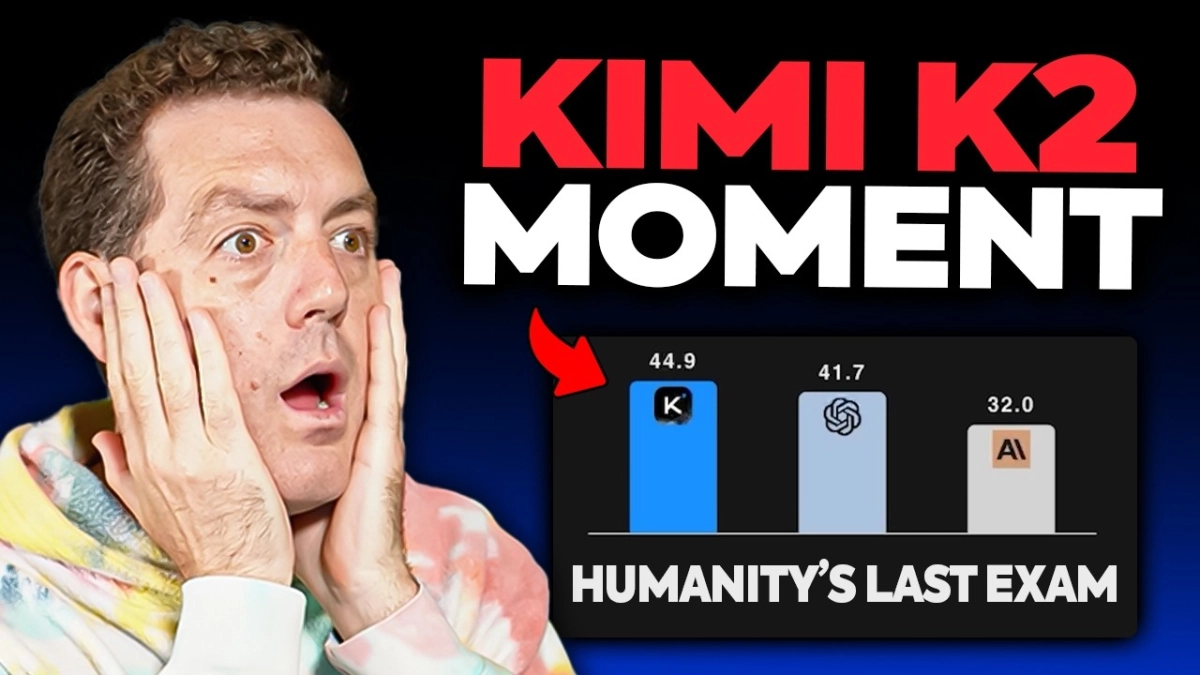
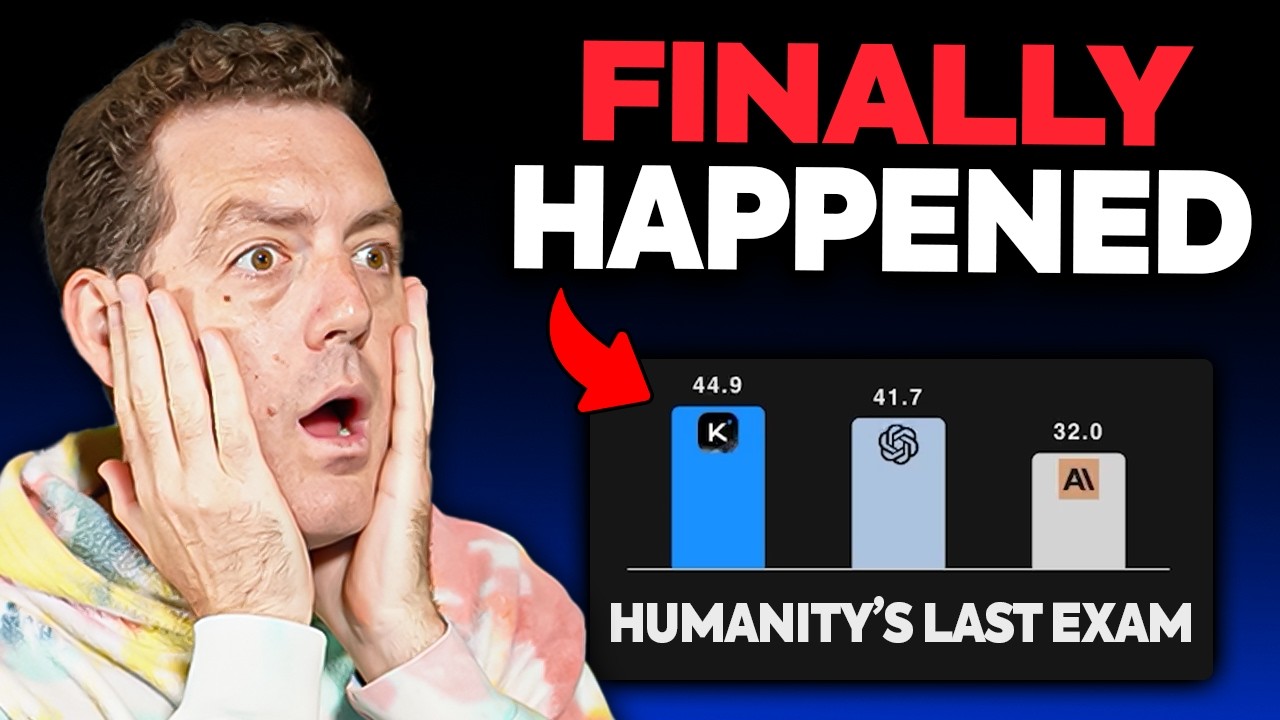
Kimi K2 Thinking's benchmark results are particularly striking. On "Humanity's Last Exam" (HLE), a notoriously difficult test for agentic reasoning, K2 Thinking scored an impressive 44.9, outperforming GPT-5's 41.7 and Claude Sonnet 4.5 Thinking's 32.0. Similarly, in agentic search scenarios, K2 Thinking achieved a 60.2 on BrowseComp, surpassing GPT-5's 54.9 and Claude Sonnet 4.5 Thinking's 34.1. These figures are more than just numbers; they represent a tangible shift in the state of the art, demonstrating Kimi K2's superior capacity for goal-directed, web-based reasoning.
The model’s agentic capabilities extend beyond benchmarks into real-world problem-solving. Kimi K2 Thinking is engineered to execute "up to 200, 300 sequential tool calls without human interference, reasoning coherently across hundreds of steps to solve complex problems," as highlighted in Moonshot Labs' own documentation. This ability was vividly illustrated in a demonstration where Kimi K2 tackled a PhD-level mathematics problem, meticulously performing 23 tool calls, including multiple web searches for relevant academic papers, to arrive at the correct solution. Such a robust, multi-step reasoning chain, autonomously navigated, represents a significant leap in AI's capacity for complex logical deduction.
Further examples showcased Kimi K2’s versatility. It generated a fully functional "Word clone" website from a single prompt, complete with editable text, font options, and local saving functionality. In another instance, it created an animated visualization of gradient descent, dynamically illustrating complex mathematical concepts. The model also demonstrated its prowess in simulations, building an interactive virus-attacking-cells scenario, and even producing live music through code in Strudel. These diverse applications underscore the model's strong generalization across programming languages and agent scaffolds.