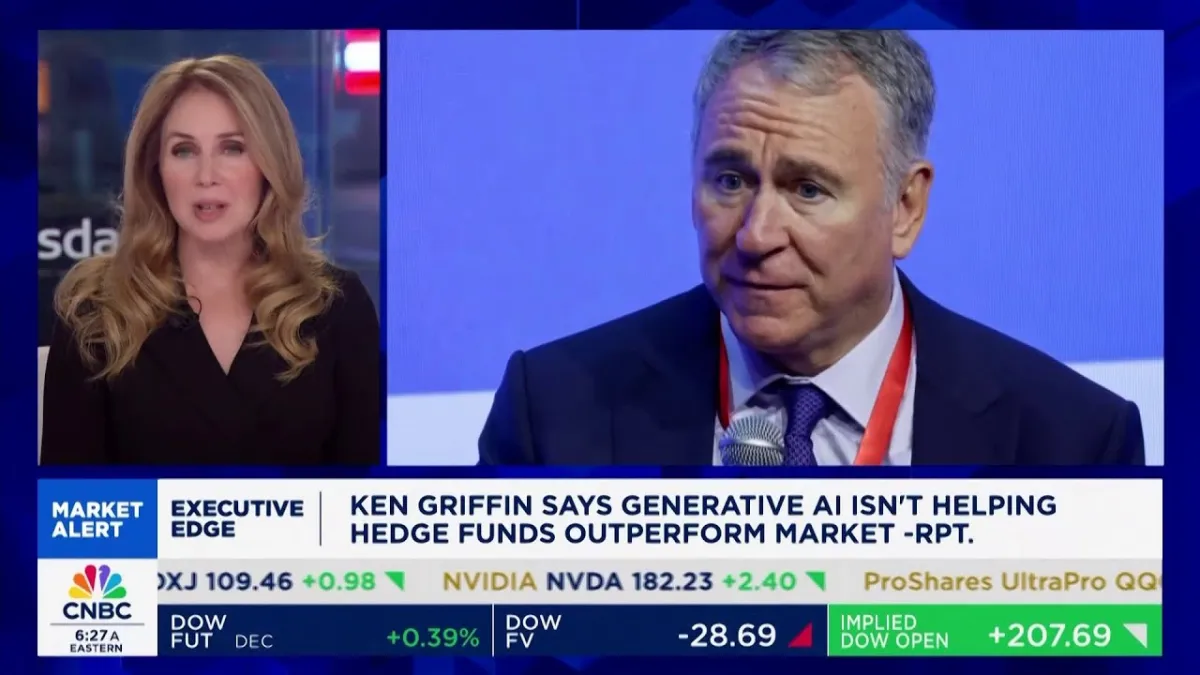
The promise of generative artificial intelligence to revolutionize every industry has been a dominant narrative, yet for the hyper-competitive world of hedge funds, its current impact on market outperformance remains limited. This was the salient point articulated by billionaire Ken Griffin, founder of Citadel, as reported by CNBC’s Becky Quick and further discussed by anchors Joe Kernen and Andrew Ross Sorkin. Griffin’s remarks, delivered at the JPMorgan Robinhood Investors Conference and referenced in a broader context that included the Milken Institute, offer a crucial reality check for founders, venture capitalists, and AI professionals betting on immediate disruption in high-stakes financial markets.
Griffin acknowledged generative AI's capacity to significantly enhance worker productivity, streamlining tasks and improving efficiency across various functions. This aspect of AI is widely recognized and is already being integrated into numerous business processes. However, the distinction he drew was sharp and insightful: while AI can make employees more productive, its ability to generate "alpha"—that elusive excess return above market benchmarks—is, in his words, "it just falls short." This suggests a fundamental gap between AI's utility as a powerful tool and its current capability as a truly independent, outperforming investment manager.
This perspective challenges the often-hyped notion that AI will simply replace human expertise in complex analytical fields like investment management. Griffin specifically noted that AI "hasn't replaced in-depth research at his firm, Citadel." This highlights the enduring value of human-driven, granular analysis, which often involves understanding nuanced qualitative factors, geopolitical shifts, or idiosyncratic company-specific dynamics that current AI models struggle to fully grasp or predict with consistent accuracy. The depth of understanding required to identify true market inefficiencies still appears to reside primarily with human experts.
Studies have indeed indicated that AI can often outperform the average individual investor, primarily due to its capacity to process vast amounts of data and execute decisions free from human emotional biases. An AI system can sift through mountains of financial reports, news articles, and market data with a speed and scale impossible for any human. It can then make "emotionless decisions," avoiding the psychological pitfalls of fear and greed that often plague human traders. Yet, as Quick relayed, this capability is "probably not up to par with the experts" in the financial industry. This implies that while AI can elevate baseline performance, it has yet to surpass the sophisticated, often intuitive, judgments of seasoned professionals who operate at the bleeding edge of market insight.
The conversation further delved into the inherent dynamics of competitive markets, particularly the zero-sum nature of much of trading. Joe Kernen succinctly captured this, explaining that in many trades, "there's a winner and a loser." If every market participant were to adopt the same advanced AI, the collective advantage would dissipate. Andrew Ross Sorkin underscored this point, stating, "Someone's gonna have to outwit the other." This implies that AI, in its current form, functions as a powerful lever, but if everyone possesses the same lever, no one gains a unique edge. True alpha generation requires not just intelligence, but *superior* intelligence or a unique informational advantage.
Related Reading
- AI Startups Thrive in Complementary Ecosystem, Attracting Rapid VC Funding
- Dimon: AI Bubble Requires Granular Scrutiny, Job Shifts Inevitable
- Gabelli Sees AI as Revolution, Touts National Fuel Gas for Data Center Energy
For AI startups targeting the financial sector, Griffin's comments serve as a critical directional signal. The market for productivity enhancements is vast and lucrative, offering significant opportunities for AI solutions that automate tasks, improve data analysis, or optimize operational workflows. However, the bar for creating AI that can consistently and independently generate alpha remains exceptionally high. This requires models that can not only process data but also infer meaning, predict unpredictable human behavior, and adapt to rapidly changing, often irrational, market conditions in ways that are genuinely novel and non-replicable by competitors.
The challenge lies in moving beyond correlational analysis to causal understanding, and then translating that understanding into actionable, profitable strategies that are not easily arbitraged away. This necessitates a continued focus on proprietary data, unique algorithmic approaches, and, critically, the integration of human expertise to guide and refine AI models, providing the qualitative context that quantitative systems often lack. The future of AI in finance, particularly in alpha generation, is likely a symbiotic relationship where human ingenuity continues to define the strategic advantage, augmented and amplified by AI's unparalleled processing power.