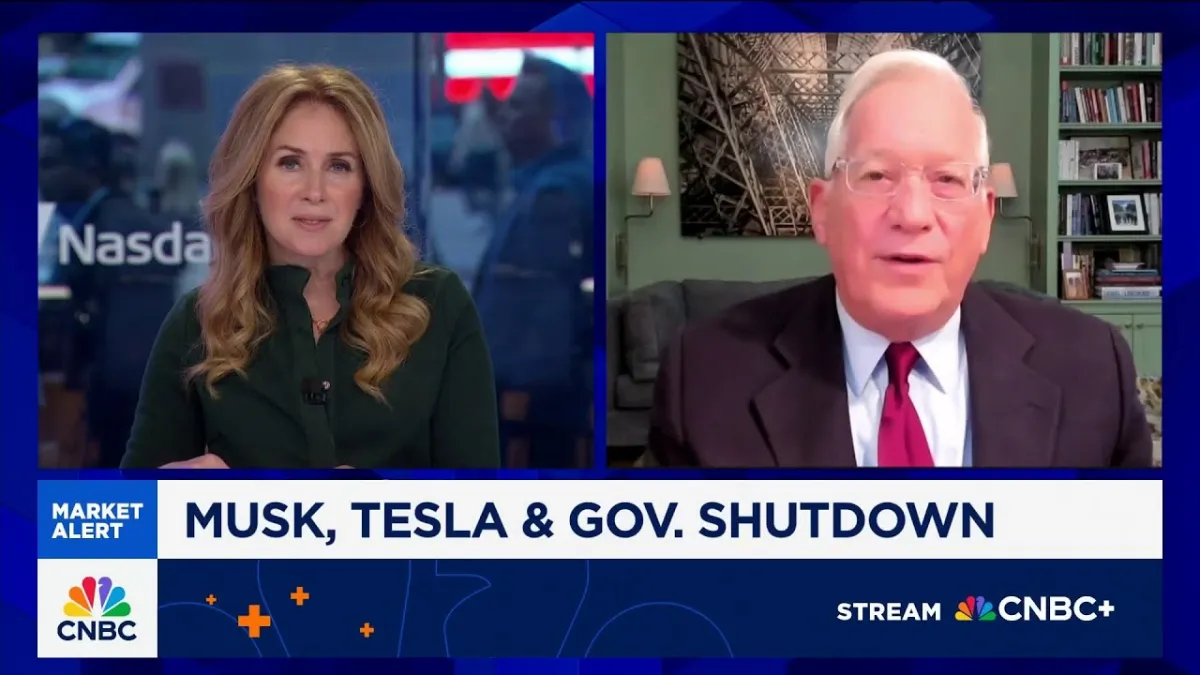
Walter Isaacson, author of the biography "Elon Musk," spoke with CNBC's "Squawk Box" to discuss the Tesla CEO's evolving vision for the company, his ambitious pay package, and the broader implications of his ventures. A key takeaway from the interview is Musk's stated intention for Tesla to transcend its identity as an automotive manufacturer and firmly establish itself as a leader in artificial intelligence. Isaacson highlighted that this strategic pivot is not a recent development, but rather a long-held aspiration of Musk's.
"Elon Musk sees Tesla moving beyond being a car company into an AI company," Isaacson stated, underscoring the fundamental shift in the company's strategic focus. This evolution is driven by Tesla's work in areas like autonomous driving and robotics, which are heavily reliant on advanced AI capabilities. The company's dedication to developing sophisticated AI is evident in its continuous efforts to enhance its Full Self-Driving (FSD) software and its ambitious plans for humanoid robots.
The interview also touched upon the significant controversy surrounding Musk's proposed $1 trillion pay package, which was up for a shareholder vote. Isaacson noted the substantial nature of this compensation, which is tied to ambitious performance milestones. He also highlighted Musk's rather audacious approach to this compensation, suggesting that if the package were not approved, Musk might consider leaving the company. Isaacson observed, "He’s not somebody who carefully calculates his own interests; he’s more of a true test pilot, somebody who’s flown in space missions and he’s not afraid to take risks." This characteristic is deeply ingrained in Musk's operational philosophy.
Related Reading
- Applied Digital CEO on $5 billion AI infrastructure lease with U.S.-based hyperscaler
- AI's Gold Rush: Disruption, Data Centers, and the New Economic Calculus
- Navigating the AI Revolution: Insights from Industry Leaders on Implementation and Impact
A crucial insight from Isaacson's commentary revolves around Musk's unwavering belief in his vision and his willingness to push boundaries, even when faced with skepticism. He pointed out Musk's long-standing fascination with artificial intelligence, dating back to his childhood reading of Isaac Asimov's robot novels. This early exposure to the potential of AI appears to have profoundly shaped Musk's future endeavors. Isaacson elaborated, "He’s not afraid to push the envelope and to try to do things that seem impossible. He’s also not afraid to be unpopular or to have people disagree with him." This relentless pursuit of ambitious goals, often perceived as audacious, is a hallmark of Musk's leadership.
The article also touched upon the broader implications of Musk's leadership style and his impact on the tech landscape. His willingness to take on seemingly insurmountable challenges, from space exploration with SpaceX to revolutionizing the automotive industry with Tesla, demonstrates a unique entrepreneurial drive. The discussion implicitly suggests that for investors and industry observers, understanding Musk's long-term vision for AI is paramount to appreciating Tesla's true valuation and future trajectory. The ambitious goals, while often met with skepticism, have a track record of eventual realization, albeit with considerable turbulence along the way.