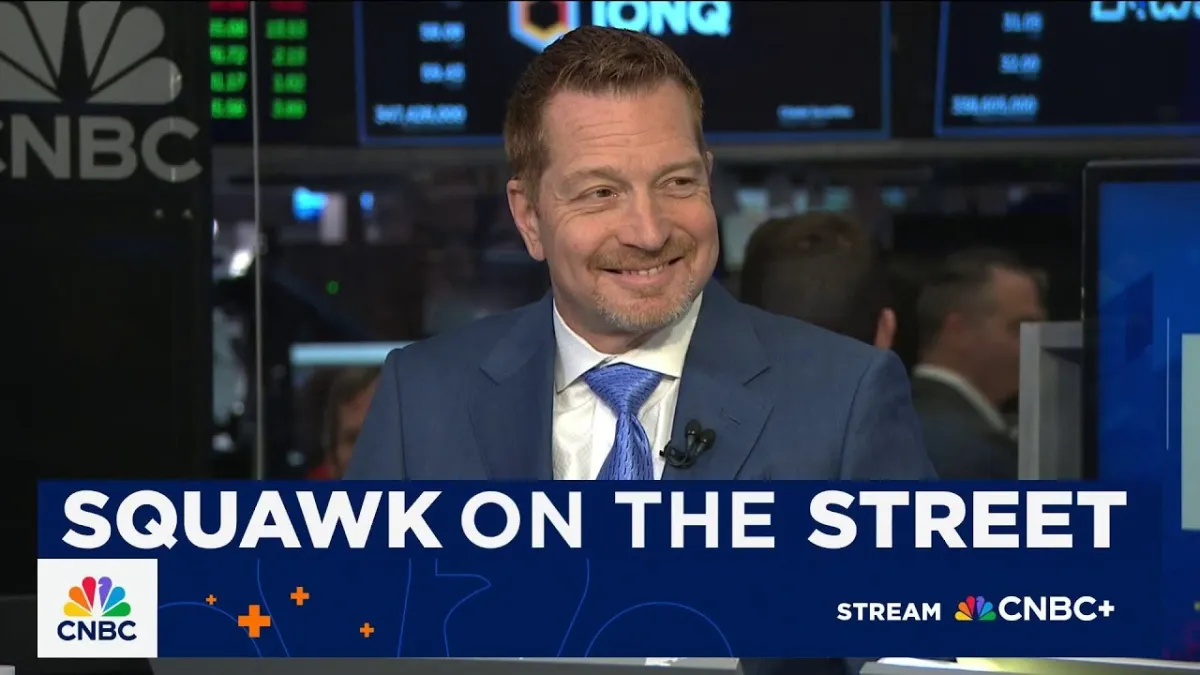
"AI is not going to kill software; you need it to protect AI." This declarative statement from George Kurtz, CEO of CrowdStrike, encapsulates a crucial perspective on the burgeoning field of artificial intelligence during his appearance on CNBC's "Squawk on the Street." Kurtz spoke with host Jim Cramer about the implications of the recent AWS outage, the evolving threat landscape, and the symbiotic relationship between AI and cybersecurity.
The conversation underscored a prevalent narrative that AI might render existing software obsolete. However, Kurtz firmly refuted this notion, arguing instead that AI's advancement necessitates a robust cybersecurity framework. He emphasized that as AI systems become more sophisticated and integrated into critical infrastructure, their susceptibility to sophisticated attacks will also increase. This creates a clear demand for advanced security solutions, not their obsolescence.
A significant point of discussion revolved around the recent AWS outage, which impacted numerous services. Kurtz highlighted how interconnectedness, while enabling innovation, also amplifies the impact of failures. He noted that "when you look at technology and how interconnected everything is, these sorts of events happen." He also pointed out that while AWS handled the situation competently, the incident served as a reminder of the inherent risks in relying on complex, distributed systems.
Kurtz's core argument is that AI and cybersecurity are inextricably linked, rather than being in opposition. He articulated this by stating, "I don't buy the idea that AI will kill software; you need it to protect AI." This perspective suggests that the very capabilities that make AI powerful also make it a target. As AI models are trained on vast datasets and deployed in critical decision-making roles, securing these systems becomes paramount. The potential for malicious actors to manipulate AI, steal sensitive data, or disrupt AI-driven operations presents a formidable challenge.
Furthermore, Kurtz drew a parallel between the current AI boom and previous technological shifts, noting that "AI has capabilities to interact with data, it has capabilities to interact with compute, it has non-human identities." This complexity means that traditional security measures may be insufficient. He elaborated on this by explaining that AI operates at "superhuman speed," amplifying the consequences of any breach or malfunction. Consequently, the development and deployment of AI must be accompanied by equally advanced security protocols.
The discussion also touched upon the geopolitical implications of AI and cybersecurity. Kurtz observed that as nations increasingly leverage AI for strategic advantages, the risk of state-sponsored cyberattacks targeting these AI systems escalates. He pointed out that adversaries are actively seeking to exploit vulnerabilities, stating, "We've seen over the last number of years, humans getting themselves into trouble... that's only going to be exasperated by AI." This implies a need for proactive defense strategies to safeguard national interests in an increasingly digital and AI-driven world.
The conversation then shifted to the role of companies like CrowdStrike in this evolving landscape. Kurtz highlighted his company's focus on delivering AI-powered cybersecurity solutions, explaining, "We deliver security and AI protection." He further elaborated on the necessity of such solutions, emphasizing that "we need it to protect AI." This symbiotic relationship means that as AI advances, the demand for sophisticated cybersecurity will not diminish but rather intensify, creating new markets and opportunities for security-focused enterprises.
Related Reading
- AI Safety Becomes Silicon Valley's New Political Battleground
- AI's Gold Rush: Disruption, Data Centers, and the New Economic Calculus
- Navigating the AI Revolution: Insights from Industry Leaders on Implementation and Impact
Kurtz also addressed the perception that AI might make software providers like those in the SaaS sector obsolete. He countered this by asserting that AI will actually enhance these businesses, stating, "It's only going to accelerate SaaS." He believes that AI will enable SaaS companies to offer more personalized, efficient, and secure services, ultimately driving growth and innovation. The key, he suggested, lies in how companies leverage AI to augment their existing offerings and create new value propositions.
In essence, Kurtz's message is one of integration and mutual dependence. He argues that the future of technology hinges on the ability to secure advanced AI systems, and that cybersecurity providers are integral to this endeavor. The proliferation of AI, while promising unprecedented capabilities, simultaneously introduces new and complex security challenges that require innovative solutions.