Claude Unlocks Legal Efficiency at Anthropic

5 min read
Claude Unlocks Legal Efficiency at Anthropic

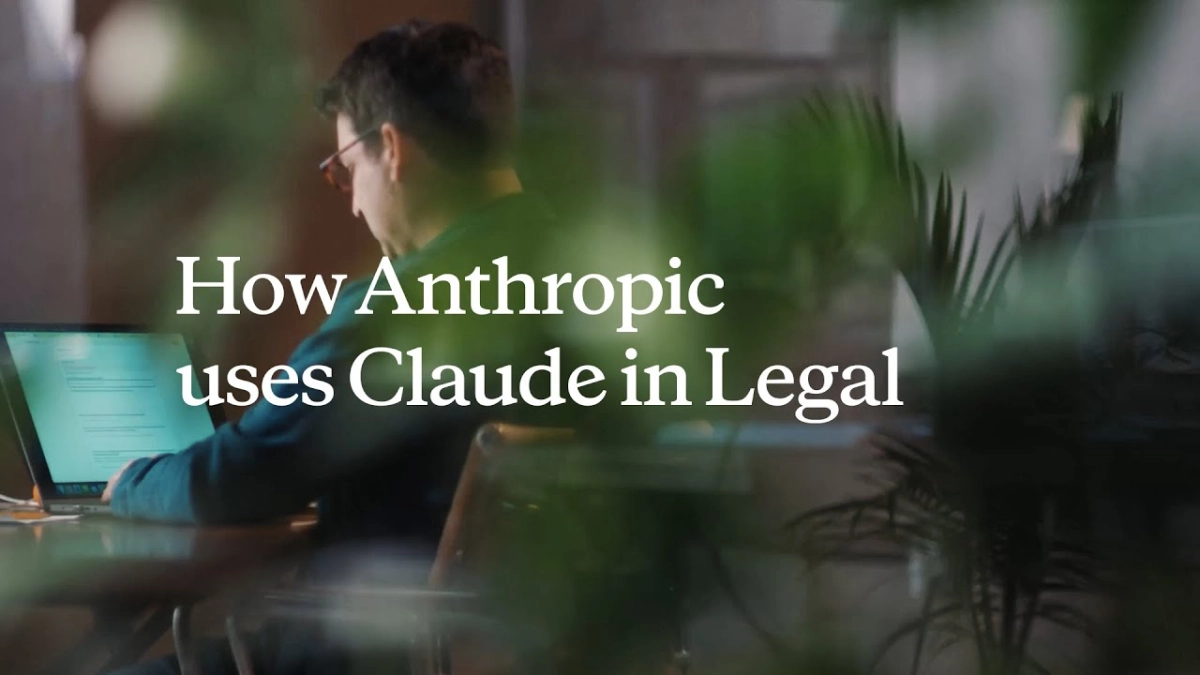
"I'm not an engineer, I'm not technical, I don't know how to code, but with Claude Code, you don't have to know how to code. You can just kind of talk to it in plain language." This statement by Mark Pike, Associate General Counsel at Anthropic, encapsulates a profound shift in how artificial intelligence is democratizing powerful tools, even within highly specialized domains like legal. The video highlights how Anthropic’s internal legal team leverages its own AI, Claude, to transform traditionally laborious and time-consuming tasks into streamlined, efficient workflows.

Mark Pike, in conversation with an unnamed interviewer, detailed Anthropic's innovative application of Claude within its legal department. The discussion centered on automating routine legal functions, thereby freeing up legal professionals for more complex, strategic work. This internal adoption serves as a compelling case study for any organization looking to integrate advanced AI solutions into critical operational areas.

A core insight from Pike's experience is the profound accessibility Claude offers to non-technical users. He humorously recounts building a "legal lamp" that blinks messages in Morse code, a personal project to understand Claude Code's capabilities. This seemingly trivial example underscores a critical point: the ability to interact with and program AI using natural language eliminates significant barriers to entry. Legal professionals, often without coding backgrounds, can now design and implement custom solutions tailored to their specific needs, moving beyond mere consumption of pre-built software to active co-creation. This shift empowers domain experts to directly address their pain points without relying on scarce engineering resources.


Related startups

The tangible benefits of this approach are most evident in the automation of routine legal tasks. Pike describes the "busy work" that once consumed his time: "No lawyer likes doing the same repetitive exercise over and over and over again... The work can be dull, you can make mistakes. Before Claude, I had a ton of busy work. Things I would put off to the end of the day because I just knew it would take a lot of time but not using the best parts of my brain." This sentiment resonates deeply within many professional services, where highly skilled individuals are often bogged down by administrative or low-value-add processes.

One key workflow demonstrated is the marketing material self-review tool. Instead of waiting for a last-minute legal review of blog posts or social media content, marketing teams can now paste their material into a Claude-powered interface. The AI instantly analyzes the content against Anthropic's legal guidelines, flagging potential issues related to accuracy, security claims, third-party content usage, and partnership mentions. Claude even provides "props" for well-written sections, fostering a more collaborative and less adversarial review process.

This automation drastically cuts review times from days to hours. It enables marketing teams to move faster while ensuring compliance, a critical advantage in today’s rapid-release product cycles. Moreover, the system generates a pre-populated Slack message for the legal team, summarizing the AI's findings and highlighting issues requiring human oversight, complete with risk levels (low, medium, high) based on a framework Pike himself provided. "Here's what I care about... and to my surprise, Claude just ran with it and set it up," he notes, emphasizing the ease of configuring such sophisticated workflows.

Crucially, Anthropic's implementation of Claude upholds the principle of "human in the loop." Pike explicitly states, "I'm always trying to ensure that a human remains in the loop from the legal team. We know that AI systems can still hallucinate. I'm still making sure I'm reviewing the work, but this is really helping us move with more speed and sort of preemptively flagging things." This responsible approach acknowledges the current limitations of even advanced AI models, particularly in a field where precision and context are paramount. The AI acts as an intelligent first pass, identifying potential risks and prioritizing them, but the ultimate judgment and final review rest with the human legal expert. This hybrid model maximizes efficiency while mitigating the risks associated with AI errors.

Beyond marketing reviews, Claude is utilized for redlining commercial contracts and reviewing outside business activity requests, demonstrating its versatility across various legal functions. The ability to quickly identify and suggest changes in complex legal documents or evaluate potential conflicts of interest significantly reduces the manual burden on the legal team. This shift allows legal professionals to focus on the nuanced strategic implications of contracts and policies, rather than the tedious task of sifting through text for standard compliance issues. The result is not just speed, but a higher quality of legal work, as human expertise is concentrated where it adds the most value.

For founders, VCs, and AI professionals, Anthropic's internal use case offers invaluable lessons. It showcases how even highly specialized and risk-averse departments can benefit from AI integration. The key lies in identifying routine, repetitive tasks that consume significant time but don't leverage high-level human intellect. By empowering domain experts to build their own AI-powered workflows with tools like Claude, organizations can unlock substantial efficiency gains, improve compliance, and reallocate human capital to more strategic endeavors. The journey begins, as Pike advises, by simply experimenting with Claude on your most routine work.

© 2025 StartupHub.ai. All rights reserved. Do not enter, scrape, copy, reproduce, or republish this article in whole or in part. Use as input to AI training, fine-tuning, retrieval-augmented generation, or any machine-learning system is prohibited without written license. Substantially-similar derivative works will be pursued to the fullest extent of applicable copyright, database, and computer-misuse laws. See our terms.