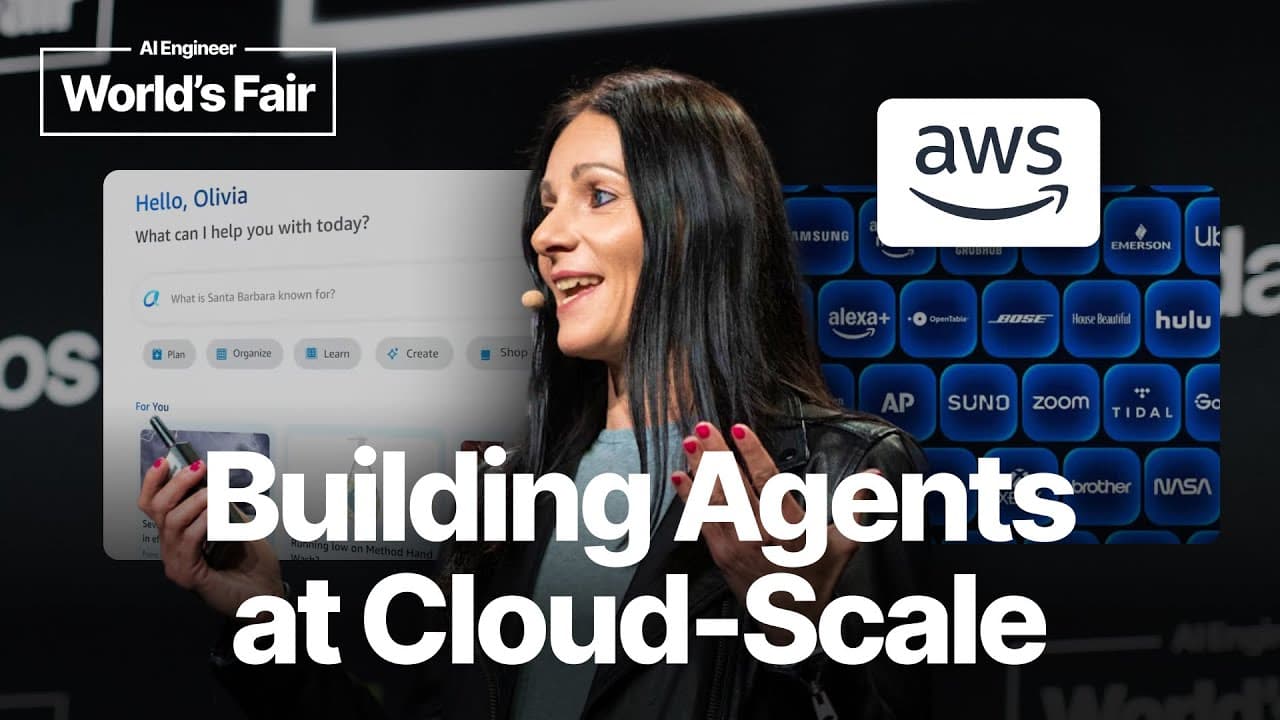
Antje Barth, Principal Developer Advocate at AWS, recently presented at the AI Engineer World's Fair in San Francisco, offering a compelling vision for "Building Agents at Cloud Scale." Her presentation underscored Amazon's deep commitment to artificial intelligence, asserting that "Every customer experience we know of will be reinvented using AI." This transformation isn't merely theoretical; Amazon itself operates over 1,000 generative AI applications internally, transforming everything from inventory forecasting and supply chain optimization to how customers shop and interact with their smart homes.
A prime example of this internal evolution is the complete reimagining of Alexa. Barth highlighted this as "the largest integration of services, agentic capabilities, and LLMs that we know of anywhere." This reinvention leverages hundreds of specialized expert systems and orchestrates tens of thousands of partner services and devices, showcasing the immense power of agents operating at an unprecedented scale.
The rapid development and deployment of agentic products is a core theme in AWS's strategy. Barth shared a remarkable anecdote about the Amazon Q Developer CLI, an AI-powered code assistant, which was "built and shipped within three weeks." This impressive velocity in developing sophisticated AI tools is now being democratized through open-source initiatives. One such offering is Strands Agents, a powerful Python SDK designed to simplify agent development. Strands Agents employs a model-driven approach, allowing developers to concentrate on *what* an agent should achieve rather than meticulously scripting *how* it should do it. This is made possible by tapping into state-of-the-art models from various providers, including Amazon Bedrock, Anthropic, Ollama, and OpenAI, alongside a rich ecosystem of over 20 pre-built tools. These tools cover a broad spectrum of functionalities, from fundamental file operations and secure shell integration to more complex tasks like managing user memory, performing mathematical computations, integrating with AWS services, processing multimedia, journaling, and enabling advanced reasoning and multi-agent workflows. Such abstractions significantly reduce development cycles and accelerate the path to production.
Crucially, this shift towards ubiquitous agentic services is underpinned by a strong commitment to open protocols and interoperability. AWS is an active contributor to initiatives like the Model Context Protocol (MCP), a burgeoning framework designed to facilitate seamless inter-agent communication. This collaborative approach fosters an environment where diverse agents can interact and share information, enabling more complex problem-solving and the emergence of sophisticated multi-agent systems. Deploying these agents at cloud scale is further streamlined, with tools supporting serverless architectures, integrating seamlessly with existing AWS services, and adhering to robust security and authorization frameworks.
The future of digital interaction, as presented by AWS, is one where specialized agents perform intricate tasks, often collaborating across various domains, to deliver highly personalized and efficient experiences. This profound transition from traditional web services to dynamic, agentic services represents a significant leap in technological evolution, driven by accessible development tools and a concerted effort towards open standards within the AI engineering community.