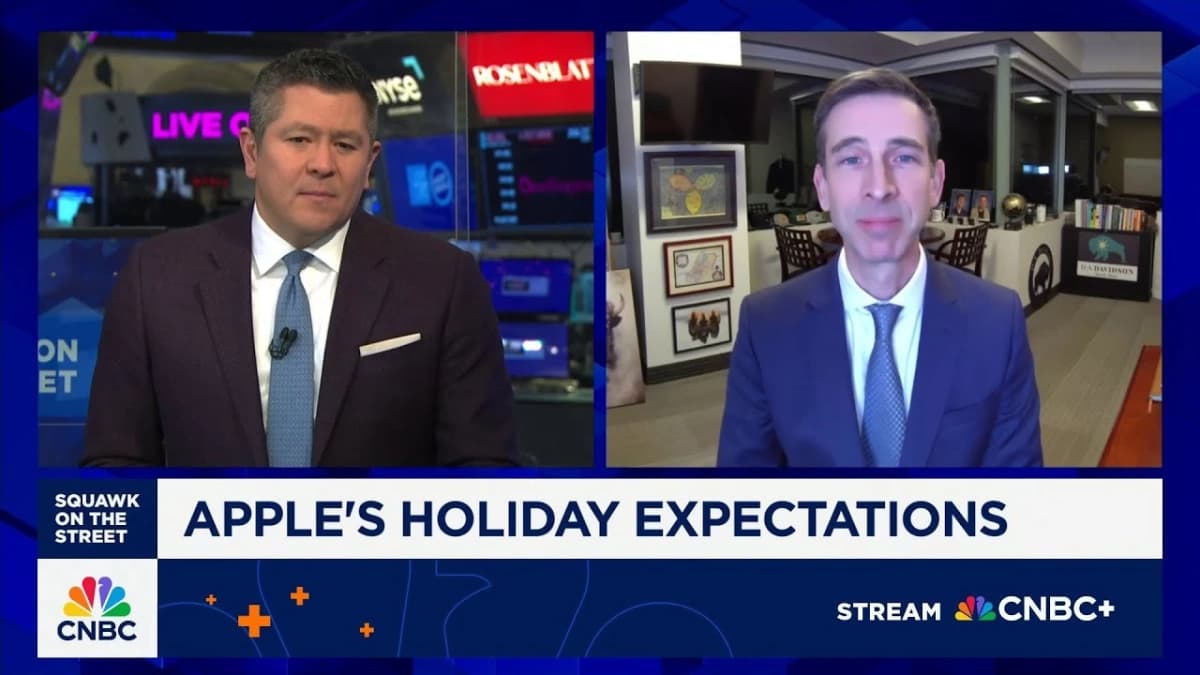
D.A. Davidson’s Head of Technology Research, Gil Luria, offered a compelling dual perspective on the tech giants Apple and Nvidia during a recent appearance on CNBC's 'Squawk on the Street'. Luria outlined Apple's robust holiday season outlook, driven by a cyclical upgrade wave, while simultaneously dissecting the fundamental drivers of Nvidia's continued indispensability in the burgeoning AI landscape, even amidst increasing scrutiny. His analysis underscored a nuanced understanding of how each company, despite operating in distinct market segments, is navigating the transformative currents of artificial intelligence.
Luria began by highlighting Apple's strong performance, asserting, "This should be Apple's best season in four years." He attributed this anticipated double-digit growth in iPhone sales not to groundbreaking AI features, but rather to a significant installed base of users whose devices are simply due for an upgrade. Many consumers, he noted, were still holding onto phones purchased around the time of the iPhone 12's 5G debut four years prior. "The only thing that mattered is that a lot of people had four-year-old phones, they decided to upgrade," Luria explained, effectively positioning the current sales boom as a natural market rhythm rather than a direct consequence of new technological marvels. This cyclical nature, however, carries a caveat: a strong upgrade year often predicates a softer following year, especially absent a truly disruptive technological leap.
This leads to a core insight regarding Apple’s approach to AI: it is not positioned as a primary sales driver but rather as an evolutionary enhancement. Luria suggests that Apple's AI strategy will be characterized by seamless integration into existing product functionality. We can expect to see improvements in notifications, more efficient email summaries, enhanced photo editing capabilities, and a more responsive Siri. This incremental integration ensures that Apple remains relevant in the AI conversation without forcing a new paradigm shift that might alienate its vast user base or disrupt its established product cycles. For investors, this translates into a predictable, stable growth trajectory, free from the volatility associated with companies whose valuations are tied to identifying the "next big AI winner."
The conversation then pivoted to Nvidia, a company whose fortunes are inextricably linked to the foundational compute power required by AI. Luria acknowledged a multitude of concerns surrounding Nvidia, including increased capital expenditure scrutiny, restrictions on sales in China, and growing competition from custom silicon like Google's TPUs. He also pointed to issues of "investor communication" and "circular deals with CoreWeave" as areas warranting caution. Yet, despite these potential headwinds, Luria's analysis maintained a bullish stance on Nvidia's long-term prospects.
The fundamental truth, as Luria articulated, is that the demand for AI compute is insatiable and growing exponentially. "We are using AI so much more, we need so much more compute for the foreseeable future. We're going to build out a lot more data centers, and they're going to be for the foreseeable future mostly with Nvidia chips." This statement encapsulates the second core insight: Nvidia’s hardware is, for now, the undisputed backbone of AI infrastructure. While Apple integrates AI at the user experience level, Nvidia provides the raw processing power that makes these sophisticated AI applications possible, whether on a device or in the cloud. The sheer scale of data center expansion and the specialized nature of AI workloads ensure Nvidia's continued dominance, at least in the near to medium term.
Related Reading
- The Nuanced Reality of the AI Chip Race: Google's Specialization vs. Nvidia's Ubiquity
- Google's AI Resurgence Rattles OpenAI's Dominance
A third key insight emerges from comparing the market's valuation of these two tech behemoths. Luria highlighted that Apple, despite a projected 10% earnings growth, trades at a higher multiple than Nvidia, which is forecast to achieve a staggering 50-60% earnings growth. This disparity underscores the market's preference for Apple's perceived stability and broad consumer appeal, even as Nvidia fuels the very engine of the AI revolution. Investors, Luria noted, appreciate that with Apple, "they don't have to worry about that. We're going to keep using our iPhones, we're going to keep buying new ones, and that's what investors like to see. They'll get more and more AI functionality over time." This sentiment contrasts sharply with the higher-risk, higher-reward profile of Nvidia, where the stakes are elevated by intense competition and geopolitical factors.
Ultimately, Luria's commentary paints a clear picture of two distinct, yet equally critical, roles in the evolving AI landscape. Apple, with its vast ecosystem and user loyalty, will continue to embed AI capabilities to enhance the user experience, making it a stable, long-term holding. Nvidia, on the other hand, will remain the indispensable provider of the underlying compute infrastructure, a high-growth engine for the AI industry, albeit one exposed to more pronounced market and geopolitical volatilities. Both companies, in their unique ways, are shaping the future of artificial intelligence, offering different value propositions for investors navigating this transformative era.