
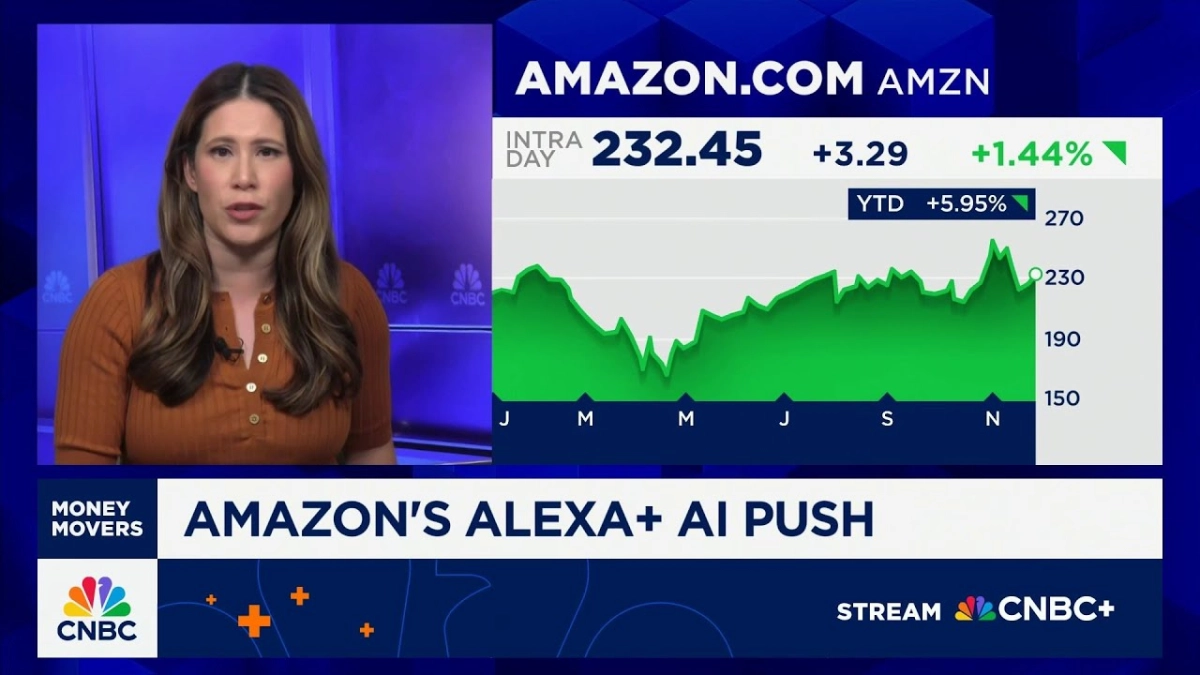
CNBC's Deirdre Bosa, speaking on 'Money Movers,' recently provided sharp commentary on Amazon's strategic pivot with Alexa+, framing it as a crucial effort to redefine its presence in the rapidly accelerating artificial intelligence landscape. Bosa spoke with the CNBC anchors about Amazon’s latest product release and its broader AI strategy, particularly in the context of the upcoming AWS Re:Invent event and the competitive holiday shopping season. Her analysis underscores a critical moment for Amazon, which despite its vast consumer footprint, has yet to fully capture the AI premium enjoyed by its peers.
Amazon’s new Alexa+ represents a concerted attempt to establish a truly functional consumer AI assistant. The goal is to evolve beyond the current limitations of Alexa, enabling more natural conversations, contextual memory, and proactive assistance. This initiative is designed to leverage Amazon's existing stronghold in the smart home, where hundreds of millions of Echo devices are already embedded in kitchens and living rooms. Bosa highlighted that "Alexa+ can handle more natural conversations, remember context, and maybe most importantly, it pushes Amazon into the next leg of this race, which is voice, where it has an advantage: the home." This points to Amazon's strategy of doubling down on its established ecosystem, aiming to transform its ubiquitous smart speakers into more intelligent, indispensable household agents.
However, Amazon’s journey in AI has been fraught with challenges. Despite its leading 61% share in the US smart speaker market, as per a Statista survey, Bosa noted that Amazon "has not been able to turn that footprint into real AI momentum." This is a significant insight for founders and VCs; market dominance in hardware does not automatically translate to leadership in the underlying intelligence layer. The company’s own custom AI chips, such as Trainium, have struggled to gain traction, contrasting sharply with the "real industry momentum" seen by Google’s TPUs. This disparity in core AI infrastructure development highlights a potential weakness in Amazon's foundational AI capabilities, impacting its ability to innovate at the pace of competitors.
The financial markets further illustrate Amazon's lagging AI narrative. While Google’s Alphabet shares have soared nearly 70% year-to-date, Amazon’s stock has seen less than a 6% increase, making it the worst-performing of the "Magnificent Seven" basket this year. This stark difference signals that investors are not yet convinced of Amazon’s long-term AI potential beyond its robust Amazon Web Services (AWS) division. The AI narrative, as Bosa rightly observed, "moves fast," and Amazon appears to be playing catch-up in a race where agility and cutting-edge innovation are paramount.
Adding to the narrative of internal struggles, Bosa pointed out a telling detail: Jeff Bezos, while still executive chair at Amazon, is also co-founding a separate AI startup, 'Project Prometheus.' This raises questions among tech insiders about where Amazon's true AI ambition and top-tier talent reside, suggesting that "some of the most ambitious frontier work is happening outside of the company that he founded." For founders and AI professionals, this is a potent signal about the difficulty even established tech giants face in fostering breakthrough innovation within their existing structures, potentially leading top talent to pursue opportunities elsewhere.
Related Reading
- Google's AI Unleashed: Gemini 3 Marks an Era of Action
- Claude's Agent Skills Unlock Granular AI Expertise
- AI Agents Transform Holiday Shopping into a Transactional Battleground
The ultimate test for Alexa+ will be its ability to translate enhanced conversational capabilities into tangible, "agentic" commerce. Amazon has long envisioned a future where consumers can effortlessly order goods through voice commands. Yet, Bosa noted, "very few people actually use their Echo devices to order things. I think probably mistakes are more common, at least in my household." This candid observation speaks volumes about the gap between aspiration and current user experience. The new Alexa+ aims to be "more agentic, more intuitive," but early reviews, according to Bosa, suggest it's good as a chatbot but its ability to "actually carry through tasks? That’s going to be the real sort of test."
For Amazon, the stakes are high. Alexa+ is not merely an incremental update; it is a critical endeavor to add a "second leg to its narrative beyond AWS." The company’s ability to turn its massive smart home footprint into genuine AI leverage, particularly in the realm of consumer-facing "AI commerce," will determine its standing in the next phase of the AI revolution. The coming months will reveal if Alexa+ can truly deliver on its promise of a more intelligent, task-executing assistant, or if Amazon will continue to grapple with translating its consumer hardware dominance into a leading AI story.