
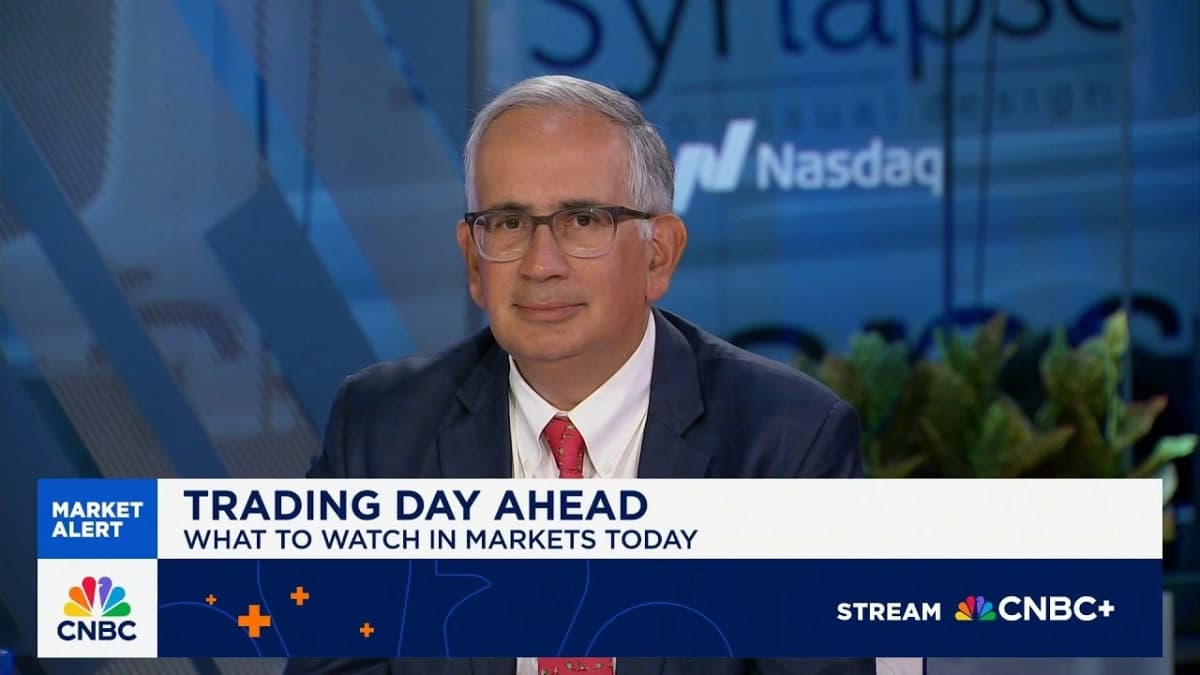
"AI is not a bubble," declared Stephanie Link, Hightower Advisors' Chief Investment Strategist and Portfolio Manager, during a recent appearance on CNBC's 'Squawk Box'. Her assertion cut through the pervasive market anxiety that often accompanies transformative technological surges, offering a grounded perspective on artificial intelligence's economic underpinnings. Link, speaking with Andrew Sorkin ahead of the opening bell on Monday, dissected current market trends, pivoting from specific stock news to a broader commentary on the enduring and tangible impact of AI across various sectors.
The interview initially touched upon the disappointing news regarding Novo Nordisk's Alzheimer's drug, which saw the stock dip nearly 10% in extended hours. Link acknowledged the negative sentiment but suggested that the market had not heavily factored in the drug's potential success into existing models, indicating a degree of insulated risk. Her focus quickly shifted to the more robust prospects of the company's Wegovy pill launch and upcoming guidance, framing Novo Nordisk as a "battleground stock" where bulls would concentrate on existing revenue streams rather than speculative drug pipelines. This brief detour into pharmaceutical volatility set the stage for a deeper dive into technology, specifically the burgeoning AI landscape.
The conversation swiftly moved to Google's parent company, Alphabet, and the recent comments from Salesforce CEO Marc Benioff, who suggested that Google's Gemini 3 had "leapfrogged" ChatGPT. While acknowledging the competitive dynamics among tech giants, Link emphasized a more expansive view of AI's economic beneficiaries. She articulated a critical insight: the impact of AI is far from confined to the immediate "winners" in the technology sphere; rather, it permeates a vast "food chain" of industries, creating substantial and measurable demand for foundational infrastructure. This perspective challenges the notion of AI as a speculative phenomenon, grounding its growth in concrete, industrial investments.
Link underscored this point by citing robust backlogs and orders in industrial companies that are essential for building out the physical infrastructure required by AI. These are not ephemeral gains but represent substantial, long-term commitments. For instance, she highlighted Quanta Services, whose backlog surged by 15% last quarter to an all-time high. Similarly, Eaton, a power management company, reported a 20% increase in its global backlog, with its data center book-to-bill ratio standing at an impressive 1.7 times, signifying "two years worth" of work already secured.
GE Vernova, another key player in the electrification space, saw its electrification backlog jump by 33%. These figures are more than just statistics; they are tangible indicators of a massive, ongoing investment cycle in the physical infrastructure necessary to support the computational demands of AI. This broad-based demand, spanning everything from data centers to the underlying power grid, illustrates that AI's growth is not merely a software play but a profound re-engineering of industrial and utility landscapes.
The sheer scale of these investments, Link argued, differentiates the current AI boom from previous speculative bubbles. She pointed to Vertiv Holdings, a provider of critical digital infrastructure, which reported orders up 60% sequentially and a backlog that had grown by 30%. "These are real revenue numbers, real revenue streams," she asserted, emphasizing that these backlogs represent committed future earnings, not just potential or speculative valuations. This depth of investment across the supply chain suggests a durable transformation rather than a fleeting trend.
Related Reading
- No AI Bubble, Just an Altitude Adjustment: Doug Clinton on Market Realities and Google's Gemini Leap
- The AI Bubble: Insider Warnings, Google's Full Stack Play, and China's Unseen Threat to Nvidia
- Nvidia's Masterpiece Quarter and the Enduring AI Revolution
Her core argument is that while tech companies like Google, Meta, and Amazon are indeed at the forefront of AI innovation and adoption, the economic benefits ripple outwards to a much broader ecosystem. This includes the industrial firms constructing and equipping data centers, the utility companies supplying the immense power demands, and the manufacturers producing the necessary hardware. "The whole food chain will win," Link stated, encapsulating the pervasive economic opportunity driven by AI. This comprehensive view suggests that the current investment cycle is driven by fundamental demand and strategic necessity, rather than speculative exuberance.
Link spent the weekend reinforcing this perspective. She wanted to solidify her conviction that AI is not a bubble. The evidence from the industrial backlogs, in her view, provides this crucial validation. It is not solely about the "perceived winners" in big tech, but the deep, underlying capital expenditures across diverse sectors that confirm the enduring nature of this technological shift. The investment in data centers, power infrastructure, and advanced components represents a tangible, long-term commitment that underpins the entire AI revolution, indicating a sustained growth trajectory rather than a fleeting speculative peak.



