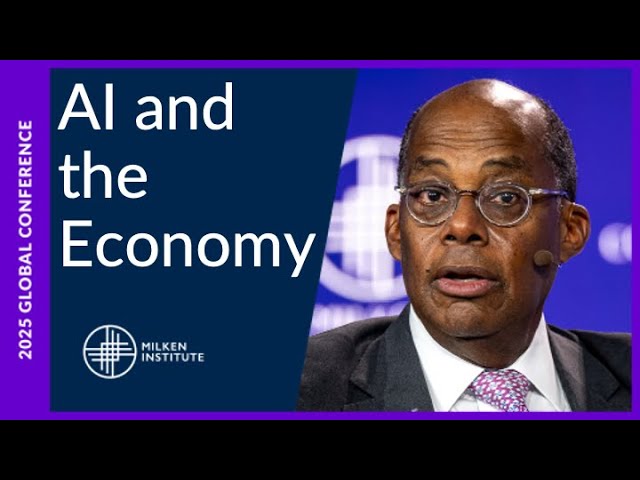
"It's kind of a front-row seat to what is one of the most exciting technology transitions that we will experience as humans," observed Lareina Yee, Senior Partner and Director of McKinsey Global Institute, encapsulating the pervasive sentiment at the Milken Institute's 2025 Global Conference panel on "AI and the Economy: Transformation and Disruption." Moderated by news anchor and fintech founder Richard Lui, the discussion brought together a diverse group of thought leaders including Roger Ferguson (Chief Investment Officer, Red Cell Partners), Mark Minevich (President, Going Global Ventures; Strategic Partner, Mayfield), and Jason Alan Snyder (Chief AI Officer, Momentum Worldwide) to dissect AI's current state, its economic reverberations, and the profound societal shifts it portends. The consensus was clear: AI is not merely a tool but a fundamental economic and social force, yet its true integration remains in its nascent stages, presenting both unprecedented opportunities and significant challenges.

Yee articulated a crucial distinction between two curves defining AI's progress: innovation and adoption. While the innovation curve is "about halfway there," the adoption curve is still in its "very early innings." Her research indicates a mere 1% of companies have achieved AI maturity, with only 11% having AI in production. This stark contrast highlights a significant gap between technological capability and widespread practical application, suggesting that the economic impact, though projected to be trillions, is yet to be fully realized through broad deployment across industries.
Jason Alan Snyder offered a nuanced perspective, suggesting that what we currently experience is "artificial inference" rather than true artificial intelligence. He likened generative AI's ability to "perform reasoning" to an actor performing a part, emphasizing its proficiency in rhetoric and language prediction. This distinction underscores a critical insight: while AI can mimic human cognitive processes with impressive fidelity, it may not yet possess genuine understanding or consciousness. Snyder also pointed to a growing societal challenge, noting that technology has outpaced both legislation and morality, creating a new landscape where "fake truth" can emerge, complicating our understanding of reality.
Mark Minevich passionately declared, "AI is our economy, AI is the world." He cited November 2022, with the release of ChatGPT, as a pivotal moment that "changed our lives forever," pushing AI from theoretical research into practical, mission-critical applications. Minevich emphasized the concept of "digital labor" as a massive driver of economic value, predicting trillions in new wealth. His call for an "AI-first" approach for businesses was stark: "If you're not going to focus on being a leader, AI first, you might as well give up. Leave the room, leave the building, go somewhere else." This aggressive stance reflects the competitive pressures and transformative potential he sees in the AI revolution.
Roger Ferguson, drawing on his extensive background in central banking and board memberships at tech giants, framed AI as a "massive supply shock." He drew parallels to historical transformations like the agricultural and industrial revolutions, each of which forced a re-evaluation and evolution of capitalism itself. Just as "Capitalism 1.0" gave way to "Capitalism 2.0" with the advent of regulatory bodies like the FDA and SEC, AI's profound impact on labor and productivity will necessitate a new "Capitalism 3.0." This will involve fundamental rethinking of economic structures, job creation, and social safety nets.