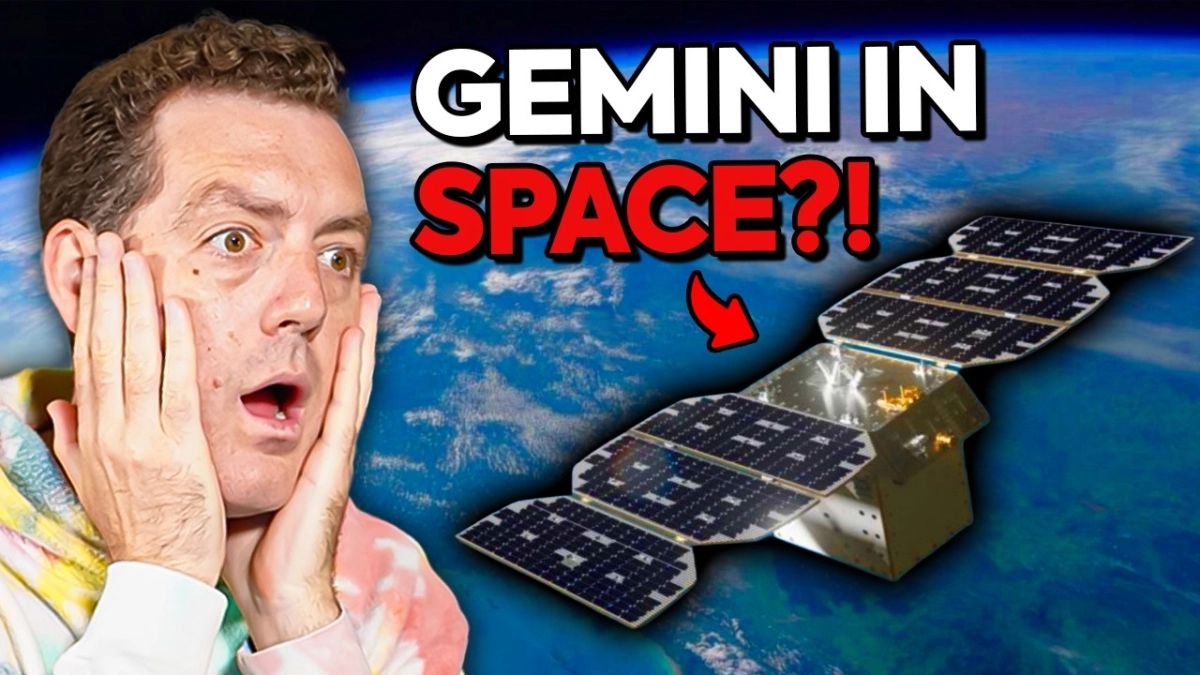
Google's ambitious Project Suncatcher, a moonshot aiming to deploy AI data centers in Earth's orbit, underscores the critical bottleneck of energy on our home planet. Berman highlighted the sheer efficiency potential, noting that "in the right solar orbit, a solar panel can be up to eight times more productive than on Earth." This vision addresses the growing energy demands of AI models, which are already straining terrestrial power grids to the extent that some completed data centers cannot even be fully powered. While the technical hurdles are immense—from maintaining tight satellite formations in orbit to ensuring radiation tolerance for Tensor Processing Units (TPUs) and managing astronomical launch costs—Google's history with projects like Waymo demonstrates their willingness to make "huge bets on very futuristic technology." This bold move signals a future where the physical location of compute resources is dictated by optimal energy capture and environmental impact minimization.
The insatiable demand for computational horsepower is further illuminated by OpenAI's aggressive push for compute infrastructure. Berman detailed a series of colossal deals, stating, "OpenAI is on a massive tear, signing absolute monster deals for compute infrastructure," including a rumored $500 billion Stargate deal and hundreds of billions with chip giants like Nvidia and AMD. This frenetic activity paints a picture of a company striving to secure the bedrock of future AI development, where access to cutting-edge chips and data centers is paramount. The narrative intensified with a tweet from Shay Boloor, highlighting Sam Altman's swift move to secure a deal with Amazon AWS just days after Microsoft, OpenAI's primary investor, lost its "right of first refusal" for OpenAI's compute needs. This maneuver underscores the high stakes and fierce competition among tech titans to control the foundational resources of the AI era.
In a significant strategic alignment, Apple is reportedly integrating a custom version of Google Gemini into its "Apple Intelligence" suite, powering features within Siri. This partnership, which could see Apple paying Google around "$1 billion annually to gain access to the technology," marks a notable shift for the iPhone maker. Crucially, Apple plans to "run the custom Gemini model on its Private Cloud Compute servers," retaining control over the model and its inference processes, allowing for optimization tailored to its ecosystem. This move signifies Apple's commitment to delivering a more capable, natively integrated AI experience for its users, moving past the "clunky experience" of previous third-party integrations, and highlights the premium placed on data sovereignty and customized AI deployment.
OpenAI also rolled out a practical enhancement for ChatGPT users. You can now interrupt long-running queries and add new context without restarting or losing progress. This quality-of-life improvement is particularly useful for deep research or complex GPT-5 Pro queries, where the ability to refine prompts mid-generation can save significant time and effort.
Related Reading
- Google's Ironwood Chip Reshapes the AI Hardware Battle
- OpenAI's Trillion-Dollar Bet on AI Dominance
- AI Hyperscalers Fuel Debt Surge, Offering Unique Investor Opportunity
Meanwhile, Microsoft unveiled MAI-Image-1, an entirely in-house developed image generation model that has already debuted in the top 10 on the LM Arena leaderboard. Microsoft emphasized its focus on delivering "genuine value for creators" by prioritizing "rigorous data selection and nuanced evaluation" to avoid the "repetitive or generically-stylized outputs" often associated with AI-generated content. This push for photorealistic imagery and diverse outputs reflects an industry-wide effort to move beyond the uncanny valley of early generative AI. Concurrently, Vidu Q2, a text-to-video model from ViduAI_official, launched at #8 on the Artificial Analysis leaderboard, outperforming OpenAI's Sora 2 and Wan 2.5. Vidu Q2's ability to generate 8-second 1080p videos with multiple reference images and angles showcases the rapid advancements in controllable video synthesis, offering creators more precise tools for visual storytelling.
However, the expansion of AI agents is not without its controversies. Perplexity, an AI-first browser, recently received an aggressive legal threat from Amazon, demanding that Comet users be prohibited from using AI assistants to shop on Amazon. Perplexity's blog post, titled "Bullying is Not Innovation," articulates a core tension: "The point of technology is to make life better for people... Bullying, on the other hand, is when large corporations use legal threats and intimidation to block innovation and make life worse for people." Amazon's concern stems from the "great decoupling" of traditional internet business models, where AI agents browsing on behalf of users could bypass advertising and upselling strategies, impacting Amazon's substantial ad revenue. This legal skirmish foreshadows numerous future battles over user autonomy, platform control, and the fundamental economic structures of the internet as AI agents become increasingly ubiquitous.