

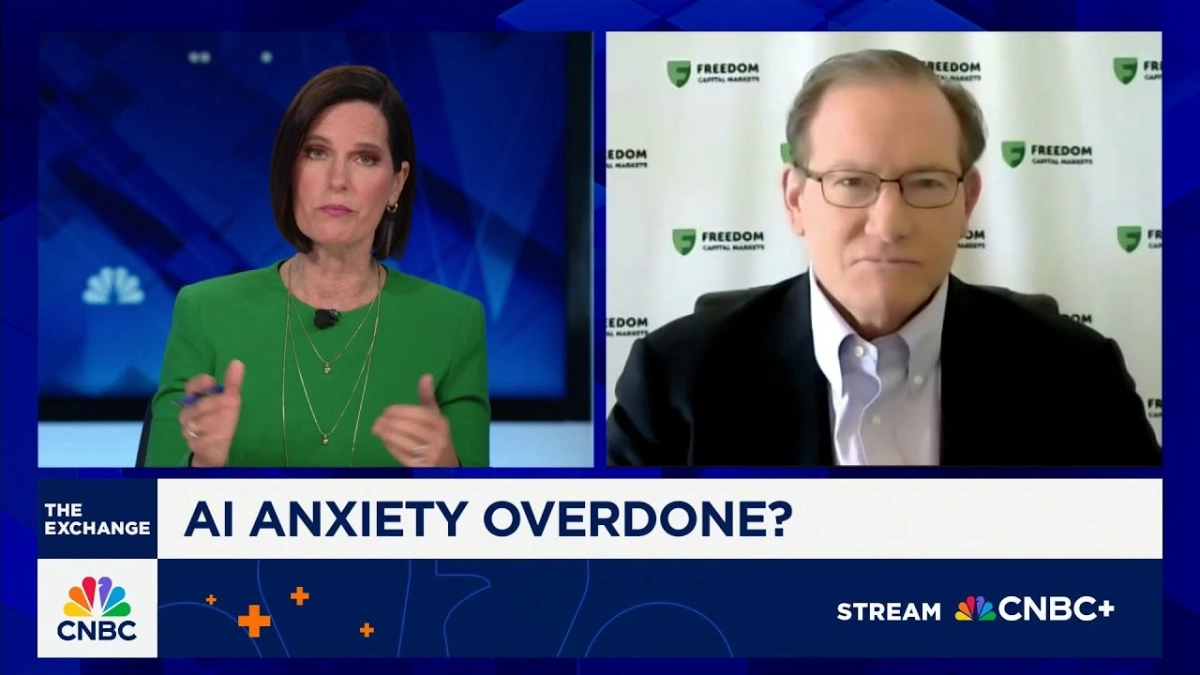
"I don't think that debt in this case is a problem like it was with the companies that were borrowing in the late 90s, early 2000s," asserted Paul Meeks, Head of Technology Research at Freedom Capital Markets, on CNBC's 'The Exchange.' His statement directly challenged the widespread "AI anxiety" that draws parallels between today's burgeoning artificial intelligence investments and the speculative fervor of the dot-com bust. Meeks, speaking with the interviewer, offered a sharp, grounded perspective on why the current wave of AI infrastructure spending is fundamentally different and less perilous than historical tech booms.

In a segment exploring whether concerns about AI's financial underpinnings are overblown, Meeks dissected the core differences between the internet infrastructure build-out of the late 1990s and the contemporary AI investment landscape. His central argument hinges on the quality of the companies driving this new wave of capital expenditure. Unlike the "crappy companies with weak balance sheets" that characterized the dot-com era's debt-fueled expansion, today's AI infrastructure is predominantly being built by a select group of financially robust entities.
This distinction is crucial. Meeks highlighted that "90%, at least thus far, of the AI infrastructure is being built by the five hyperscalers, who all have very big balance sheets, very strong cash flows." These tech giants, unlike many of their dot-com predecessors, are not relying heavily on debt to fund their ambitious AI projects. Instead, a significant portion of their investment comes from their own substantial free cash flow, minimizing the risk of insolvency or liquidity crises that plagued earlier tech bubbles. This strong financial footing means less worry about making interest expense payments, a stark contrast to the highly leveraged, often unprofitable ventures of two decades ago.
The conversation also touched on the depreciation of expensive AI infrastructure, a concern raised by figures like Michael Burry. While acknowledging that lengthening the life of an asset will, in early years, lower depreciation expense and boost reported earnings, Meeks downplayed its immediate significance for investors. He articulated a clear prioritization: "I think I want to see my company spend heavily in '25, '26, '27. So I'm looking at revenue growth, not necessarily over that period, as they build the infrastructure, in earnings growth." This perspective suggests that for the foreseeable future, the market's focus will remain firmly on the top-line expansion and strategic positioning derived from these investments, rather than the intricate details of accounting depreciation.
The current AI infrastructure "trade" is far from over, according to Meeks. He anticipates that the heavy capital expenditures by hyperscalers will not only continue but accelerate into 2026, building off an already high 2025 base. This sustained investment, driven by the competitive imperative to dominate the AI frontier, is "locked in" for at least another year. While acknowledging that growth might eventually slow or plateau in 2027, he stated, "I don't expect them to collapse." This suggests a long runway for growth and innovation, rather than an imminent bust.