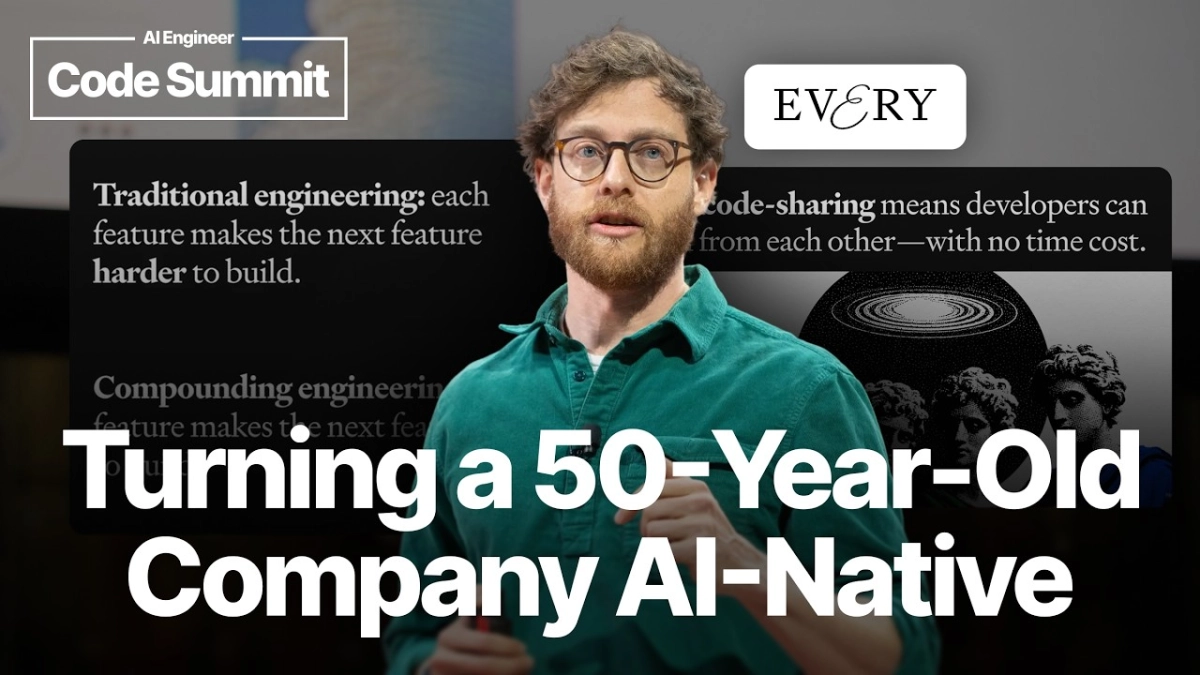
"You're not just adding a new feature. You're changing the substrate of what you're building on." This profound assertion from Dan Shipper, co-founder of Every, encapsulates the central thesis of his recent discussion at AI.Engineer. He argues that artificial intelligence is not merely an incremental technological advancement but a fundamental new primitive, akin to the internet or mobile, demanding a complete re-evaluation of how companies are built and how software is conceived. The challenge, then, for businesses old and new, is not just to adopt AI, but to become "AI-native."
Dan Shipper spoke with an interviewer at the AI.Engineer event about the profound shift AI represents for businesses, focusing on the strategic imperatives for both burgeoning startups and established enterprises navigating this new technological epoch. His insights cut through the hype, offering a pragmatic roadmap for founders, investors, and technologists grappling with the implications of an AI-driven world. The core message is clear: true AI integration requires a first-principles rebuild, not simply an overlay of new features onto existing structures.

The distinction between "AI-enabled" and "AI-native" is crucial. Many companies today are busy integrating AI features into their existing products, aiming for marginal improvements or efficiency gains. This approach, while potentially beneficial in the short term, misses the deeper, more transformative opportunity. An AI-native company, by contrast, fundamentally rethinks its value proposition, its operations, and its product architecture from the ground up, with AI as the central orchestrator. It's about designing systems where intelligence is not an add-on, but the very core of the product's function and competitive advantage.
For legacy companies, this shift presents a significant, often existential, dilemma. Decades of optimized workflows, established revenue streams, and deeply ingrained organizational structures create formidable inertia. The natural inclination is to protect existing assets and incrementally adapt. Shipper, however, warns against this cautious approach. He insists that true AI adoption for incumbents requires a willingness to engage in self-cannibalization. "The first step is to recognize that you're going to have to cannibalize your existing business," he stated, highlighting the necessity of proactively disrupting one's own market before external forces do. This often means establishing independent "skunkworks" teams, empowered to build entirely new, AI-native products that may directly compete with, and ultimately supersede, the company's current offerings.
The organizational challenge extends beyond mere product strategy; it permeates the very fabric of how software is developed and iterated. Shipper emphasizes a new "inner loop" of AI development: data, model, product, repeat. This continuous feedback cycle, where product usage generates data that refines the model, which in turn improves the product, is a hallmark of AI-native companies. Mastering this loop requires a new breed of cross-functional teams, deeply integrated and capable of rapid experimentation. It’s a departure from traditional waterfall or even agile software development, demanding a fluid interplay between data scientists, engineers, and product managers who are constantly optimizing the entire intelligence pipeline. This competency becomes a core differentiator, enabling faster learning and adaptation in a rapidly evolving landscape.
Furthermore, AI-native companies understand that data is not just an asset, but the fuel for a powerful "data flywheel." Every interaction, every user input, every outcome generated by the AI system contributes to a growing, proprietary dataset. This data, when fed back into the models, makes the product smarter, more effective, and increasingly difficult for competitors to replicate. This creates a virtuous cycle where usage improves the product, which drives more usage, further enhancing the data advantage. It's a strategic shift from merely selling software licenses to cultivating an ever-improving intelligence service.
The implications for founders and VCs are profound. Investing in or building an AI-native company means looking beyond superficial AI integrations to identify businesses built on these new primitives. It requires assessing a team's ability to manage the inner loop, cultivate data flywheels, and embrace a culture of continuous learning and disruption. The market will increasingly differentiate between companies that merely use AI and those whose very essence is defined by it. Shipper's perspective pushes leaders to confront the fundamental changes AI brings, urging them to embrace a transformative vision rather than settling for incremental adjustments. It's not just about using LLMs; it's about building a company that is fundamentally structured around these new primitives, ready to thrive in an era where intelligence is the ultimate product.