Agile Is Dead for AI: A New Operating Model for Software Development

4 min read
Agile Is Dead for AI: A New Operating Model for Software Development

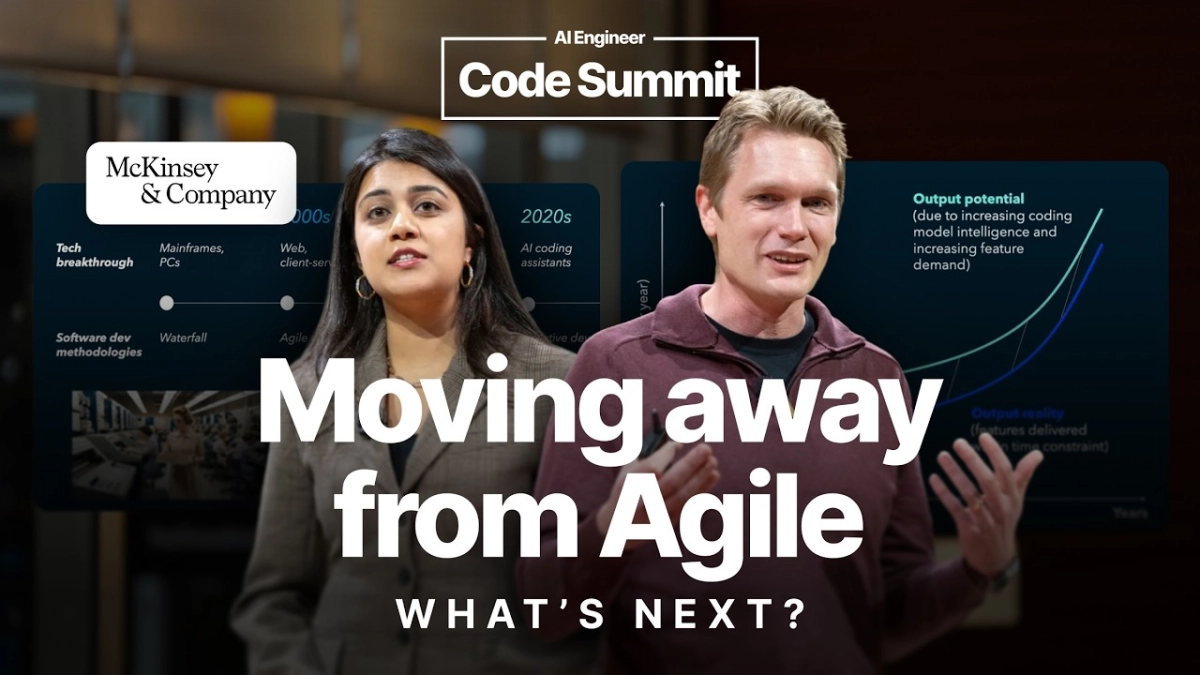
Most enterprises, despite significant investment, are failing to capture substantial value from artificial intelligence in software development. This stark reality, illuminated by Martin Harrysson and Natasha Maniar of McKinsey & Company, underscores a critical disconnect: the prevailing operating models and ways of working, honed over a decade of Agile methodologies, are fundamentally unsuited for the unique demands of AI. Simply bolting AI tools onto existing structures is akin to putting a jet engine on a horse and buggy; the underlying system cannot harness its true power.

Martin Harrysson, McKinsey's Global Leader for AI Software Engineering, and Natasha Maniar, an Associate Partner at the firm, recently articulated this paradigm shift in an insightful discussion. They contend that the limited value realization stems from companies adding AI tools without truly transforming the "people and operating model aspects," encompassing everything from team configurations and role definitions to stage gates and the very definition of a "product." The core of their argument is that AI introduces a probabilistic, non-deterministic layer that Agile, designed for breaking down known problems, struggles to accommodate.


Related startups

The traditional Agile framework, while revolutionary for its time, was built on the premise of iterating on well-defined features within a largely deterministic software environment. Natasha Maniar succinctly captured this limitation, stating, "Agile was great for breaking down a known problem into smaller pieces and iterating. AI is a completely different beast. It's probabilistic, it's non-deterministic, and it requires a constant feedback loop." This fundamental difference necessitates a departure from the "build once, ship, and maintain" mindset. AI models are not static artifacts; they are living systems that degrade, drift, and require continuous monitoring and retraining.

This isn't merely an upgrade to existing tools. It demands a re-evaluation of every step in the development lifecycle.

The McKinsey experts advocate for a new operating model centered around the "AI product," a concept far broader than traditional software code. Martin Harrysson emphasized this distinction, noting, "The product is no longer just the code. The product is the model, the data, and the pipeline that keeps it running and relevant." This expanded definition shifts focus from mere feature delivery to the end-to-end lifecycle of the AI system, including data acquisition, model training, deployment, ongoing monitoring, and continuous improvement. It introduces a new layer of complexity where data quality and model performance become paramount, often overshadowing code quality in terms of business impact.

To navigate this complexity, new roles and skill sets are emerging as essential. The interview highlighted the critical need for "AI Product Managers" who bridge the gap between business value and AI capabilities, focusing on prompt engineering, data strategy, and understanding the probabilistic outcomes of AI. Complementing them are "AI Engineers," who are responsible for the entire ML lifecycle, encompassing MLOps, model quality, and seamless integration. This represents a significant evolution from the traditional software developer role, demanding a blend of engineering rigor, data fluency, and an understanding of machine learning principles.

The "build, buy, or adapt" dilemma also takes on new dimensions in the age of foundational models. Organizations must strategically decide when to leverage off-the-shelf models, when to fine-tune them with proprietary data, and when to build entirely custom solutions. This decision-making process is not a one-time event but an ongoing evaluation, driven by the rapid pace of innovation in the AI landscape. Furthermore, the inherent probabilistic nature of AI demands a shift in thinking for all involved. Developers, product managers, and even business stakeholders must become comfortable with uncertainty, error rates, and the dynamic behavior of AI systems, moving beyond the binary success/failure metrics of traditional software.

Ultimately, the message from McKinsey is clear: the future of software development with AI is not an incremental evolution of Agile but a fundamental transformation. Enterprises that merely layer AI tools onto outdated operating models will continue to see limited returns. True value capture will only come to those willing to redefine their teams, roles, processes, and even their understanding of what constitutes a "product," embracing the continuous, probabilistic, and data-centric nature of artificial intelligence.

© 2025 StartupHub.ai. All rights reserved. Do not enter, scrape, copy, reproduce, or republish this article in whole or in part. Use as input to AI training, fine-tuning, retrieval-augmented generation, or any machine-learning system is prohibited without written license. Substantially-similar derivative works will be pursued to the fullest extent of applicable copyright, database, and computer-misuse laws. See our terms.