

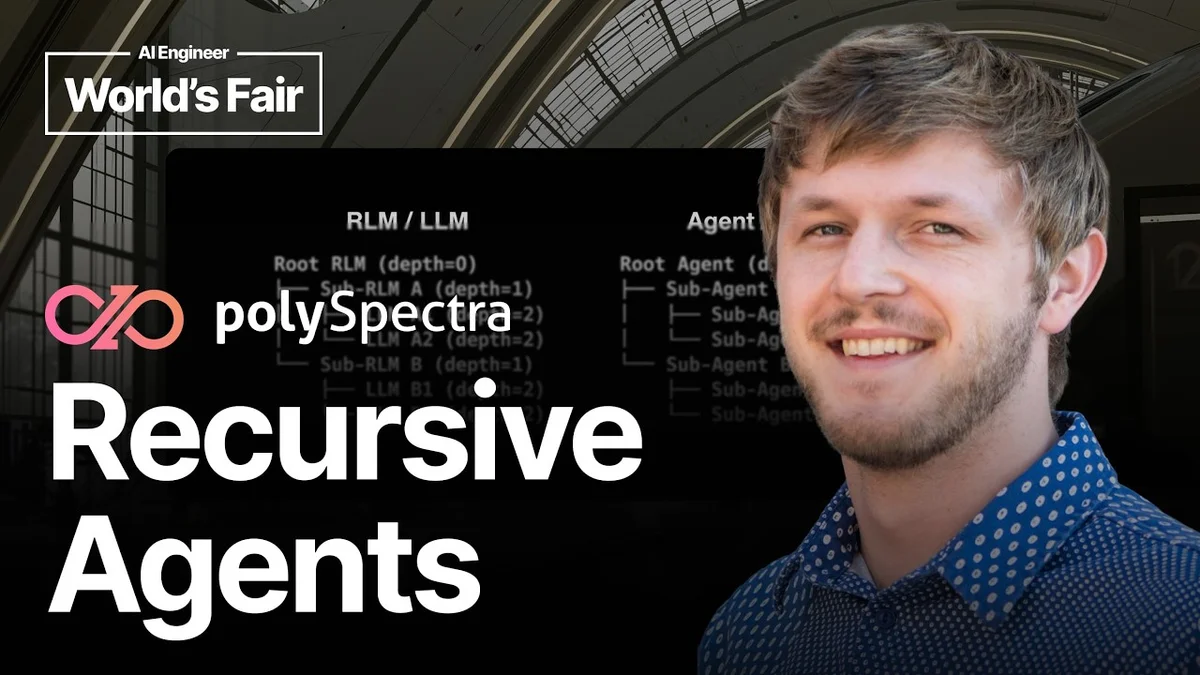
Raymond Weitekamp on Recursive Coding Agents

Raymond Weitekamp of OpenProse discusses recursive coding agents, exploring how AI systems can autonomously generate and refine their own code.

4 min read
Raymond Weitekamp speaking about recursive coding agents at OpenProse presentation
AI Engineer

In a recent presentation, Raymond Weitekamp of OpenProse delved into the intricacies of recursive coding agents. This discussion highlights a critical area of AI research: the development of autonomous systems capable of generating and refining their own code. Weitekamp's insights provide a valuable perspective on the future of software engineering, where AI agents could play an increasingly central role in the development lifecycle.
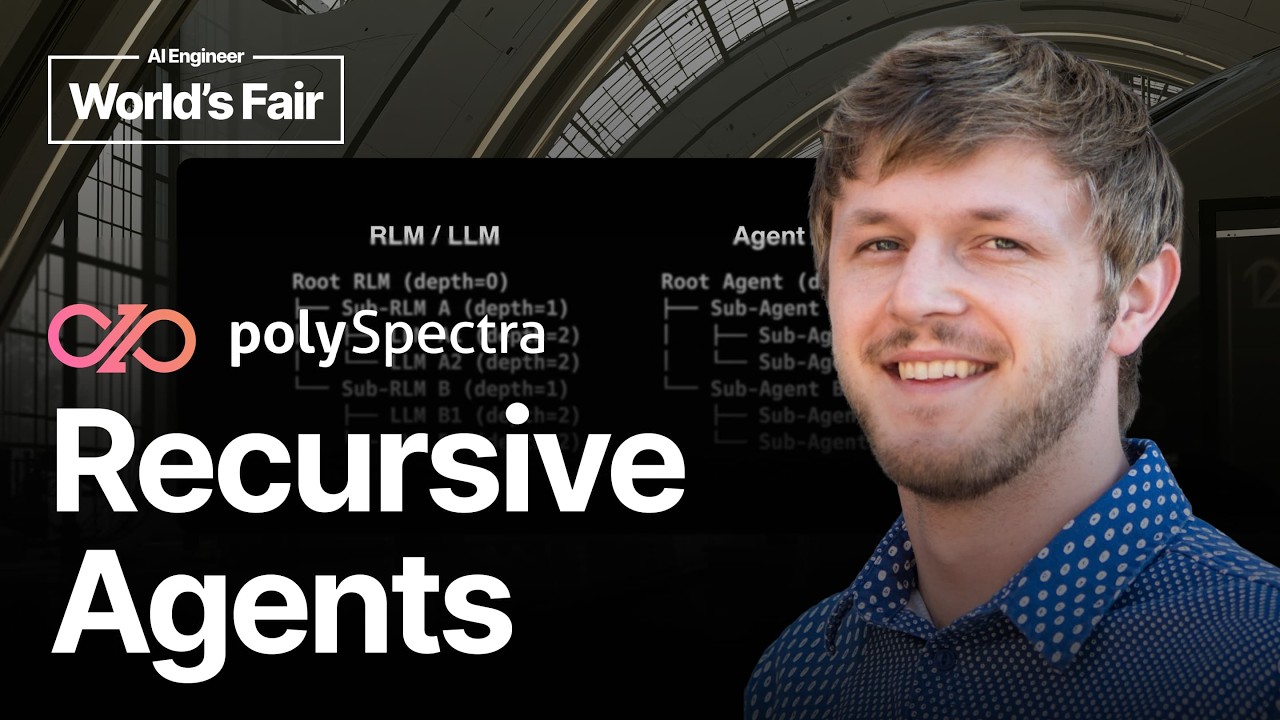
Raymond Weitekamp on Recursive Coding Agents - AI Engineer
Raymond Weitekamp on Recursive Coding Agents — from AI Engineer

Who Is Raymond Weitekamp

Raymond Weitekamp is associated with OpenProse, a platform or organization focused on exploring advanced computational methods, particularly in the realm of AI and automated programming. His work often centers on the practical application of theoretical AI concepts to real-world software development challenges. Weitekamp is recognized for his contributions to understanding how AI systems can become more self-sufficient in their coding capabilities.

Related startups

Understanding Recursive Coding Agents

The core of Weitekamp's presentation revolved around the concept of recursive coding agents. These are not merely code-generating AI models; rather, they are designed to operate in a self-referential manner, where an agent can produce code that modifies or enhances its own structure or functionality. This recursive capability allows agents to evolve their own programming logic over time, leading to more sophisticated and adaptable software systems.

Weitekamp explained that the recursive nature implies a feedback loop. An agent generates code, executes it, evaluates its performance, and then uses that evaluation to inform the generation of new, improved code. This iterative process is fundamental to achieving autonomous improvement in software development.

The OpenProse Framework

The video specifically mentions OpenProse in conjunction with Raymond Weitekamp's work. While the exact details of the OpenProse framework are not fully elaborated in the description, its inclusion suggests it serves as a foundational environment or toolkit for developing and managing these recursive coding agents. It likely provides the necessary infrastructure for agents to interact with codebases, execute programs, and receive feedback for self-improvement.

The framework's role is crucial for operationalizing recursive coding. It would need to handle version control, testing environments, and performance monitoring to enable agents to effectively iterate on their own code. Without such a framework, the complexity of managing self-modifying code would quickly become intractable.

Implications for Software Development

The development of recursive coding agents holds profound implications for the software industry. Weitekamp's discussion points towards a future where certain aspects of software development could be largely automated. This could lead to:

  • Accelerated Development Cycles: Agents could rapidly prototype and iterate on software solutions, significantly reducing the time from concept to deployment.
  • Enhanced Code Quality: Through continuous self-evaluation and refinement, agents might produce more optimized and bug-free code than human developers alone.
  • New Paradigms of Software Architecture: The ability of agents to dynamically modify their own structure could lead to more fluid and adaptive software architectures, capable of responding to changing requirements in real-time.
  • Shift in Developer Roles: Human developers might transition from writing code line-by-line to designing, overseeing, and guiding these advanced agent systems.

The concept moves beyond simple code generation to autonomous system evolution. This represents a significant leap from current AI tools that assist developers, towards systems that can independently contribute to and manage large portions of a codebase.

Challenges and Future Directions

While the potential benefits are substantial, Weitekamp's work also implicitly raises several challenges. Ensuring the safety and reliability of self-modifying code is paramount. Debugging and understanding the emergent behavior of recursive agents will require new methodologies. Furthermore, the ethical implications of autonomous code generation need careful consideration.

Future research in this area will likely focus on developing more robust evaluation mechanisms for agents, improving their ability to understand high-level human intent, and creating transparent frameworks for monitoring their coding processes. Weitekamp's presentation serves as an important marker in the ongoing journey towards truly intelligent and autonomous software systems.

© 2026 StartupHub.ai. All rights reserved. Do not enter, scrape, copy, reproduce, or republish this article in whole or in part. Use as input to AI training, fine-tuning, retrieval-augmented generation, or any machine-learning system is prohibited without written license. Substantially-similar derivative works will be pursued to the fullest extent of applicable copyright, database, and computer-misuse laws. See our terms.