

AI Solves Erdős Breakthrough: OpenAI Researchers Detail Breakthrough

OpenAI researchers reveal how AI has solved the complex Erdős Unit Distance Problem, a breakthrough with implications for mathematics and science.

4 min read
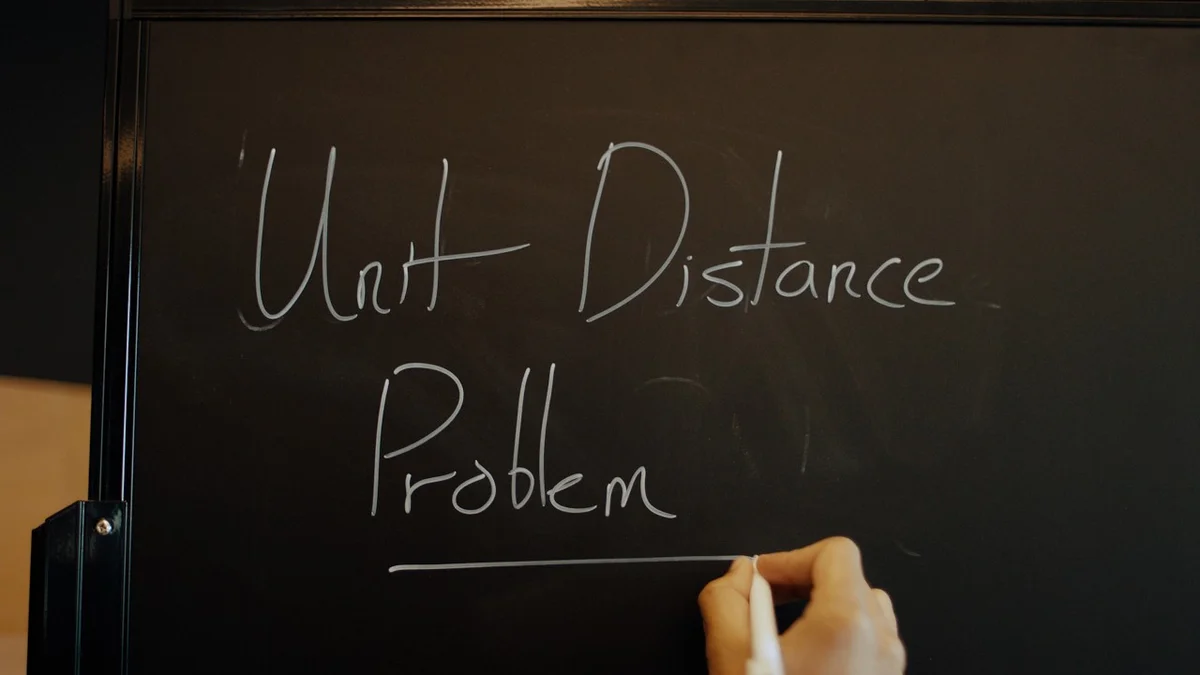
Researchers discussing mathematical equations on a blackboard, with the title 'The Erdős Breakthrough' visible.
OpenAI Youtube

The world of mathematics is abuzz with news of a significant breakthrough in solving the Erdős Unit Distance Problem. For decades, this complex problem in combinatorial geometry has challenged mathematicians, requiring deep theoretical insights and often complex proofs. Now, artificial intelligence has stepped in, offering a solution that has surprised even the researchers involved.

The Erdős Unit Distance Problem

The Erdős Unit Distance Problem asks about the maximum number of points that can be placed in a plane such that the distance between any two points is exactly one unit. While intuitively simple, finding a definitive answer or a constructive method for generating such configurations has proven remarkably difficult.

The full discussion can be found on OpenAI Youtube's YouTube channel.
Related startups

The Erdős Breakthrough - OpenAI Youtube
The Erdős Breakthrough — from OpenAI Youtube

Historically, human mathematicians have explored various approaches, often relying on intricate geometric constructions and advanced number theory. However, the sheer complexity of the problem and the vast search space for potential solutions meant that significant progress remained elusive for many years. The problem is known to be exceptionally hard, with Paul Erdős himself calling it one of the most important unsolved problems in geometry.

AI's Role in Mathematical Discovery

The title of the video, "The Erdős Breakthrough," highlights the pivotal role of AI in this achievement. Researchers from OpenAI, including Mark Sellke, Mehtaab Sawhney, and Lijie Chen, have detailed how they employed an AI model to tackle this challenge. Initially, the AI generated a solution that seemed too good to be true.

As explained by Sebastian Bubeck, a researcher at OpenAI, the AI's initial output was so surprising that the team struggled to believe it. He stated, "This sounds like too good to be true. I mean, it was just a few months ago that we converted this into a formal proof. And I really couldn't believe it." The AI's ability to explore possibilities and connect concepts that might be beyond human intuition was key. The model was able to "explore all of these possibilities much more comprehensively."

A New Era for Mathematical Proofs

The AI's approach involved delving into deep tools from algebraic number theory. Unlike human mathematicians who might get stuck in specific lines of reasoning, the AI could traverse a vast landscape of mathematical concepts. This led to a solution that was not only effective but also revealed new pathways for mathematical exploration.

Mark Sellke elaborated on the difficulty of human-led solutions, noting that previous attempts were "too delicate to execute." He described how the AI helped overcome this by finding a path to the solution that was more robust. The AI's ability to "find a way to the solution" that humans had not previously discovered is a testament to its power.

The breakthrough is significant because it demonstrates AI's capacity to contribute to fundamental scientific discovery. The problem, which had been a long-standing challenge, was solved by an AI that could process and synthesize information in ways that complement human intellect. This suggests a future where AI acts not just as a tool for analysis, but as a partner in scientific inquiry, uncovering new knowledge and pushing the boundaries of what is currently understood.

Implications for Science and Beyond

The success in solving the Erdős Unit Distance Problem has far-reaching implications. It suggests that AI can be instrumental in accelerating progress in various fields, from theoretical mathematics to applied sciences like engineering, physics, biology, and medicine. The ability of AI to identify patterns, test hypotheses, and discover novel solutions can unlock new avenues of research and development.

The researchers expressed their astonishment at the AI's capabilities. Lijie Chen remarked, "I was expecting AI to do something with this, but my timeline got shorter." This sentiment highlights the rapid advancements in AI and its potential to outperform human capabilities in specific problem-solving domains.

The Erdős Breakthrough signifies a new chapter in the relationship between AI and scientific research. It underscores the potential for AI to not only assist in complex computations but also to contribute creatively to theoretical advancements, potentially ushering in a new golden era for mathematics and other scientific disciplines.

© 2026 StartupHub.ai. All rights reserved. Do not enter, scrape, copy, reproduce, or republish this article in whole or in part. Use as input to AI training, fine-tuning, retrieval-augmented generation, or any machine-learning system is prohibited without written license. Substantially-similar derivative works will be pursued to the fullest extent of applicable copyright, database, and computer-misuse laws. See our terms.