

Agent Evals Lag Behind AI Evolution

Ameya Bhatawdekar explains how AI agent evaluations are lagging behind model advancements, creating a need for new methods.

7 min read
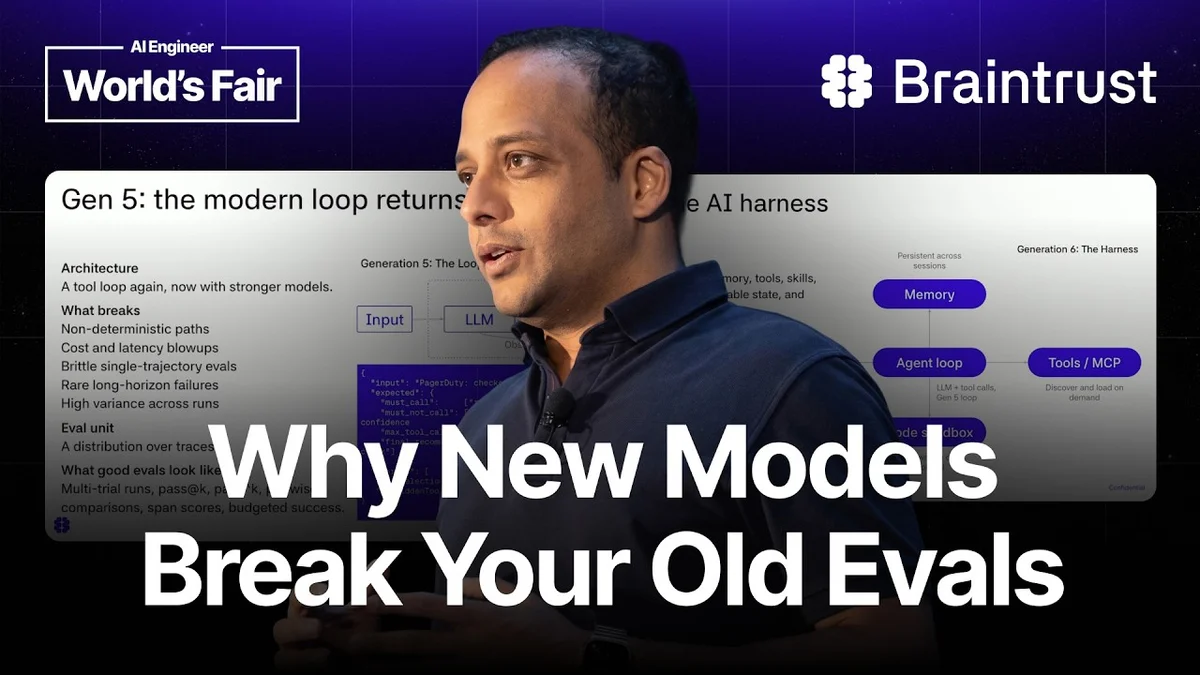
Ameya Bhatawdekar speaking at a presentation about AI agent evolution and evaluation.
AI Engineer

Visual TL;DR. AI Models Evolve Rapidly causes Evals Lag Behind. Evals Lag Behind highlighted by Bhatawdekar's Argument. Early AI Evals Simple evolved to Retrieval Chains Complex. Retrieval Chains Complex further evolved to Orchestration Graphs Add Errors. Orchestration Graphs Add Errors requires New Evals Needed. AI Models Evolve Rapidly drives need for New Evals Needed.

  1. AI Models Evolve Rapidly: rapid evolution of AI models outpaces evaluation method development
  2. Evals Lag Behind: AI agent evaluations are lagging behind model advancements, creating a bottleneck
  3. Early AI Evals Simple: early AI systems needed only a single answer to a single prompt
  4. Retrieval Chains Complex: retrieval chains introduced new failure points like incorrect parsing or irrelevant context
  5. Orchestration Graphs Add Errors: orchestration graphs with branch logic and classifier nodes added further error surfaces
  6. New Evals Needed: each step change in model capability demanded new evaluation strategies
  7. Bhatawdekar's Argument: Ameya Bhatawdekar explains how current architectures hinder progress
Visual TL;DR
Visual TL;DR, startuphub.ai AI Models Evolve Rapidly causes Evals Lag Behind. Evals Lag Behind highlighted by Bhatawdekar's Argument. AI Models Evolve Rapidly drives need for New Evals Needed causes highlighted by drives need for AI Models Evolve Rapidly Evals Lag Behind New Evals Needed Bhatawdekar's Argument From startuphub.ai · The publishers behind this format
Visual TL;DR, startuphub.ai AI Models Evolve Rapidly causes Evals Lag Behind. Evals Lag Behind highlighted by Bhatawdekar's Argument. AI Models Evolve Rapidly drives need for New Evals Needed causes highlighted by drives need for AI Models EvolveRapidly Evals Lag Behind New Evals Needed Bhatawdekar'sArgument From startuphub.ai · The publishers behind this format
Visual TL;DR, startuphub.ai AI Models Evolve Rapidly causes Evals Lag Behind. Evals Lag Behind highlighted by Bhatawdekar's Argument. AI Models Evolve Rapidly drives need for New Evals Needed causes highlighted by drives need for AI Models Evolve Rapidly rapid evolution of AI models outpacesevaluation method development Evals Lag Behind AI agent evaluations are lagging behindmodel advancements, creating a bottleneck New Evals Needed each step change in model capabilitydemanded new evaluation strategies Bhatawdekar's Argument Ameya Bhatawdekar explains how currentarchitectures hinder progress From startuphub.ai · The publishers behind this format
Visual TL;DR, startuphub.ai AI Models Evolve Rapidly causes Evals Lag Behind. Evals Lag Behind highlighted by Bhatawdekar's Argument. AI Models Evolve Rapidly drives need for New Evals Needed causes highlighted by drives need for AI Models EvolveRapidly rapid evolution ofAI models outpacesevaluation method… Evals Lag Behind AI agentevaluations arelagging behind… New Evals Needed each step change inmodel capabilitydemanded new… Bhatawdekar'sArgument Ameya Bhatawdekarexplains howcurrent… From startuphub.ai · The publishers behind this format
Visual TL;DR, startuphub.ai AI Models Evolve Rapidly causes Evals Lag Behind. Evals Lag Behind highlighted by Bhatawdekar's Argument. Early AI Evals Simple evolved to Retrieval Chains Complex. Retrieval Chains Complex further evolved to Orchestration Graphs Add Errors. Orchestration Graphs Add Errors requires New Evals Needed. AI Models Evolve Rapidly drives need for New Evals Needed causes highlighted by evolved to further evolved to requires drives need for AI Models Evolve Rapidly rapid evolution of AI models outpacesevaluation method development Evals Lag Behind AI agent evaluations are lagging behindmodel advancements, creating a bottleneck Early AI Evals Simple early AI systems needed only a singleanswer to a single prompt Retrieval Chains Complex retrieval chains introduced new failurepoints like incorrect parsing orirrelevant context Orchestration Graphs Add Errors orchestration graphs with branch logic andclassifier nodes added further errorsurfaces New Evals Needed each step change in model capabilitydemanded new evaluation strategies Bhatawdekar's Argument Ameya Bhatawdekar explains how currentarchitectures hinder progress From startuphub.ai · The publishers behind this format
Visual TL;DR, startuphub.ai AI Models Evolve Rapidly causes Evals Lag Behind. Evals Lag Behind highlighted by Bhatawdekar's Argument. Early AI Evals Simple evolved to Retrieval Chains Complex. Retrieval Chains Complex further evolved to Orchestration Graphs Add Errors. Orchestration Graphs Add Errors requires New Evals Needed. AI Models Evolve Rapidly drives need for New Evals Needed causes highlighted by evolved to further evolved to requires drives need for AI Models EvolveRapidly rapid evolution ofAI models outpacesevaluation method… Evals Lag Behind AI agentevaluations arelagging behind… Early AI EvalsSimple early AI systemsneeded only asingle answer to a… Retrieval ChainsComplex retrieval chainsintroduced newfailure points like… OrchestrationGraphs Add Errors orchestrationgraphs with branchlogic and… New Evals Needed each step change inmodel capabilitydemanded new… Bhatawdekar'sArgument Ameya Bhatawdekarexplains howcurrent… From startuphub.ai · The publishers behind this format

The rapid evolution of AI models has outpaced the development of evaluation methods, creating a bottleneck for agent development. Ameya Bhatawdekar, a speaker from Braintrust, argues that the very architectures built to manage AI capabilities are now hindering progress. He traces this loop across five generations of AI architecture, highlighting how each step change in model capability demanded new evaluation strategies.

Agent Evals Lag Behind AI Evolution - AI Engineer
Agent Evals Lag Behind AI Evolution — from AI Engineer

The Evolution of AI Architecture and Its Evaluation Challenges

Bhatawdekar explains that early AI systems, requiring only a single answer to a single prompt, had straightforward evaluations. The complexity increased with retrieval chains, which introduced new failure points like incorrect parsing or irrelevant context retrieval. The introduction of orchestration graphs, designed to manage more complex workflows, added further surfaces for potential errors. These graphs incorporated branch logic, contracts between nodes, and classifier nodes that could fail silently. This increased complexity meant a greater need for rigorous checking.

A significant shift occurred when models became reliable enough to operate autonomously. At this stage, the same input could produce different outputs on each run. This variability made single evaluation results less meaningful. Bhatawdekar emphasizes that this is not just an iteration but a replatforming problem.

Shifting from Capability to Reliability in Evals

The core of Bhatawdekar's argument lies in the distinction between capability and reliability in AI agent evaluation. He breaks down the problem into two key questions that a single eval result can hide. The first is 'pass at k', which measures whether the system succeeds at least once within 'k' attempts. This is a measure of capability.
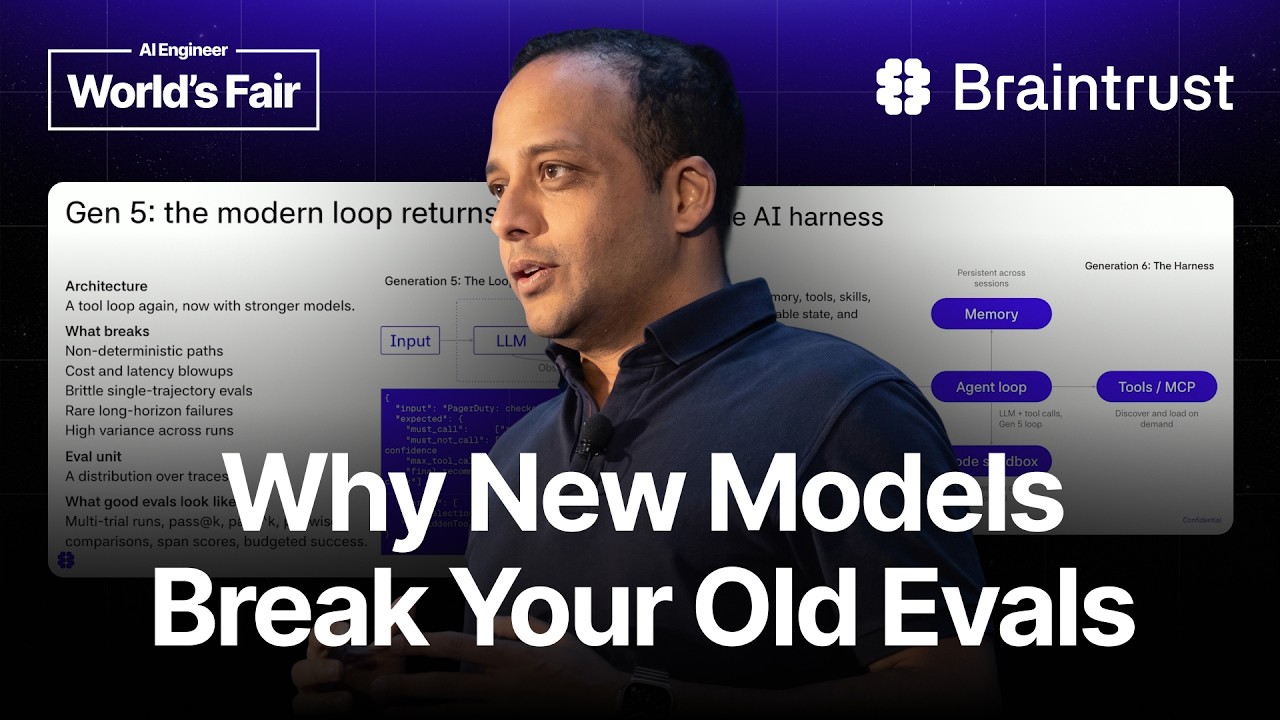
The second, stricter question asks how many of those 'k' attempts actually succeed. This metric measures reliability. A system might demonstrate strong capability by succeeding once, but fail to be reliable if it only succeeds sporadically. Bhatawdekar stresses that understanding this difference requires running the distribution of results, not just a single sample. He points out that memory, sandboxes, and skills around the AI loop also need careful evaluation as agents become more sophisticated.

Evals as the Durable Asset

Bhatawdekar posits that evaluations are the most durable asset for AI teams, especially through replatformings. However, he warns that evals become stale and lose their value if they are not continuously fed with data from production. This continuous feedback loop is essential for maintaining relevant and effective evaluation strategies that keep pace with AI advancements.

The challenge for many teams is that they accept a flywheel of development and deployment but fail to run the crucial evaluation component of that flywheel effectively. This leads to a situation where the agents are advancing rapidly, but the tools to measure their performance and reliability are not keeping up.

© 2026 StartupHub.ai. All rights reserved. Do not enter, scrape, copy, reproduce, or republish this article in whole or in part. Use as input to AI training, fine-tuning, retrieval-augmented generation, or any machine-learning system is prohibited without written license. Substantially-similar derivative works will be pursued to the fullest extent of applicable copyright, database, and computer-misuse laws. See our terms.