

• StartupHub.ai
    StartupHub.aiAI Intelligence
Discover
  • Home
  • Search
  • Trending
  • News
Intelligence
  • Market Analysis
  • Comparison
  • Market Map
Workspace
  • Email Validator
  • Pricing
Company
  • About
  • Editorial
  • Terms
  • Privacy
  • v1.0.0
  1. Home
  2. News
  3. Microsofts Echo Language Model Learns From Failure
Back to News
Ai research

Microsoft's ECHO Language Model learns from failure

S
StartupHub Team
Oct 19, 2025 at 4:20 PM3 min read
Microsoft's ECHO Language Model learns from failure

AI agents are notoriously clumsy when dropped into a new environment. Like a tourist with a bad map, they stumble, repeat mistakes, and take forever to learn the ropes. This "sample inefficiency" is a massive roadblock to deploying them in the real world, where every interaction with a human or a physical system costs time and money.

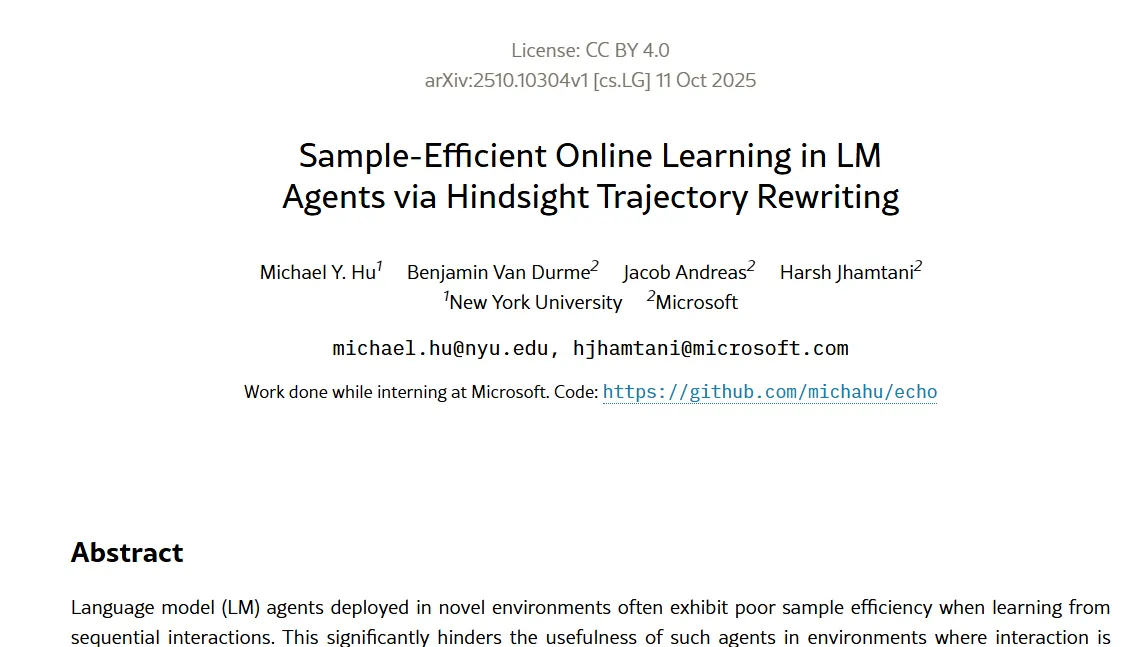
Now, researchers from Microsoft and New York University have developed a clever framework that teaches these agents to learn from their mistakes by literally rewriting the past. It’s called ECHO (Experience Consolidation via Hindsight Optimization), and it treats every failure not as a dead end, but as an accidental success for a different goal.

According to a new paper, ECHO adapts a technique from reinforcement learning called hindsight experience replay. But instead of just relabeling a failed attempt, it uses the language model’s own reasoning abilities to generate a completely new, optimized plan for a goal that *could* have been achieved. Imagine an agent trying to get a key in another room and failing. Along the way, it passed a shiny star. Instead of just noting the failure, ECHO steps in and says, “You failed to get the key, but you got close to the star. Here is the perfect, most efficient way you *could* have just gone for the star.”

Rewriting the Past

This process effectively creates synthetic, positive training examples out of thin air, turning one failed run into multiple successful lessons. The agent’s memory isn’t just a log of what happened; it becomes a curated playbook of best practices, constantly refined by the AI itself. The ECHO framework consists of a "hindsight rule" that identifies these alternative goals and rewrites the trajectory, and an "update rule" that stores the shortest, most efficient plan for each goal in its memory.

The results are striking. In tests on XMiniGrid-Stateful, a text-based navigation benchmark, the ECHO language model framework improved performance by up to 80 percent over standard agents. It also outperformed more sophisticated architectures like Reflexion and AWM, demonstrating significantly faster adaptation. In a collaborative information-gathering simulation called PeopleJoinQA-Stateful, ECHO made the agent more efficient, reducing the number of messages needed to complete tasks.

ECHO isn’t a new, bigger model; it’s a smarter prompting strategy. By leveraging an LM's ability to reason about counterfactuals, it sidesteps the need for the agent to build a perfect world model from scratch. This approach of using the model to self-correct and generate its own training data from failures is a powerful technique that could finally make AI agents efficient enough for the real world.

#AI
#AI Agents
#Autonomous Agents
#Large Language Models (LLMs)
#Microsoft
#Prompt Engineering
#Reinforcement Learning
#Research

AI Daily Digest

Get the most important AI news daily.

GoogleSequoiaOpenAIa16z
+40k readers