

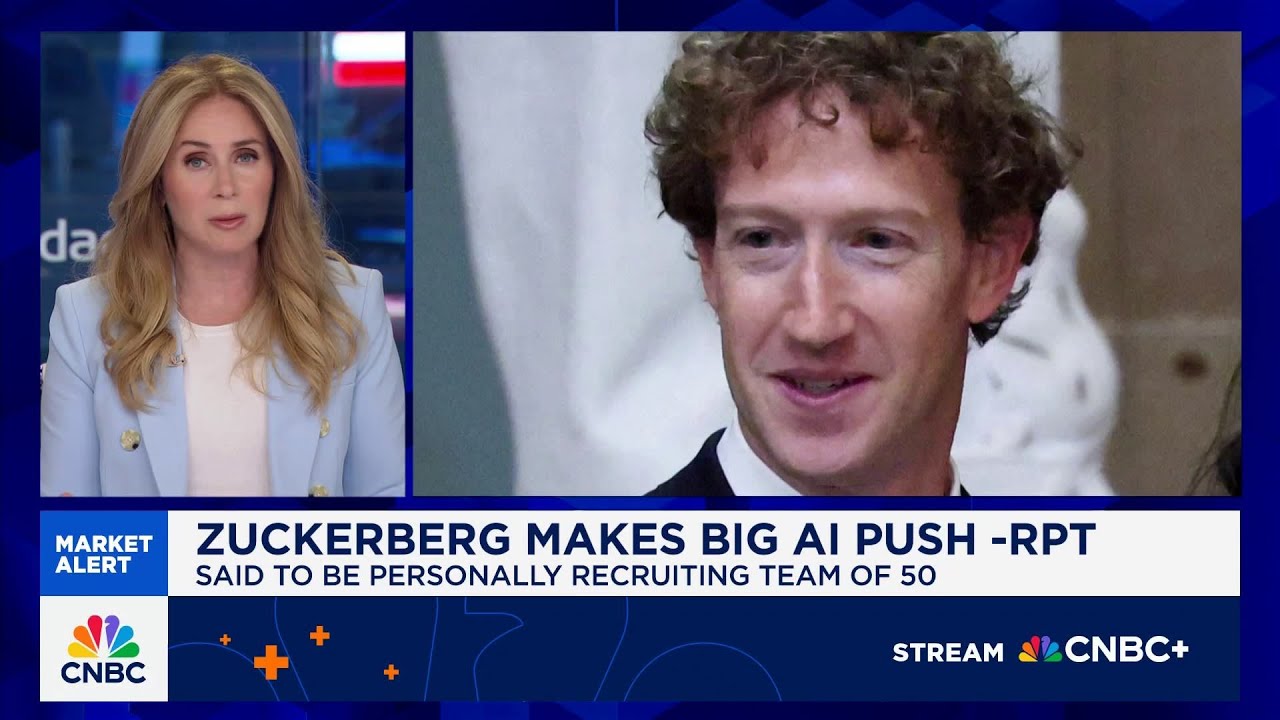
“AI is definitely the thing that has all these original coders super excited, super competitive about,” observed one CNBC anchor, capturing the raw, visceral energy currently coursing through the tech world. This sentiment, often reserved for nascent, disruptive technologies, now squarely defines the race for artificial intelligence supremacy, and Mark Zuckerberg, once singularly fixated on the metaverse, appears to be fully re-engaging with a fervor that signals a profound strategic pivot at Meta Platforms.
On a recent CNBC segment, anchors discussed reports detailing Mark Zuckerberg’s renewed and intensely personal drive to accelerate Meta’s artificial intelligence capabilities, particularly its pursuit of Artificial General Intelligence, or AGI. The conversation revolved around Bloomberg’s insights into Zuckerberg's alleged frustration with Meta's current pace in the burgeoning AI landscape, prompting him to personally spearhead a new, dedicated "super intelligence group" within the company, recruiting a team of around 50 elite AI researchers and engineers. This isn't merely an internal reshuffle; it's a profound reorientation of Meta's strategic compass, demonstrating a clear recognition that the future of tech, and indeed Meta’s own relevance, hinges on its prowess in AI.
Zuckerberg's reported "frustration" is a telling sign. For years, Meta, under his unwavering leadership, poured billions into the metaverse, a vision of immersive virtual worlds that, while futuristic, struggled to gain mainstream traction or generate significant revenue. This single-minded focus, often criticized by investors and analysts, arguably allowed competitors to pull ahead in the generative AI race. The recent surge of interest in large language models and generative AI tools, epitomized by OpenAI's ChatGPT and Google's Bard, has undoubtedly underscored the urgency of catching up, if not surpassing, rivals. This intense personal involvement, including reports of him "personally working to recruit dozens of people" and even "moving desks in the office so that all of these people can sit right by him," is a throwback to the early days of Facebook, a hands-on, founder-driven approach indicative of a make-or-break moment. It suggests that Meta's AI ambition is no longer a distributed effort but a concentrated, highly prioritized mission directly overseen by its founder, marking a significant strategic pivot away from the all-consuming metaverse bet.
The competitive landscape for AGI is nothing short of an arms race, and Zuckerberg's stated goal to "beat other tech companies to reaching the point where AI can perform as well as humans do" lays bare the high stakes. This isn't just about incremental improvements; it's about achieving a "quantum leap," as one anchor put it, a paradigm shift that could redefine industries and human interaction. The comparison drawn to Google co-founder Sergey Brin, who reportedly also got "reinvigorated" by AI a couple of years ago, highlights a recurring pattern among tech titans: when the next truly transformative technology emerges, the founders themselves often return to the trenches, driven by a blend of competitive fire and a primal urge to shape the future. For startups and VCs, this intense competition from established giants like Meta presents both formidable challenges and unprecedented opportunities. While it signifies a higher barrier to entry in foundational AI research, it also validates the market, accelerates infrastructure development, and creates a demand for specialized applications and services built atop these foundational models.
The pursuit of AGI also reveals a deep-seated talent war. Zuckerberg’s personal recruitment of a 50-person "super intelligence group" is a testament to the scarcity and immense value of top-tier AI talent. In an era where AI engineers and researchers are among the most sought-after professionals, attracting and retaining this caliber of expertise requires more than just competitive salaries; it demands a compelling vision, direct access to leadership, and the resources to pursue ambitious, impactful projects. The anecdote of Zuckerberg moving desks to be closer to his new AI team, while seemingly minor, speaks volumes about the culture he aims to foster, one of intense collaboration, rapid iteration, and direct oversight, mirroring the agile, focused environment often found in successful startups. For founders, this underscores the critical importance of not just building great technology, but also cultivating an environment that attracts and empowers exceptional talent, even when competing with the deep pockets and established brands of tech giants.