

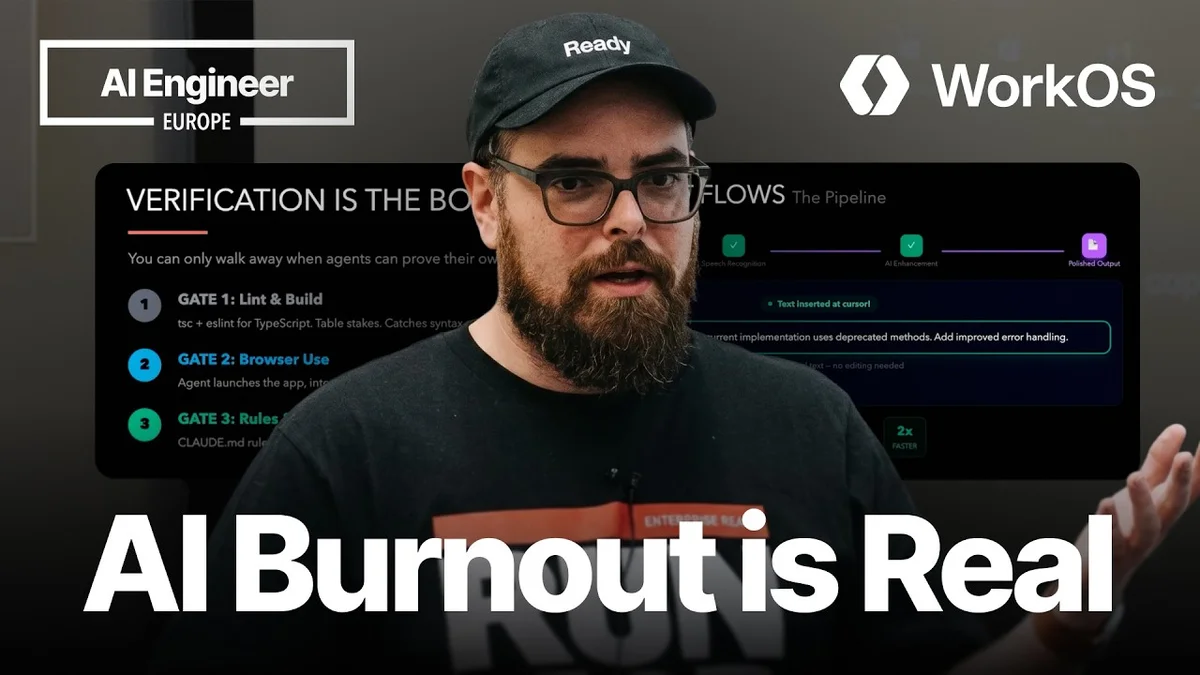
WorkOS's Zack Proser on Untethered AI Productivity

WorkOS's Zack Proser discusses how developers can maintain productivity and well-being amidst the rapid advancement of AI coding agents, focusing on balance and intentional workflows.

Zack Proser of WorkOS presenting on untethered productivity in the AI era.
AI Engineer
Visual TL;DR
AI Coding AgentsCore
developers juggling multiple AI agents and tools
From the article 9+ mentionsTitled "Untethered Productivity: Staying Healthy, Creative, and Shipping in the AI Coding Era," Proser's talk, presented at AI Engineer Europe, highlighted the challenges and opportunities that arise when leveraging AI agents for coding tasks.
Daily Reality ChaosDriver
constant context switching and rapid influx of new tools
From the articleProser opened by painting a vivid picture of the current state of AI-assisted development, describing a daily reality that often feels chaotic and overwhelming.
Human Attention BottleneckDriver
sheer volume of AI outputs requires verification and debugging
From the article 2 mentionsHe noted that while AI agents can perform tasks with incredible speed and tirelessness, the human element, specifically, the developer's attention and judgment, becomes the critical bottleneck.
Developer OverwhelmOutcome
feeling scattered and overwhelmed by AI-generated code
From the article 9 mentionsHe illustrated this with examples of developers juggling multiple AI agents, facing constant context switching, and dealing with the rapid influx of new tools.
Finding BalanceContext
strategies for maintaining developer well-being and creativity
From the article 3 mentionsHis recommendations for finding this balance included:
Intentional WorkflowsContext
designing workflows that leverage AI effectively
From the article 2 mentionsThis integration of personal context into the AI workflow is crucial for sustainable productivity.
Untethered ProductivityEffect
achieving sustained productivity and shipping code with AI
From the article 4 mentionsThis "closing the loop" process, where the AI can self-correct and validate its work, is a key enabler of untethered productivity.
Contents(5)

Zack Proser, from WorkOS, recently shared insights on navigating the complexities of modern software development in the age of AI. Titled "Untethered Productivity: Staying Healthy, Creative, and Shipping in the AI Coding Era," Proser's talk, presented at AI Engineer Europe, highlighted the challenges and opportunities that arise when leveraging AI agents for coding tasks.

WorkOS's Zack Proser on Untethered AI Productivity - AI Engineer
WorkOS's Zack Proser on Untethered AI Productivity, AI Engineer

The Daily Reality of AI-Assisted Coding

Proser opened by painting a vivid picture of the current state of AI-assisted development, describing a daily reality that often feels chaotic and overwhelming. He illustrated this with examples of developers juggling multiple AI agents, facing constant context switching, and dealing with the rapid influx of new tools. The sheer volume of AI-generated outputs, combined with the need for verification and debugging, can lead to a state of being "scattered" or "overwhelmed," as indicated by the visual cues on his slides.

He noted that while AI agents can perform tasks with incredible speed and tirelessness, the human element, specifically, the developer's attention and judgment, becomes the critical bottleneck. The challenge, therefore, is not just in using AI, but in managing the interaction and ensuring that the human remains in control and focused on high-value tasks.

closing the loop with AI agents

Proser shared a personal anecdote about building a Slack bot at WorkOS that democratized blog post creation. The bot, powered by an AI agent, could generate a blog draft in just 90 seconds. However, a bug related to acronyms like SCIM and SSO mangling the sentence case highlighted the need for robust verification. In a typical scenario, this bug would require manual intervention and debugging. Instead, Proser demonstrated how giving the AI agent direct access to Slack allowed it to fix, deploy, and verify the solution autonomously. This "closing the loop" process, where the AI can self-correct and validate its work, is a key enabler of untethered productivity.

The Bottleneck: Human Attention

A central theme of Proser's talk was the inherent tension between the "nuclear" power of modern AI tools and the "ancient" nature of the human nervous system. He emphasized that while agents can scale infinitely, human attention is a finite resource. This creates a challenge for developers to maintain focus and avoid burnout. The answer, he proposed, lies in "developer balance", a state of working smarter, not just harder.

Proser outlined four key capabilities that make untethered work possible: Signal Layers, Voice-First Flows, Remote Control, and The System Improves Itself. Signal Layers involve automating the ingestion of information from various channels, allowing developers to see only the "delta" or changes. Voice-First Flows, which Proser has been exploring for over a year, allow for natural language interaction with AI agents. Remote Control enables agents to work on a developer's machine even when they step away, while The System Improves Itself refers to the AI's ability to learn patterns and recommend automations.

Finding Developer Balance

Proser stressed the importance of bringing the human developer into balance with these new ways of working. He highlighted that the speed of AI tools can lead to faster burnout if not managed correctly. His recommendations for finding this balance included:

  • Build one signal layer: Automate your niche input channels (Slack, email, etc.) to see only the relevant changes.
  • Add verification gates: Before scaling agent counts, ensure each loop can prove its own work through linting, testing, or screenshots.
  • Reclaim one hour of margin: Use speed to your advantage to create more breathing room, allowing for more movement and less work on the same day.

He also shared a personal anecdote about using his Aura ring data to inform his AI agents about his sleep and readiness, allowing them to adjust their tasks and protect him from himself. This integration of personal context into the AI workflow is crucial for sustainable productivity.

The Path Forward

Proser concluded by emphasizing that while the AI tools are powerful, the developer's ability to manage their own attention, focus, and well-being is paramount. He encouraged the audience to experiment with building their own signal layers and verification gates, and to reclaim time for more strategic work. By intentionally designing workflows that protect their focus and leverage AI effectively, developers can not only ship more but also sustain their careers and well-being in the long run.

© 2026 StartupHub.ai. All rights reserved. You may not republish this article in full without a license. Search engines and AI research tools may crawl and summarize for reference. Bulk reproduction or model training requires a license. See our terms.
Daniel Singer

Written by

Daniel Singer

Editor, StartupHub.ai

Daniel Singer is the editor of StartupHub.ai, a technology expert and thought leader on AI and its applications across sectors, from fintech and healthcare to developer tooling and consumer software. He writes and tests the tools covered here thoroughly and regularly, and built StartupHub.ai to give founders, operators and buyers a clearer read on what they are actually being sold.