

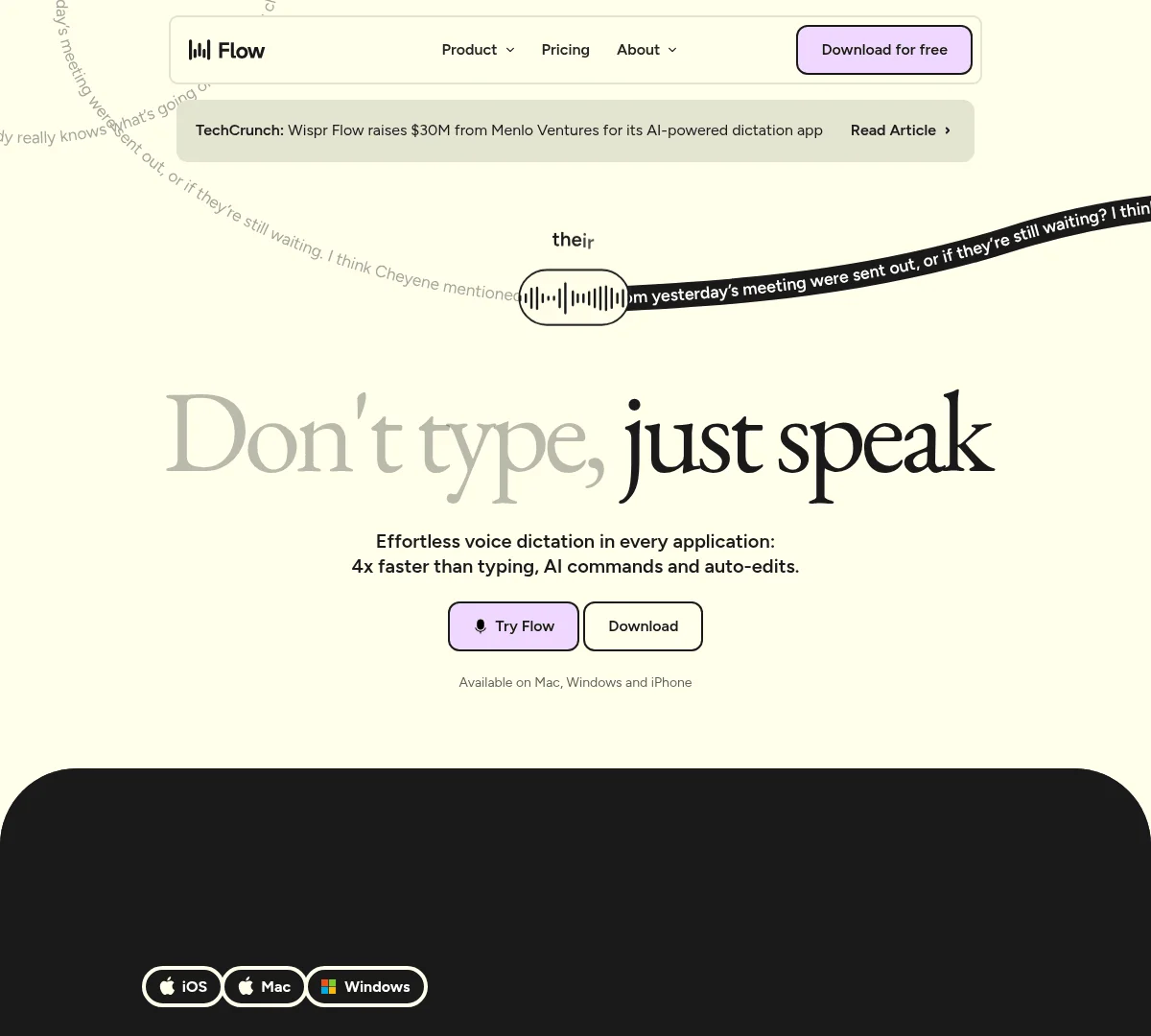
Wispr Flow, a developer of an AI-powered dictation application, announced a $30 million Series A funding round. The company's software application transcribes speech into text. The round was led by Menlo Ventures. Participating investors included NEA, 8VC, Opal CEO Kenneth Schlenker, Pinterest founder Evan Sharp, Carta CEO Henry Ward, and Lindy CEO Flo Crivelli. Menlo Ventures' Matt Kraning, a previous angel investor, will join the company's board. This brings Wispr Flow's total funding to $56 million.
The global AI-powered dictation software market is experiencing significant growth, although precise market size projections for 2030 were unavailable from the source material. Wispr Flow launched a Mac application in October 2024, followed by Windows and iOS versions in March and June 2025, respectively. The company reports 50% month-over-month user growth. Currently, 40% of its users are located in the U.S., with the remaining 60% distributed across Europe and other regions. Over 30% of users lack a technical background. The application supports dictation in 104 languages, with English accounting for 40% of usage. Spanish, French, German, Dutch, Hindi, and Mandarin are among the other top languages used.
Wispr Flow plans to use the funding to expand its 18-person team, focusing on engineering and go-to-market roles. Further development includes an Android app release and enterprise-focused features such as company-wide phrase context and dedicated support teams. The company is also exploring integration with AI hardware partners to enhance the user interaction layer. The company aims to evolve its application into a more comprehensive AI-powered assistant capable of handling tasks such as messaging, note-taking, and reminders.
Competitors include Granola, an AI-powered note-taking application, and other voice AI applications such as Read AI and Fireflies AI, which focus on meeting transcription and collaboration tools.
"Wispr Flow is creating an efficient way to translate digital thoughts and intent. The app captures users’ speech and what they want to convey very well. The team has thought about how people speak while developing models rather than focusing on things like word error rates," commented Matt Kraning, Partner at Menlo Ventures.