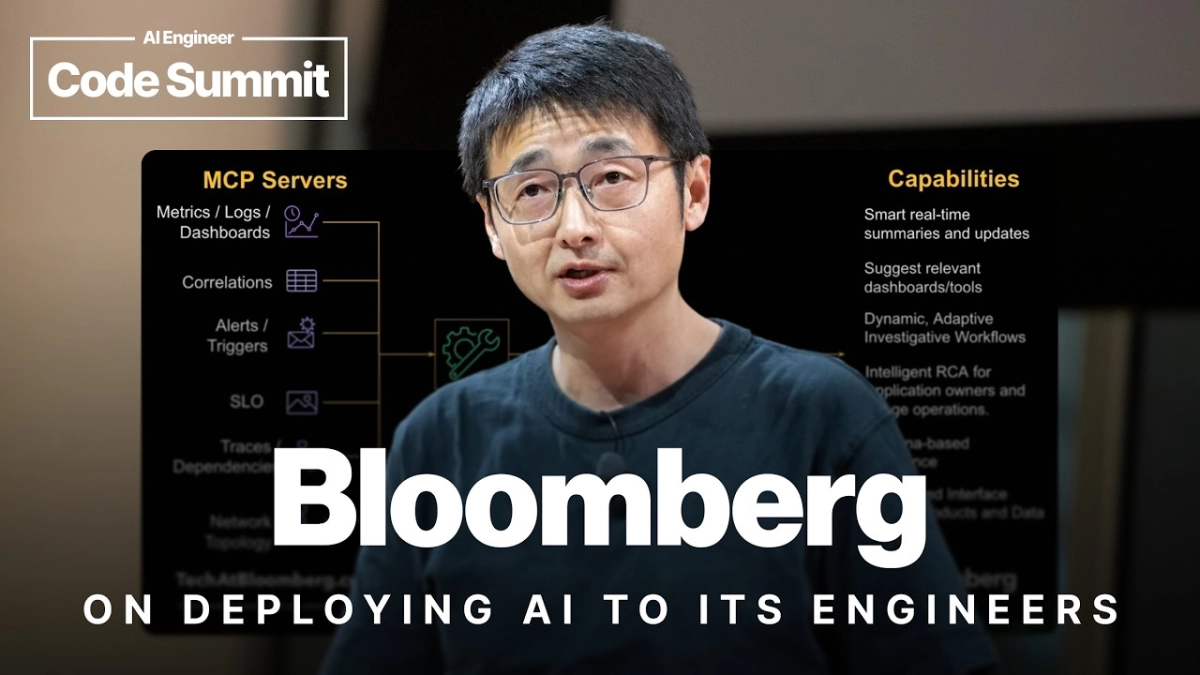
"The reality of applying AI at scale inside a mature engineering organization is far more complex and nuanced," stated Lei Zhang, Head of Technology Infrastructure Engineering at Bloomberg, during a recent discussion. Zhang, speaking about Bloomberg’s extensive experience integrating AI into the workflows of over 9,000 software engineers, offered a candid look at the practical challenges and profound lessons learned, moving beyond the initial "demo magic" to the sustained integration of artificial intelligence. This conversation, a vital exploration for anyone navigating the practical deployment of AI in enterprise settings, underscored that the true return on investment often lies not in the flashy generative capabilities, but in the subtle, systemic enhancements to existing processes.
Zhang's presentation detailed Bloomberg's year-long journey, a period marked by a deliberate shift from theoretical possibilities to concrete applications. The initial allure of AI, particularly large language models (LLMs) capable of generating code, is undeniable. Countless studies have showcased the potential for dramatic productivity gains by transforming requirements directly into executable code. However, Zhang emphasized that this initial excitement, while valid, represents only a fraction of the AI integration puzzle within a large, established entity like Bloomberg. The real work, he explained, involves embedding AI into the daily routines of a vast engineering workforce, demanding a more robust and carefully considered approach.
A core insight from Zhang's presentation is the realization that the most significant value of AI within a large engineering organization often emerges not from entirely novel code generation, but from augmenting and improving existing, often mundane, engineering tasks. This involves a careful examination of where AI can provide the most impactful, albeit less glamorous, assistance. For instance, automating code reviews, identifying potential security vulnerabilities earlier in the development cycle, or providing intelligent assistance for debugging can yield substantial benefits. These are not the headline-grabbing feats of AI writing entire applications, but rather the steady, incremental improvements that accumulate to drive significant efficiency and quality gains across thousands of engineers.
Enabling AI across such a vast and established organization requires more than just technological prowess; it necessitates a profound cultural shift. Zhang highlighted the importance of fostering an environment where engineers are not only receptive to AI tools but actively encouraged to explore and adopt them. This involves comprehensive training, clear communication about the purpose and limitations of AI, and the establishment of robust feedback loops. The goal is to move from a top-down mandate to a bottom-up adoption, where engineers see AI as a valuable partner rather than a disruptive force.
One of the most critical lessons learned by Bloomberg pertains to the establishment of guardrails and best practices. In an environment with a large number of users and a high volume of sensitive data, security, privacy, and ethical considerations are paramount. Zhang stressed the need for a multi-layered approach to governance, ensuring that AI tools are used responsibly and that the integrity of Bloomberg's systems is maintained. This includes rigorous testing, continuous monitoring, and clear policies outlining acceptable use cases and data handling protocols.
The journey at Bloomberg demonstrates that the successful deployment of AI is a marathon, not a sprint. It requires a deep understanding of the existing organizational structure, a willingness to adapt and iterate, and a commitment to building trust among the engineering community. The initial "wow" factor of AI's capabilities must be tempered with a pragmatic approach that prioritizes sustainable integration, cultural buy-in, and robust governance. The true ROI, as Zhang so clearly articulated, is found in the sustained, systemic improvements AI can bring to the intricate tapestry of modern software development.