

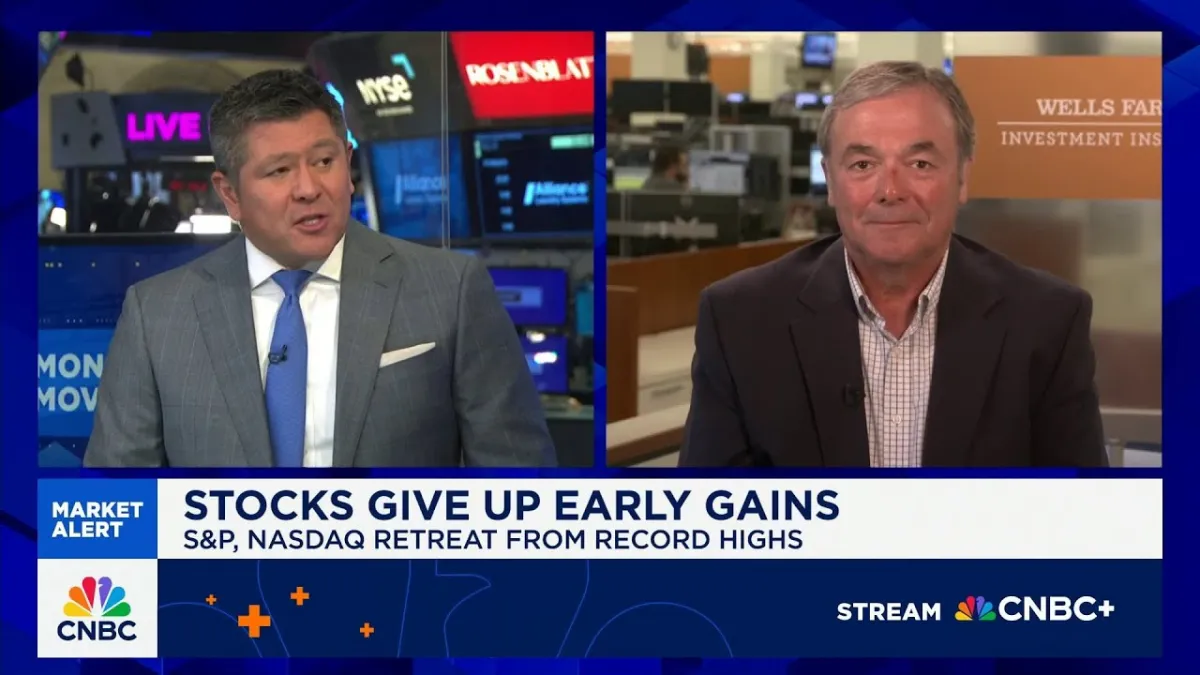
"We want to continue to lean into the AI play," stated Scott Wren, Senior Global Market Strategist at Wells Fargo Investment Institute, articulating a prevailing sentiment among institutional investors navigating the burgeoning artificial intelligence landscape. Wren, appearing on CNBC's "Money Movers," provided a nuanced perspective on the current market outlook, emphasizing both the enduring potential of AI and the strategic imperative for diversification amidst rising risks and slowing momentum. His insights offer a critical lens for founders, venture capitalists, and AI professionals assessing the broader economic currents shaping the tech sector's future.
Wren's discussion with CNBC highlighted Wells Fargo's strategic adjustments, moving beyond a singular focus on traditional tech to embrace a broader interpretation of AI's impact. While maintaining an overweight position in the technology sector, the institute has begun trimming exposure in areas like Communication Services and small-cap stocks, which they perceive as fully valued after significant runs. This move reflects a cautious optimism, acknowledging the market's current highs while preparing for potential pullbacks.
The core insight underpinning Wells Fargo's strategy is a recognition that market momentum, while still positive, is showing signs of deceleration. Wren pointed to an increasing dispersion in stocks, suggesting that broad-based gains are becoming less common. This environment necessitates a more selective approach, favoring sectors that stand to benefit from the indirect effects of AI adoption rather than just the direct beneficiaries. "The risks of a pullback… not a 5% pullback that can happen on noise, but something a little bit bigger, they've increased," Wren observed, underscoring the need for prudent portfolio management.
This diversification extends to what Wren calls "looking at AI in a different way." The firm has rotated capital into sectors such as Industrials and Utilities. These sectors, while not typically considered frontline AI innovators, are expected to be significant consumers and integrators of AI technologies, driving demand for infrastructure, automation, and efficiency solutions. Financials also remain a most overweighted sector, reflecting confidence in its resilience and potential for technology-driven transformation.
A pivotal element for sustained market growth, according to Wren, lies in the "AI CapEx conversation." He stressed the importance of companies not only maintaining but increasing their capital expenditures related to AI. This spending, encompassing everything from advanced computing hardware to specialized software and data center infrastructure, is the lifeblood of the AI ecosystem. Without robust CapEx, the transformative potential of AI risks remaining theoretical rather than translating into tangible economic growth and sustained market appreciation.
Wren’s perspective on earnings season further clarified the market's current dynamics. He noted that while Q1 and Q2 earnings significantly surpassed expectations, leading to the market's upward trajectory, future beats will need to be substantial to continue driving prices higher. For an analyst, he explained, "all this is is a confirmation process." This suggests that current valuations already bake in a certain level of positive performance, and only truly exceptional results or unexpected increases in AI-related investment will provide fresh impetus.
The current economic backdrop, characterized by decent growth and inflation under control, provides a supportive foundation for stocks. However, the market's sensitivity to AI CapEx announcements signals a maturing phase in the AI investment cycle. Investors are moving beyond speculative bets on pure-play AI companies to scrutinize how established industries are integrating and leveraging AI to enhance productivity and profitability. This shift demands that companies clearly articulate their AI investment strategies and demonstrate tangible returns.
For leaders in the startup ecosystem and venture capital, Wren's commentary serves as a signal to broaden their horizons beyond direct AI development. Opportunities are increasingly emerging in companies that facilitate AI adoption in traditional sectors, provide the necessary infrastructure, or develop specialized applications that solve real-world problems in industries like manufacturing, energy, and finance. The emphasis on "good CapEx spending" means that startups and their investors must demonstrate not just innovation, but also a clear path to scalable implementation and return on investment for enterprise clients.
Ultimately, while Wells Fargo remains committed to the AI theme, their strategy underscores a growing emphasis on disciplined investment and diversification. The market's future, particularly for AI-driven gains, hinges not just on technological breakthroughs, but on the sustained capital commitment of corporations to integrate these innovations across the broader economy. This pragmatic outlook suggests that while the AI revolution is far from over, the next phase of growth will reward strategic deployment and demonstrated value.



