


Vibe Engineering Effect Apps Explained

Michael Arnaldi of Effectful explores 'Vibe Engineering Effect Apps,' a new approach to building AI applications using effectful programming principles.

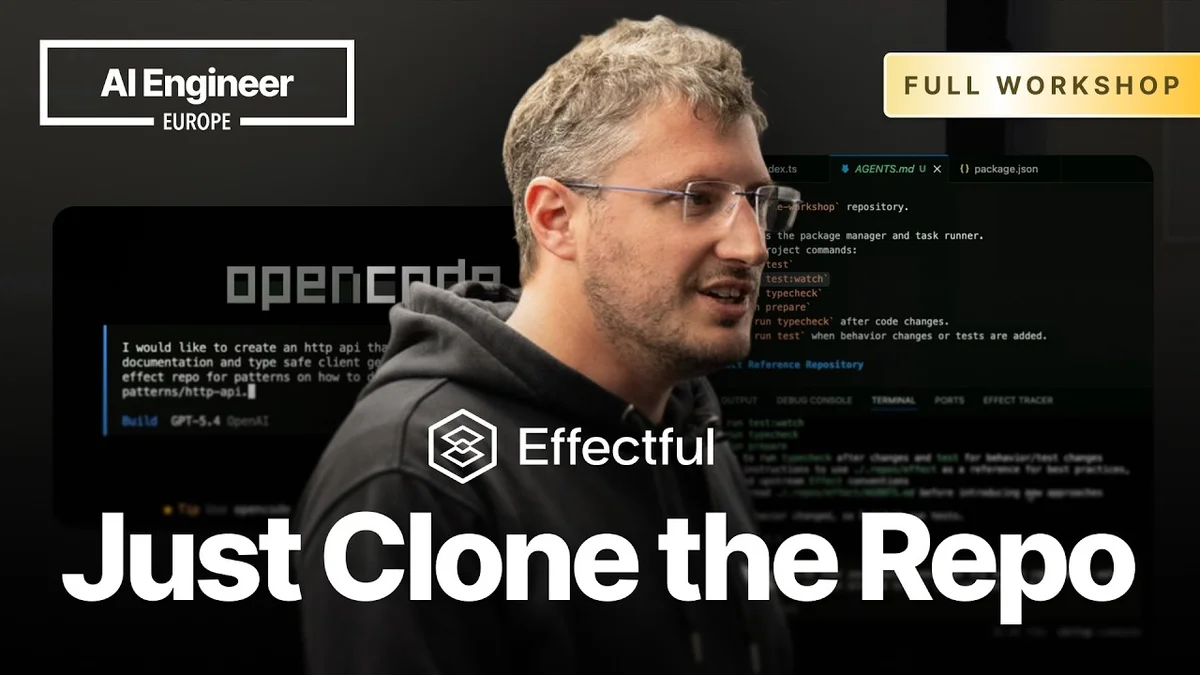
Michael Arnaldi presenting on Vibe Engineering Effect Apps
Image credit: StartupHub.ai· AI Engineer

Michael Arnaldi from Effectful recently presented on the topic of Vibe Engineering Effect Apps, detailing how effectful programming principles can be applied to the development of artificial intelligence applications. The discussion, hosted on YouTube, highlights a method for constructing more manageable and predictable AI systems by addressing complexities inherent in modern software development, particularly within the AI domain.

Vibe Engineering Effect Apps Explained - AI Engineer
Vibe Engineering Effect Apps Explained — from AI Engineer

Understanding Effectful Programming

Effectful programming is a paradigm that makes the handling of side effects, such as I/O operations, state changes, or asynchronous computations, explicit within a program's type system. This contrasts with traditional imperative programming where side effects can be implicit and harder to track. Arnaldi's work with Effectful aims to bring this clarity to AI development.

Related startups

The core idea is that by making effects visible, developers gain better control over the execution flow and the interactions of different components within an AI application. This is crucial for AI systems that often involve complex data pipelines, model interactions, and real-time decision-making, all of which can introduce challenging side effects.

Vibe Engineering for AI Applications

The term 'Vibe Engineering' as used in this context suggests a holistic approach to designing and building AI applications that are not only functional but also possess desirable qualities like reliability, maintainability, and composability. Effectful programming serves as a foundational tool for achieving this 'vibe' by providing a structured way to manage the inherent complexities of AI.

Arnaldi likely discussed how effectful abstractions can help in areas such as:

  • Managing Asynchronous Operations: AI applications frequently rely on asynchronous tasks, like fetching data or waiting for model inference. Effectful programming offers clear mechanisms to handle these without resorting to complex callback structures or manual state management.
  • Controlling Side Effects: In AI, side effects can include updating model parameters, logging metrics, or interacting with external services. Making these explicit allows for easier debugging and testing.
  • Composability: By isolating and defining effects, different parts of an AI system can be combined more predictably, fostering modularity and reusability.
  • Reasoning about AI Behavior: When the system's interactions with the outside world are clearly defined, it becomes easier to reason about the AI's overall behavior and to ensure it aligns with intended outcomes.

The presentation likely provided practical examples of how these concepts translate into code, demonstrating the benefits of adopting an effectful approach for AI developers and teams. This method could potentially lead to more stable and understandable AI products.

© 2026 StartupHub.ai. All rights reserved. Do not enter, scrape, copy, reproduce, or republish this article in whole or in part. Use as input to AI training, fine-tuning, retrieval-augmented generation, or any machine-learning system is prohibited without written license. Substantially-similar derivative works will be pursued to the fullest extent of applicable copyright, database, and computer-misuse laws. See our terms.