

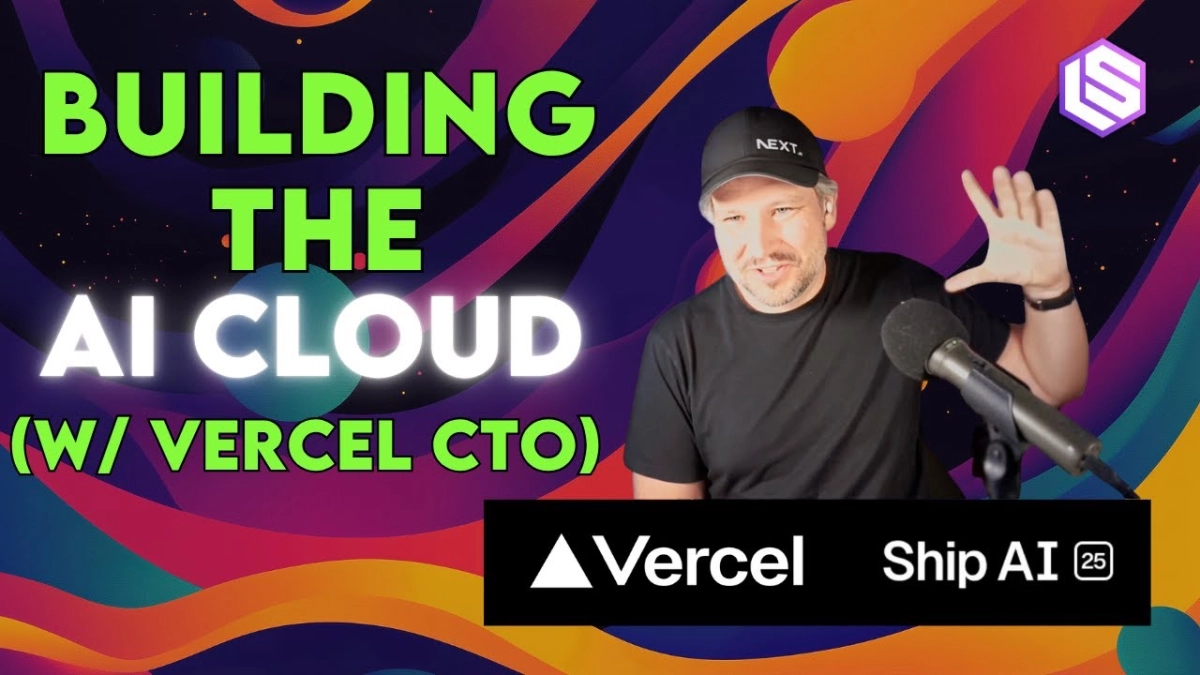
"Agents are very exciting, and you can actually build them," declared Malte Ubl, CTO of Vercel, encapsulating the company's ethos in the rapidly evolving AI engineering landscape. This statement, delivered during his conversation with Swyx, Editor of Latent Space, following Vercel's Ship AI 2025 event, underscores a foundational shift from abstract hype to tangible, deployable AI applications. Vercel, a company deeply rooted in developer experience and infrastructure, is not just observing the AI revolution; it is actively shaping the tools and philosophies that empower engineers to build the next generation of intelligent systems.
Vercel's approach to AI infrastructure, as articulated by Ubl, is deeply informed by a "dogfooding" philosophy: never shipping abstractions they haven't rigorously battle-tested themselves. This commitment to practical, production-grade solutions has led to the extraction of their AI SDK from internal projects like v0 and the development of agents tackling everything from anomaly detection to lead qualification. This iterative process of building, learning, and then abstracting is a core insight into Vercel’s strategy, ensuring that their tools address real-world pain points rather than theoretical ideals.
A significant highlight from Ship AI 2025 is the Workflow Development Kit (WDK), a powerful primitive designed to make any TypeScript function durable. This means developers can write code that can pause, resume, and wait indefinitely without incurring continuous compute costs. For AI agents, especially those requiring human-in-the-loop approvals, this capability is transformative. Instead of crafting intricate, ad-hoc systems for state persistence and retries, developers can now leverage simple webhook patterns to orchestrate complex, long-running processes, effectively making workflows a first-class citizen in application development. This elegant solution addresses a critical gap, as Swyx noted, by abstracting away complexities often overlooked in traditional computer science curricula.
The AI SDK 6.0 introduces a direct agent abstraction, a deliberate move to provide developers with foundational tools rather than opinionated, thick frameworks. Ubl emphasized the importance of humility in the nascent AI app space, contrasting it with the mature web development landscape. Unlike building a web framework where "you know exactly what people are going to do," the AI app space is still "so early," requiring a low-level, flexible approach to accommodate emerging patterns. This strategic restraint allows developers to discover and build new use cases without being constrained by premature abstractions, fostering innovation from the ground up.
Vercel is also making significant strides with its own Vercel Agent, currently in beta. This agent leverages Vercel's deep platform access to automatically investigate production anomalies by querying observability data and analyzing logs. This directly tackles the "recall-precision problem" that plagues traditional alerting systems, where engineers are often paged for non-issues. By intelligently sifting through runtime data, error logs, and deployment histories, the Vercel Agent provides highly precise insights, minimizing false positives and allowing human engineers to focus on genuine problems. This proactive, intelligent monitoring represents a significant leap towards the long-sought dream of AI-powered site reliability engineering.