

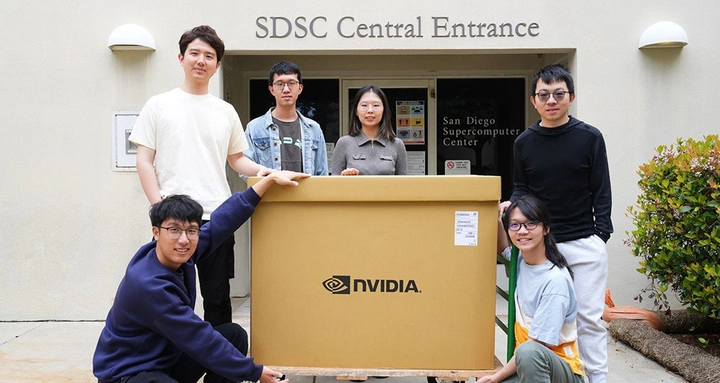
The University of California San Diego's Hao AI Lab recently acquired an NVIDIA DGX B200 system, a move poised to significantly accelerate research into low-latency LLM serving. This powerful new hardware will enable the lab to push the boundaries of large language model inference, directly impacting how quickly and efficiently generative AI can respond to user requests. The Hao AI Lab is no stranger to this domain; its foundational research, including DistServe, has already shaped production LLM inference platforms like NVIDIA Dynamo.
A core contribution from the Hao AI Lab is the concept of "goodput," a critical metric for evaluating LLM serving performance. Historically, systems focused solely on "throughput," measuring tokens generated per second across the entire system. While high throughput reduces token generation cost, it often comes at the expense of user-perceived latency, creating a fundamental trade-off. Goodput, however, measures throughput while strictly adhering to user-specified latency objectives, ensuring both efficiency and a quality user experience.
This shift to goodput acknowledges that for many real-world applications, a fast, consistent response is paramount, even if it means a slight reduction in raw aggregate token output. For users interacting with chatbots, coding assistants, or creative tools, the delay between prompt and first token is a make-or-break factor. Optimizing for goodput means developers can build more responsive and satisfying AI experiences without sacrificing economic viability.
Disaggregated Inference: The Key to Real-time LLMs
Achieving optimal goodput hinges on a technique called prefill/decode disaggregation. Traditionally, the prefill phase (processing user input to generate the first token) and the decode phase (generating subsequent output tokens) ran concurrently on the same GPU. This created resource contention, as prefill is compute-intensive and decode is memory-intensive. By splitting these tasks onto different sets of GPUs, the Hao AI Lab researchers found they could eliminate interference, allowing both processes to run faster.
This disaggregated approach fundamentally improves the responsiveness of LLM serving. By dedicating specific hardware resources to each phase, systems can scale workloads continuously without compromising on low-latency or the quality of model responses. NVIDIA Dynamo, an open-source framework, directly leverages this disaggregated inference method, making it accessible for developers aiming to build highly efficient and responsive generative AI applications. The DGX B200 system now empowers the Hao AI Lab to further refine these techniques, exploring the next generation of real-time LLM capabilities.