

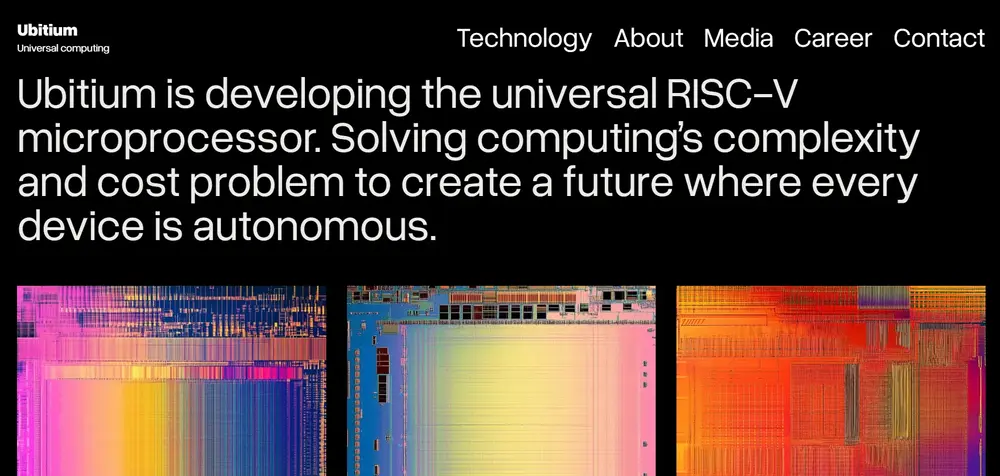
Ubitium, a German hardware startup founded by semiconductor experts, has raised $3.7 million in seed funding to develop a universal RISC-V processor. It eliminates the need for specialized chips, enabling advanced AI in embedded systems without additional costs.
Ubitium’s innovation challenges the 57-year-old industry reliance on specialized processors by introducing a universal chip capable of handling diverse computing workloads, including CPU, GPU, DSP, and FPGA tasks, within a single architecture. This approach reduces complexity and cost while providing advanced AI capabilities, revolutionizing system architectures across industries.
The startup was founded by CTO Martin Vorbach, who has over 200 semiconductor patents and pioneered workload-agnostic microarchitecture. Drawing on his experience in reconfigurable computing, Vorbach’s design allows transistors to be reused for various tasks, eliminating the need for multiple specialized cores. CEO Hyun Shin Cho, with extensive experience in industrial sectors, joined Vorbach to commercialize this groundbreaking technology. Chairman Peter Weber, a seasoned veteran of Intel, Texas Instruments, and Dialog Semiconductor, completes the leadership team.
"We envision a future where every device operates autonomously, making intelligent decisions in real time and transforming the way we interact with technology," said Shin Cho.
Ubitium aims to make advanced computing accessible across industries by targeting the embedded systems and robotics markets initially. Its universal processor design simplifies development, reduces costs, and accelerates time-to-market, allowing companies to focus on software rather than complex hardware integrations. The scalable architecture also enables customers to deploy solutions ranging from small devices to high-performance computing systems without modifying their development processes.