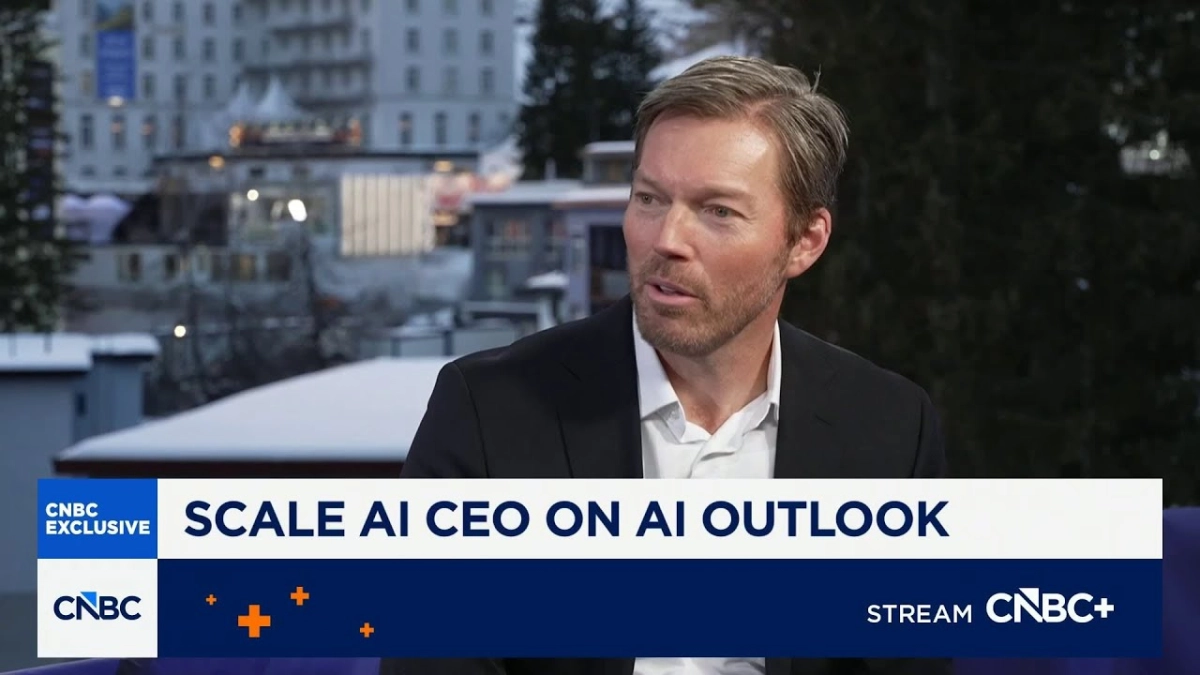
“It will become very clear in the next 12 months who’s actually delivering value, what kind of use cases there are.” This declaration from Scale AI CEO Jason Droege cuts through the pervasive exuberance currently dominating the artificial intelligence sector. While the conversation around generative AI often feels like a speculative frenzy centered on consumer-facing models, Droege, speaking with CNBC’s Sara Eisen at the World Economic Forum in Davos, emphasized that the real economic value is being built in the trenches of enterprise infrastructure, where reliability and measurable outcomes supersede hype. Scale AI, a foundational player in data infrastructure for AI, is positioned at this critical intersection, and their recent financial performance reflects a maturation of the market toward tangible, mission-critical applications.
Droege confirmed that 2023 was a landmark year for the company, highlighting the nuts and bolts of the AI infrastructure business, which is experiencing booming demand. He noted that Scale AI’s total new bookings for the year exceeded a billion dollars, with "more than half of that came in Q4." Importantly, he stressed that the fourth quarter was not only their largest revenue quarter ever but also their most profitable. These figures provide a quantitative counterpoint to the prevailing narrative of high burn rates and unproven business models common among highly valued AI startups. For Scale AI, the demand for reliable data and robust infrastructure—the foundational elements that allow advanced models to function effectively—is translating directly into substantial, profitable growth.
Scale AI’s success, Droege explained, stems from its ability to solve highly specific, complex problems for customers in sectors where failure is not an option. The company recently announced major new clients including BP, Mayo Clinic, and Allianz, adding to an already formidable roster that includes the U.S. Department of Defense. This client composition underscores a key insight: enterprise and government adoption demands a level of technical rigor and trust far exceeding consumer expectations. Droege pointed out that the bar for adopting AI within an enterprise environment is “much higher than for a consumer.” This isn't about novelty; it's about embedding AI into core operational processes, logistics, and decision-making where precision is paramount.
The challenge for enterprise AI, as Droege sees it, is selecting the right problems for the technology to tackle. Often, companies are tempted to apply AI to their most difficult business challenges, which may not be technically solvable yet. Scale AI’s approach is highly consultative, working directly with customers to identify problems that are not only high-value but also genuinely amenable to AI solutions. This requires deep collaboration and subject- matter expertise. Droege stated that they go on-site with teams that have been working with these models for years, focusing on “the problems that AI can actually solve, rather than just any old problem.” This disciplined focus on deliverable value is what separates infrastructure providers like Scale AI from the model builders who often generate significant excitement without immediate, scalable commercial viability.
In the defense sector, for example, Scale AI is moving beyond its initial work in data labeling—the necessary foundation for training models—into building applications for operational planning and logistics. These processes within the Department of Defense are traditionally manual, expensive, and slow. By leveraging AI to assist in complex logistical operations, Scale AI is demonstrating how machine learning can deliver critical efficiencies and strategic advantages, far removed from the general-purpose chat applications that dominate public discussion. This work highlights Scale AI's strategic positioning as a provider of AI applications and services built on top of the underlying data infrastructure.
Addressing the widespread discussion of an "AI bubble," Droege offered a nuanced perspective, agreeing that there are many promises about AI's capabilities that are currently not being delivered. He suggested that many providers are struggling to deliver real value despite ample funding. This year, however, is set to be a crucial inflection point. Droege predicted that 2024 will see the “wheat and the chaff separate.” The pressure on companies to demonstrate quantifiable returns on their massive AI investments will intensify, forcing a market reassessment based on performance rather than potential. This shift favors firms that, like Scale AI, have concentrated on building reliable, agnostic infrastructure capable of servicing diverse, high-stakes customers across both the commercial and national security sectors.