

For the last three decades, the internet’s front door was built for you. Search engines like Google were designed for human eyeballs, human questions, and human clicks. That era is officially over. The web is now being fundamentally rearchitected for a new user: autonomous AI agents. And according to a new piece by Andreessen Horowitz (a16z), this shift is igniting a new search war, fought not on homepages but in the invisible world of APIs.
The problem is that the human-centric web is a terrible place for an AI, argues a16z's Jason Cui (Partner) and Steph Zhang. It’s a minefield of SEO-optimized listicles, pop-up ads, and sponsored content, what the report calls "garbage." For an AI agent tasked with finding clean, accurate information, today's web is a costly, inefficient mess. Trying to build intelligent systems on top of it is like trying to build a skyscraper on a swamp.
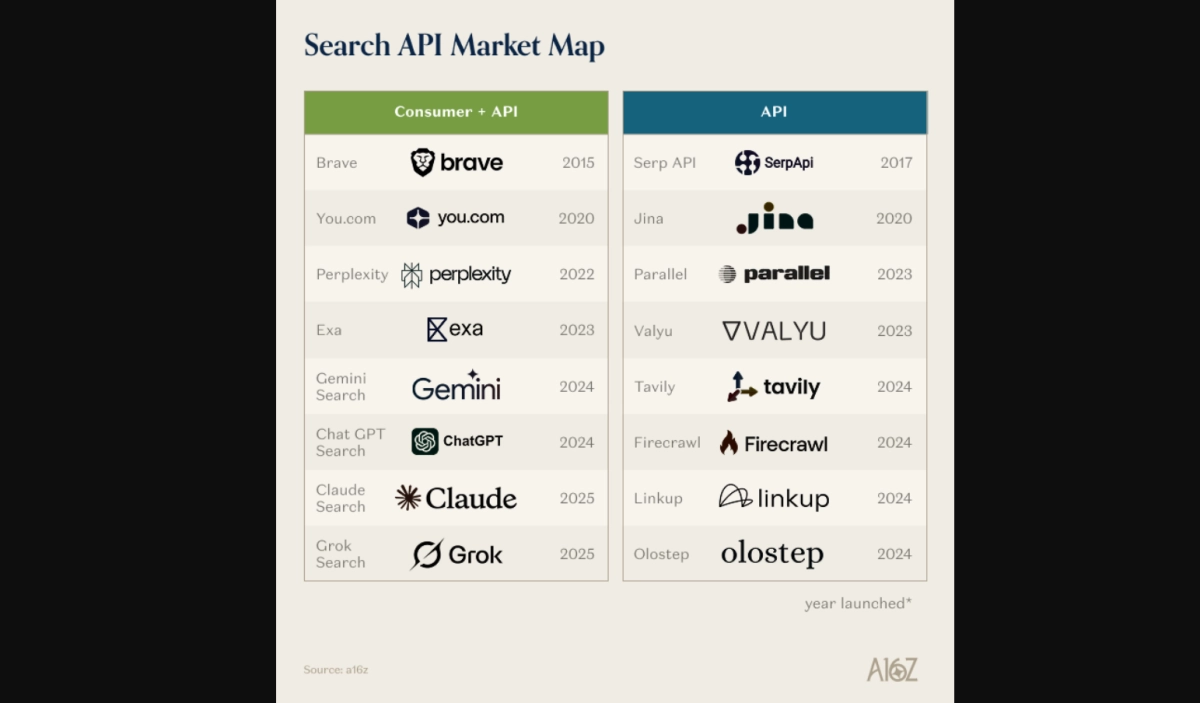
This has created a massive opportunity for a new wave of startups that are building an "AI-native" search layer from the ground up. Unlike the search wars of the '90s, which pitted consumer portals like Yahoo and Excite against each other, this new battle is largely between API providers. Companies are increasingly outsourcing their search needs to specialists who can provide clean, token-efficient data ready to be plugged directly into an LLM.
The New Arms Race is an API Race
The playing field is already crowded with startups taking wildly different approaches to indexing the web for machines. Some, like Exa and Parallel, are taking an infrastructure-heavy approach, deploying massive GPU clusters to continuously crawl and re-index petabytes of data for maximum freshness and coverage. Their goal is to build a comprehensive, real-time mirror of the web, optimized for AI reasoning.
Others, like Tavily and Valyu, are making a strategic trade-off to save on compute costs. They use reinforcement learning models to intelligently decide when a page needs to be re-crawled. A static blog post might be ignored for months, while a dynamic e-commerce site could be updated hourly. It’s a bet that they can maintain sufficient accuracy on the most relevant parts of the web without boiling the entire digital ocean.