


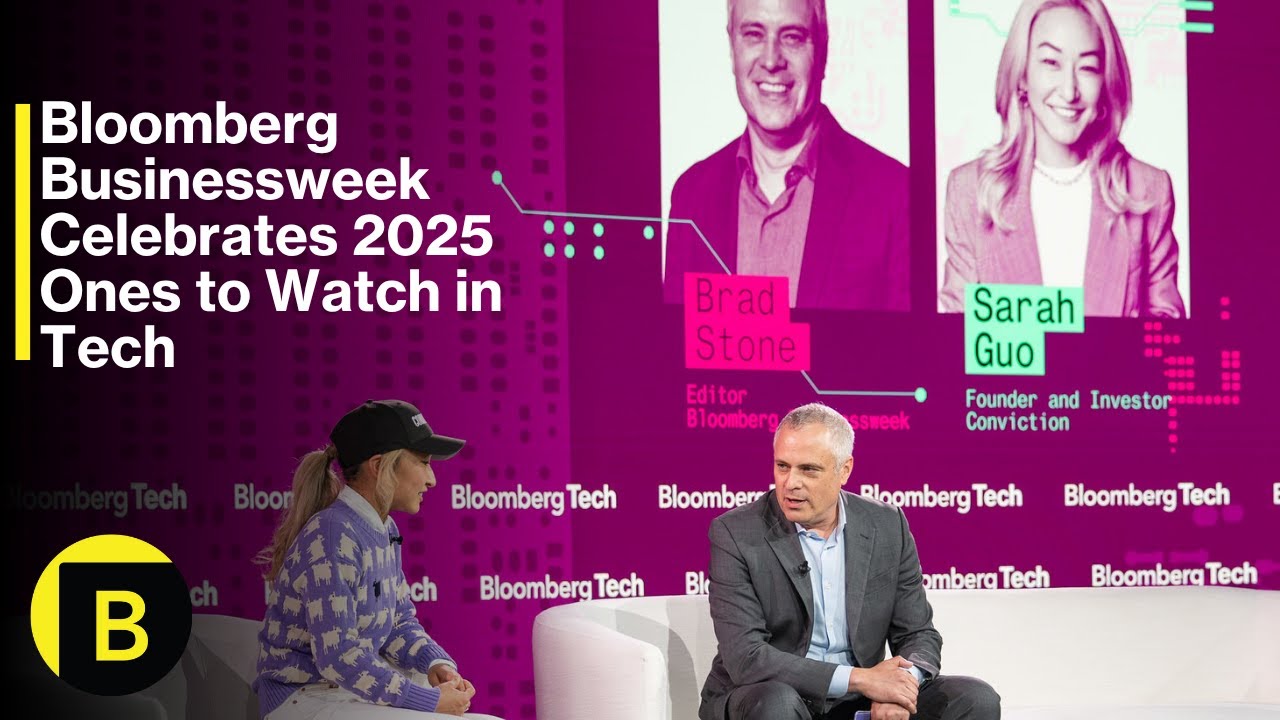
“We are in an age where software, the ability to deliver like 80% of the product you want, is becoming more and more commoditized,” declared Sarah Guo, founder and investor at Conviction, setting a stark, yet profoundly insightful, tone for the discussion. This wasn't merely an observation but a foundational insight into the evolving landscape of technology. Guo, a prominent voice in the venture capital world and co-host of the "No Priors" podcast, joined Brad Stone, Editor of Bloomberg Businessweek, at Bloomberg Tech to dissect the future of AI, venture capital, and the elusive quality of "taste" that will define success in a rapidly commoditizing tech sphere. Their conversation offered a refreshingly grounded perspective, cutting through the hype to reveal the underlying currents shaping the next wave of innovation.
Guo’s recent post on the importance of taste was a central theme, highlighting it as "a decision-making accelerant, the relentless, almost painful ability to know what should exist, what shouldn't, and where quality matters." This timeless sentiment, Stone noted, holds particular resonance in the age of AI. Guo elaborated, explaining that when the baseline of product delivery becomes easily achievable through readily available software and AI tools, the true differentiator lies in the subjective, almost artistic, understanding of what truly matters to a user. The distinction between delivering "80% and 99%" of a product is where human judgment, discernment, and an innate sense of quality become paramount. This isn't about doing *more*, but about knowing what *should* be done, a critical insight for founders grappling with the paradox of abundant generative capabilities.
While many prognosticators, including some referenced earlier in the Bloomberg Tech event, voice concerns about mass job displacement due to AI, Guo maintained a staunchly optimistic outlook. "How sad would it be to work on something this hard that I'm not optimistic about?" she quipped, emphasizing the inherent belief required to navigate the high-stakes world of venture. Her optimism stems from a historical perspective: "Technology overall has been the driver to more abundance and productivity in the economy." She sees the current acceleration of product adoption as unprecedented, stating, "Faster than I've ever seen in my investing and operating career... I've never seen products adopted so fast." This rapid uptake, she believes, is a testament to the immense value creation happening, estimating we are only "one or two percent in." Despite acknowledging the "scary" pace of change and the potential for disruption, particularly in how certain tasks will be valued, she firmly believes that "every other technological revolution in history has just created new jobs." The shift, then, isn't a total reduction in demand, but a re-allocation of human effort towards new, higher-value tasks, driven by AI’s ability to "help your people do more with less."
This rapid evolution also fundamentally alters the venture capital landscape. Stone pointed out that traditional metrics for success, like achieving 3x, then 2x, then 2x growth in annual recurring revenue, are no longer sufficient. "That is not at all true now," Guo asserted, highlighting that some companies are experiencing "50x" growth. This hyper-growth environment means that investors, particularly smaller funds like Conviction (which has raised around $345 million), must adapt their strategies. Rather than simply chasing traditional revenue milestones, the focus shifts to identifying "category winners" – companies poised to dominate nascent, high-growth sectors. The sheer volume of capital flooding the market, with "more money continuing to flow into venture," means that capital itself is becoming commoditized. For early-stage companies, it's less about the size of the check and more about the strategic value and access an investor provides. "Entrepreneurs aren't looking at capital as a commodity," Guo explained. "All you need is access and you need to be right." This underscores a critical truth for founders: choose your partners wisely, not just for their cash, but for their conviction and unique insights.
The conversation naturally drifted to the future of AI interfaces and devices. The recent hiring of Fiji Simo, a seasoned advertising executive from Meta and Instacart, by OpenAI, sparked a curious line of questioning from Stone. He mused whether this signaled a pivot towards advertising as a revenue model for AI, moving beyond the current subscription-heavy landscape. Guo's partner, Mike Vernal, an early Facebook and Meta VP, "believes really strongly in the advertising business model as a democratizing function," she shared. While she couldn't confirm OpenAI's internal debates, she noted that advertising could indeed be a way to democratize access to powerful AI services for a broader global audience who might not afford high subscription fees. Beyond business models, the discussion turned to the physical manifestation of AI. With Apple design guru Jony Ive now involved with OpenAI on a new AI-centric hardware device, the implications are profound. Guo believes the current phone form factor is insufficient for truly pervasive AI. "You need reasons to have new IO," she stressed, highlighting the limitations of current devices in continuous listening or comprehensive context gathering. The future, she mused, might involve "a pin or a set of glasses," devices designed from the ground up for seamless, always-on AI interaction, fundamentally changing the "hardware spec."
Ultimately, Guo’s optimism for AI is deeply personal, rooted in her experience as a parent. "I have young kids," she said, revealing a profound motivation. "I think more people are creators of different kinds than we give them credit for in today's world." She envisions a future where AI dramatically lowers the barrier to creation, allowing anyone to generate "images, writing, video, voice, music," and even "personalized stories for my kids." This ability to "come up with their own narratives" and "just be creative" through accessible AI tools is, for Guo, "really compelling." It promises a world where human ingenuity is amplified, not replaced, by technology. As she concluded, the quality of AI output is already so good that it will "keep them more creative over time." This vision of democratized creativity, where human imagination is unshackled by AI, offers a powerful and hopeful counter-narrative to the prevailing anxieties, suggesting that the true revolution lies not just in what AI can do, but in what it empowers us to become.

