

A US deep-tech startup, Tiiny AI, has officially unveiled what it claims is the world’s smallest personal AI supercomputer, the Pocket Lab, verified by Guinness World Records. The device is designed to run large language models (LLMs) with up to 120 billion parameters entirely on-device, completely bypassing the need for cloud connectivity, servers, or expensive, power-hungry GPUs.
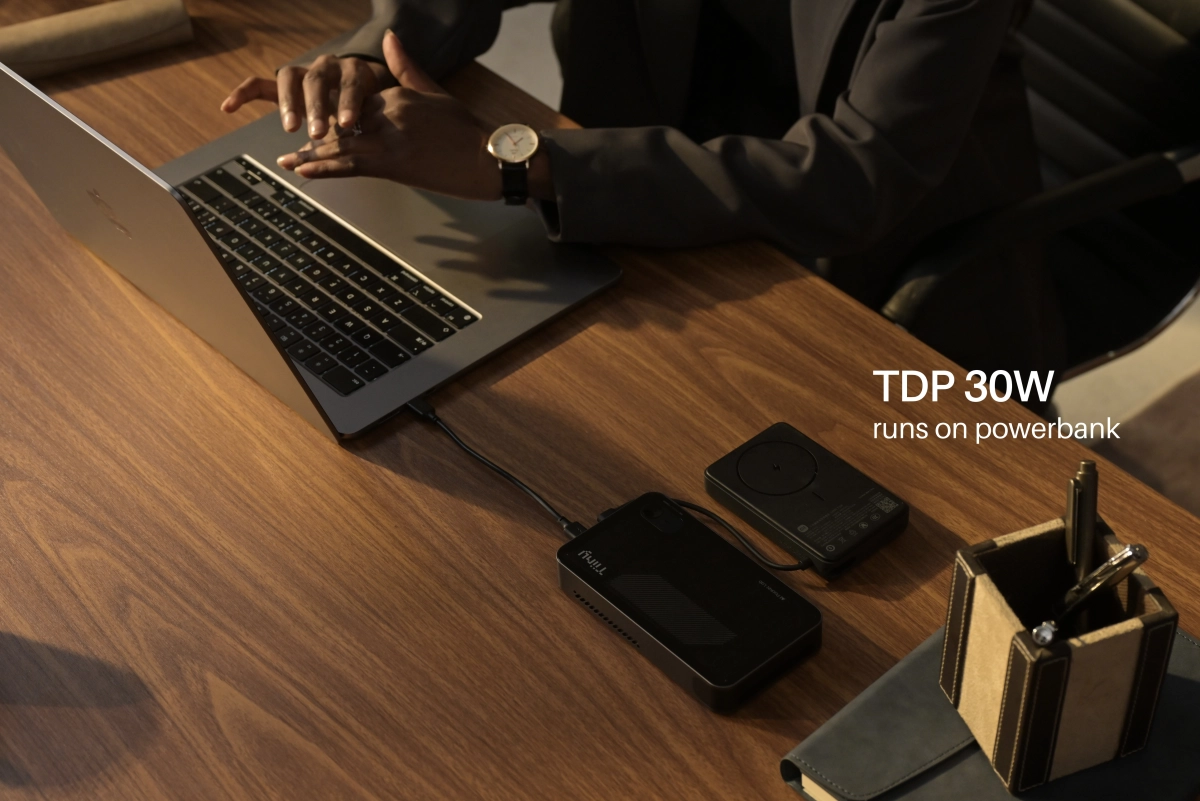
The announcement, made in Hong Kong, represents a direct challenge to the prevailing cloud-centric AI ecosystem dominated by OpenAI and Google. The Pocket Lab is pocket-sized (14.2 × 8 × 2.53 cm) and operates within a 65W power envelope, aiming to solve the growing issues of privacy, sustainability, and rising energy costs associated with massive data centers.
Tiiny AI is betting that the real future of advanced intelligence is personal and private. “Cloud AI has brought remarkable progress, but it also created dependency, vulnerability, and sustainability challenges,” said Samar Bhoj, GTM Director of Tiiny AI. The company argues that intelligence should belong to the individual, not the data center, positioning the Pocket Lab as the first step toward truly accessible and private AI.
The device is built to handle the ‘golden zone’ of personal AI, models between 10B and 100B parameters, which Tiiny AI claims satisfies over 80 percent of real-world needs. By scaling up to 120B parameters, the Pocket Lab promises intelligence levels comparable to GPT-4o, enabling PhD-level reasoning, multi-step analysis, and deep contextual understanding, all while keeping sensitive data secure and offline.
The Technology Making Offline LLMs Possible
Achieving server-grade LLM performance on a device weighing only 300g required two core technological breakthroughs. The first is TurboSparse, a neuron-level sparse activation technique designed to significantly improve inference efficiency without sacrificing model intelligence.