

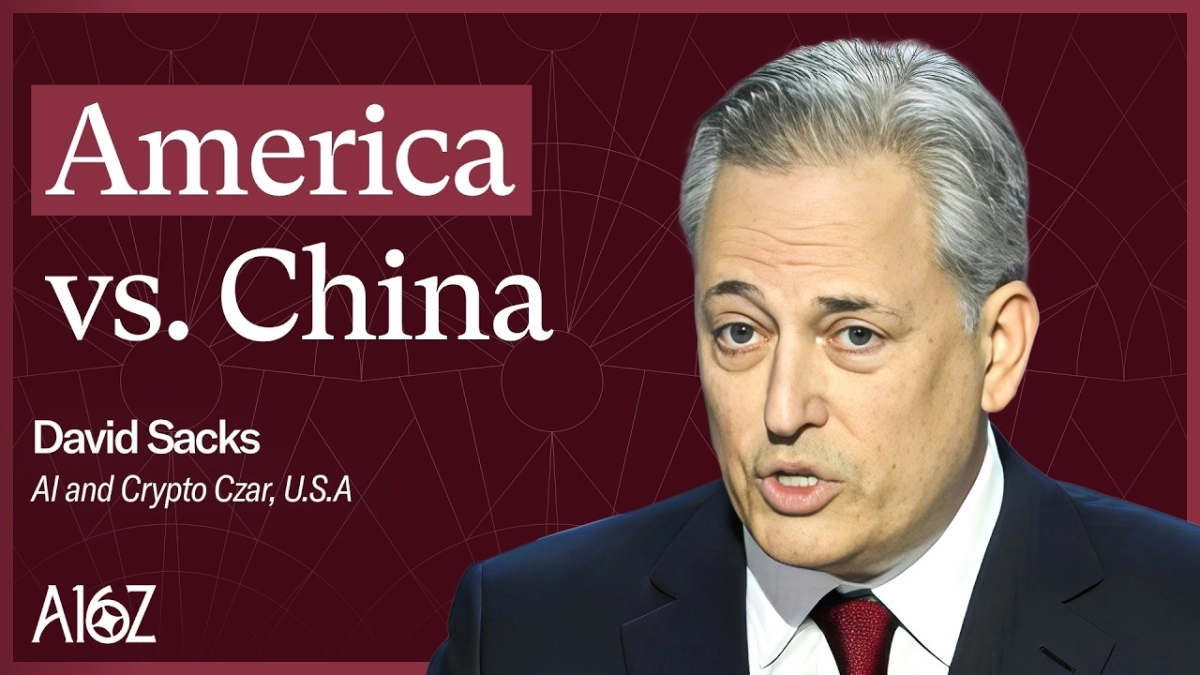
"What we're really talking about is Orwellian AI." This stark warning from David Sacks, the self-proclaimed White House AI and Crypto Czar, cuts through the typical tech discourse, laying bare the profound ideological struggle shaping the future of artificial intelligence. Speaking on the a16z podcast alongside Marc Andreessen, Ben Horowitz, and Erik Torenberg, Sacks offered a candid, often provocative, commentary on the divergent paths the United States and other global powers are charting for these foundational technologies. The conversation illuminated a critical juncture where policy choices risk either unleashing unprecedented innovation or entrenching a stifling, centralized control.
Sacks’s perspective hinges on a fundamental contrast in regulatory philosophies. He highlights Europe's approach to AI, which he characterizes as defining "AI leadership" primarily through the imposition of regulations. This mindset, he suggests, prioritizes control and standardization from the outset. In the U.S., a similar, albeit domestically driven, divergence is evident in the Biden administration's handling of emerging technologies. For crypto, Sacks states, the previous administration adopted "regulation through enforcement," which effectively drove the industry offshore due to a lack of clear rules. This punitive, opaque strategy, he argues, deprived America of a burgeoning industry. Conversely, former President Trump's stated goal is to provide clear regulatory certainty, aiming to establish the U.S. as the global crypto capital.
The implications of such regulatory approaches are particularly acute in the nascent AI landscape. Marc Andreessen sharply pointed out a worrying trend: "in AI, we've seen very like interesting kind of calls coming from inside the house with certain companies really going for regulatory capture." This critical observation underscores a key insight: established players with early leads are actively lobbying for regulations that create high barriers to entry, effectively stifling competition and innovation from smaller, agile startups. This dynamic threatens the very "permissionless innovation" that has historically fueled Silicon Valley's success.
The consequences of this regulatory capture, Sacks warns, extend far beyond economic competition. He views the pervasive fear-mongering around AI, often portraying it as an existential threat, as a calculated strategy to justify heavy-handed government control. This, he argues, leads directly to "Orwellian AI," a future where algorithms are imbued with ideological biases, capable of censoring information, distorting reality, and even rewriting history in real-time. Such a centralized, state-controlled AI would represent an unprecedented tool for surveillance and societal manipulation, a risk far more tangible than hypothetical superintelligence scenarios.
Against this backdrop of potential centralization and control, open-source AI emerges as a vital bulwark for freedom and innovation. Sacks champions open source as a mechanism to democratize access to powerful AI models, ensuring that development remains distributed and transparent rather than concentrated in the hands of a few corporations or governments. This distributed, competitive environment is essential for rapid innovation and serves as a natural defense against the regulatory capture playbook. It fosters a vibrant ecosystem where diverse voices can contribute and scrutinize AI development, preventing the insidious creep of ideological control and promoting software freedom.