

The Pitfalls of Instance-Based Computing in AI Training

The Pitfalls of Instance-Based Computing in AI Training

Instance-based cloud computing is complex, expensive and slow — the entire data science community knows this. What you might not know is that two out of three AI models currently fail to make it into production as a result of these issues. There are huge engineering efforts, time and friction associated with it because of issues surrounding GPU size and quality.

In addition to this, numerous personnel are required to complete a training task. These must be extremely skilled people, such experts in MLOps, DevOps, SecOps and FinOps, who are notoriously difficult to find and expensive to recruit.

To add insult to injury, running AI training workloads on cloud instances incurs expenses based on usage duration. Without careful monitoring and optimization, data scientists risk exceeding budgetary constraints, leading to unexpected cost overruns and project delays.

Related startups

I could go on and on listing hundreds more issues associated with instance-based training but, if you’re a member of the data science community, you’ll know them all too well So, if you’re struggling to overcome the barriers to AI training, you’re not alone.

VMWare for AI training

When it was founded in 1998, VMWare tackled one of the largest IT issues of its day and transformed the industry through virtualization. With this, multiple virtual machines (VMs) are able to run on the same physical server, sharing resources such as networking and RAM. This signified a huge turning point in the IT industry, enabling the cloud computing that we rely on today.

Compare this to where we are today with AI training. Data scientists are facing many similar challenges to IT professionals back in the early 1990s. Unfortunately, you cannot virtualize a GPU. But, with swarm computing, you can virtualize the workload.

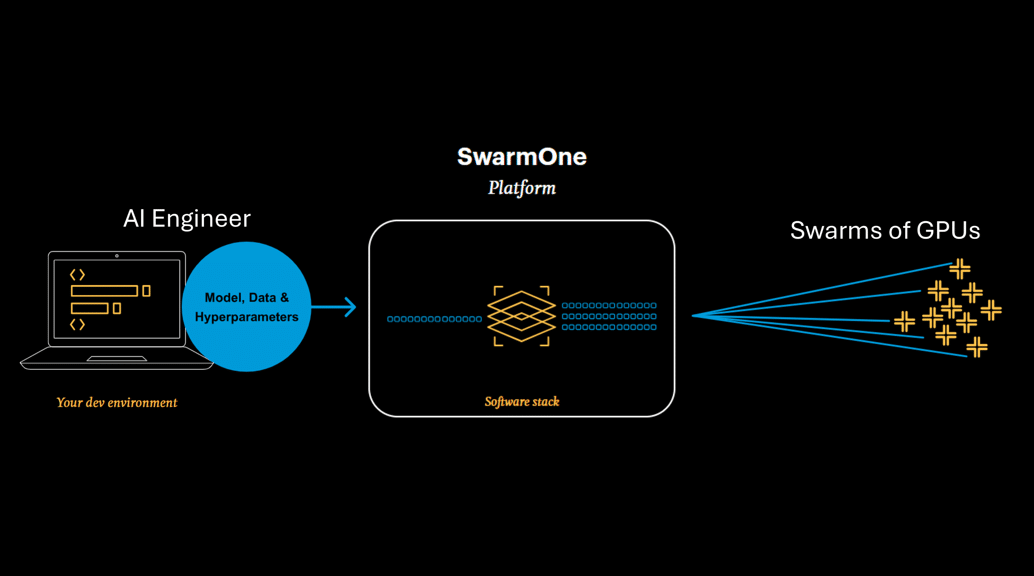
With just two lines of code, SwarmOne, the world’s first swarm computing platform, abstracts away all the engineering tasks in AI training, providing a revolutionary instance-less software stack that automatically allocates AI model training tasks across a swarm of GPUs, which are located across our network of data centres.

This means that data scientists are no longer required to set up and manage GPU instances, and their dependence on DevOps, MLOps, SecOps and FinOps is dramatically reduced. They can train right from their computational notebook after adding just two lines of code, completely removing any compatibility issues previously faced.

Importantly, the data scientist will know the cost of their project before they submit it, which means no more surprise cost overruns. Overall, swarm computing means that the user can focus on what they do best — the data science.

Just like VMWare radically changed the industry all of those years ago, swarm computing it set to revolutionize the way that AI training is carried out. At SwarmOne, we’re aware that you might need convincing that instance-less computing offers everything that we say it does. If you’d like to find out more, you can visit the SwarmOne, and even request a free demo.

Sponsored content disclosure: This article contains sponsored content. Our editorial standards remain paramount — opinions, analysis, and conclusions are independent and were not dictated by the sponsor. We accept compensation for distribution and promotion, never for editorial direction. See our partner program for how sponsorships work.

© 2024 StartupHub.ai. All rights reserved. Do not enter, scrape, copy, reproduce, or republish this article in whole or in part. Use as input to AI training, fine-tuning, retrieval-augmented generation, or any machine-learning system is prohibited without written license. Substantially-similar derivative works will be pursued to the fullest extent of applicable copyright, database, and computer-misuse laws. See our terms.