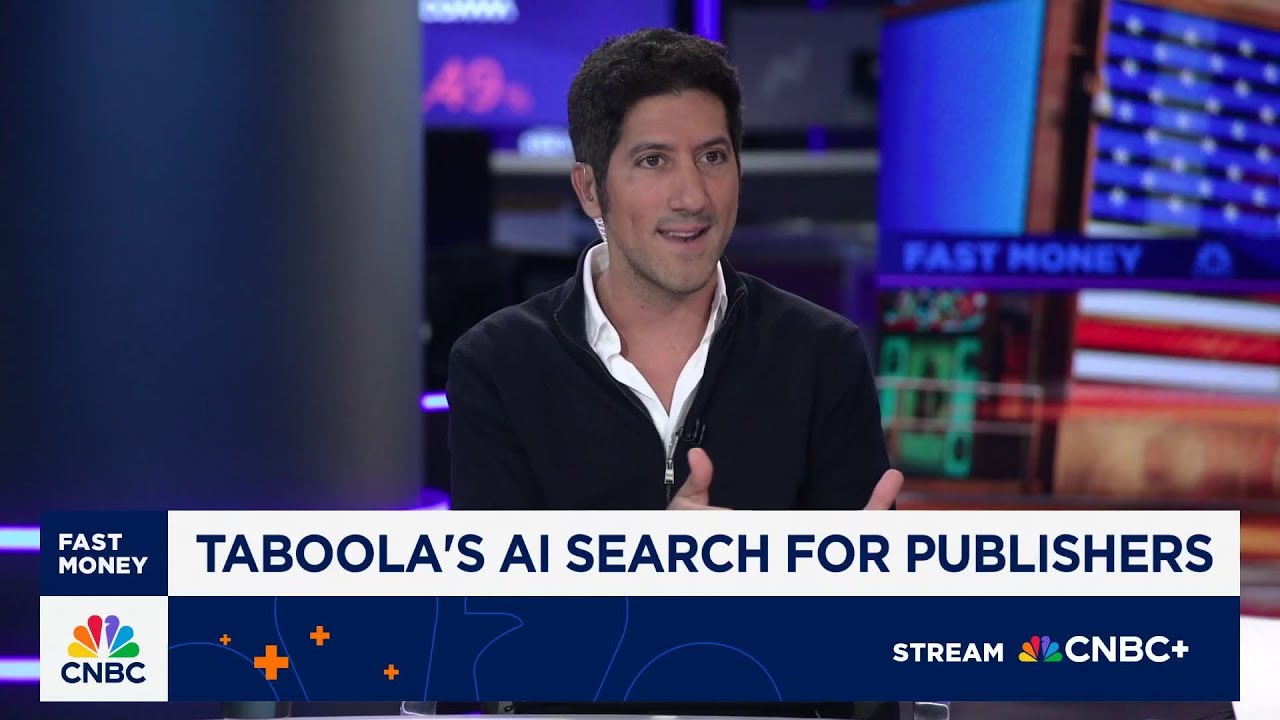
The rise of generative AI has presented the publishing industry with a stark dichotomy: a powerful new tool for content discovery, yet one that often disintermediates creators from their audience and revenue. This tension was at the heart of the discussion when Adam Singolda, Founder and CEO of Taboola, recently spoke with the hosts of CNBC's Fast Money. Singolda unveiled Taboola's latest innovation, DeeperDive, positioning it as a generative AI search engine designed not to replace, but to empower publishers by integrating AI directly onto their sites.
Singolda articulated three primary challenges posed by the current landscape of AI search. First, he highlighted what he termed the "simplexity" of leading generative AI models. These platforms tend to offer concise, summarized answers that, while convenient, often lack the depth and nuance required for informed decision-making. "You get this short summarization of my question," Singolda explained, suggesting that such brevity creates a "new generation of a chamber box," one that may be "too simple" for complex queries. This superficiality inherently disincentivizes users from seeking further information on original publisher sites, undermining deep engagement.
The second, more contentious issue, is the perceived "stealing of content from publisher sites" without compensation or traffic referral. Singolda characterized this as a "short-term strategy," questioning, "How long can they take publishers' content and just not compensate the industry for that?" This concern echoes growing sentiments across the publishing world, with recent legal actions and public statements from major media entities like NewsCorp and Disney underscoring the industry's demand for fair value exchange. The current model, where AI models ingest vast amounts of copyrighted material to train their systems without direct remuneration to the creators, is fundamentally unsustainable for the open web.
This on-site integration is a game-changer. It keeps readers within the publisher's ecosystem, allowing them to engage more deeply with content and, significantly, enabling publishers to monetize that engagement through advertising or subscriptions. Singolda provided a compelling example: "If I want to have a conversation about a trip to Cancun with my kids... and I know the travel section of USA Today is awesome. Today I can't do it. But what if I can just say I have three kids, seven, five, and three, that's what my wife loves, what should I do? And I get the answer similar to Perplexity, but I also get a deeper dive." This approach transforms passive information consumption into an interactive, value-driven journey on the publisher's own property.
The historical precedent of Facebook's Instant Articles, which initially hosted publisher content directly within the social media feed before publishers withdrew due to lack of traffic and revenue, serves as a cautionary tale. Singolda believes that "history will repeat itself" in the generative AI space. Publishers, he contends, will eventually reach a breaking point, demanding either fair compensation for their content or direct traffic referrals. The alternative, he warned, is that they will simply "get lost" from the AI aggregators. Taboola's DeeperDive offers a proactive solution, allowing publishers to embrace AI as a tool for deeper user engagement and a new revenue engine, rather than a threat to their very existence.