


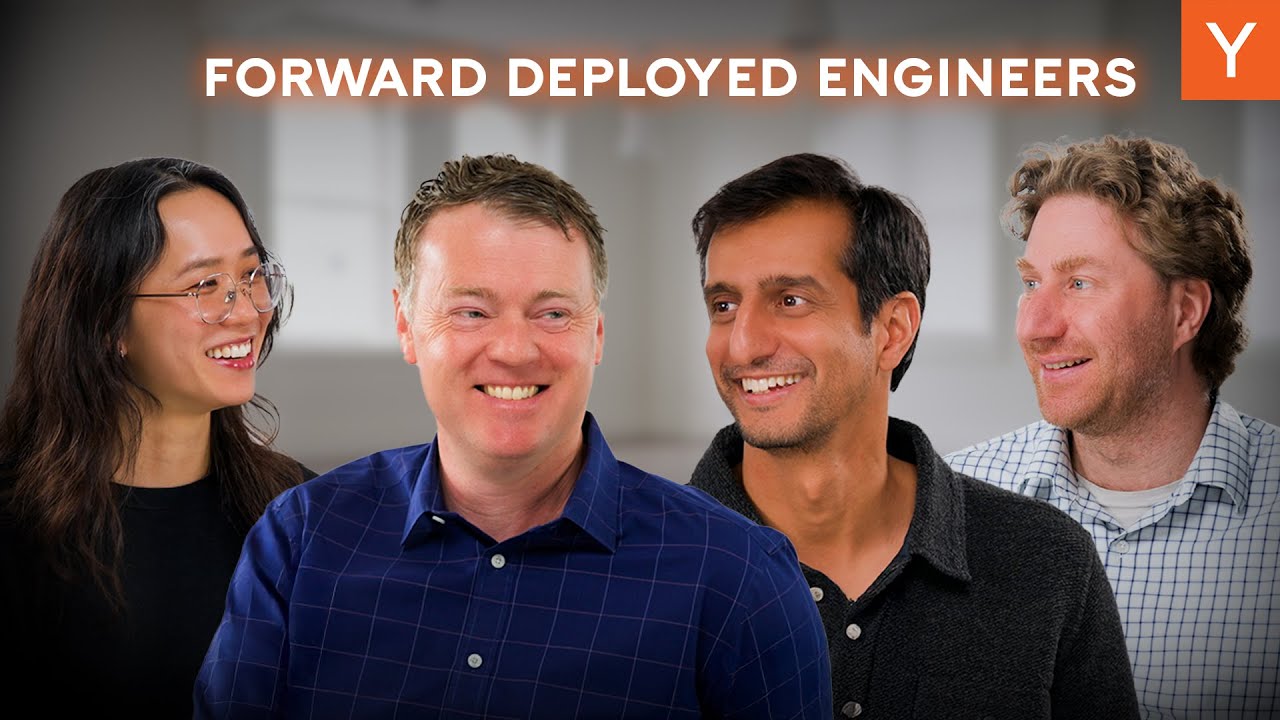
The resurgence of the Forward Deployed Engineer (FDE) model, once a niche strategy pioneered by Palantir, is now at the epicenter of the AI startup boom. Bob McGrew, a veteran of PayPal and Palantir, and former Chief Research Officer at OpenAI, recently joined Y Combinator partners Harj Taggar, Jared Friedman, and Diana Hu on The Lightcone podcast to unpack this pivotal shift, revealing how a bespoke approach to customer engagement has become essential for navigating the uncharted territories of AI product development. Their conversation illuminated why this intensely hands-on methodology, often misconstrued as mere consulting, is proving indispensable for today's AI innovators.
At its core, a Forward Deployed Engineer is a technically proficient individual embedded at the customer's site. Their primary function, as McGrew explains, is to "fill the gap between what the product does and what the customer needs." This isn't about selling an off-the-shelf solution; it's about actively discovering and building the solution alongside the client.
The FDE model's genesis at Palantir provides crucial context. When building software for intelligence agencies, Palantir faced a unique challenge: their users (spies) couldn't articulate their needs directly, nor would they disclose their work processes. This necessitated an unconventional approach. Palantir engineers had to build rudimentary demos, present them, solicit feedback, and iterate rapidly. McGrew vividly recalls a founder showing a demo to intelligence agents, receiving the blunt assessment, "This is terrible. This isn't related to what we do at all." Instead of retreating, the founder asked, "How would you like it to be different?" This direct, iterative feedback loop, where engineers were physically present and actively coding, became the bedrock of Palantir's FDE strategy.
This methodology, often summarized as "doing things that don't scale at scale," is fundamental. In traditional product development, companies strive for "product-market fit," where a scalable product meets a broad market need. Once achieved, the focus shifts to scaling sales and standardizing customer interaction. However, the FDE model thrives in the "product discovery" phase, where the problem itself is ill-defined, and the solution is nascent. For AI agents, especially, there is often "no incumbent product," meaning the market is wide open for discovery, not just optimization.
The FDE team structure at Palantir was divided into "Echo Teams" and "Delta Teams." Echo Teams comprised domain experts, often former military officers or healthcare professionals, who served as embedded analysts and account managers. They understood the customer's world and identified key problems. Delta Teams were the deployed engineers themselves – rapid prototypers who "ate a lot of pain," quickly translating complex, often vague requirements into functional software. These Delta engineers were not "craftsmen" obsessed with perfect, long-term maintainable code from day one, but rather pragmatists focused on immediate delivery and problem-solving, even if it meant temporary, "rough and ready code."
The FDE model effectively turns product discovery into a core function of deployment. FDEs build "gravel roads" – custom solutions for specific customer needs – which the central product and engineering teams then generalize into "paved superhighways" – scalable platform features. This generalization is critical to avoid the "consulting trap," where a company becomes a bespoke service provider rather than a software product company. The internal product team's discipline in abstracting these individual solutions into reusable components is paramount.
For AI startups, this approach is more relevant than ever. The generative nature of AI agents means their capabilities are broad, but their specific applications for complex enterprise problems are often unarticulated. "There's so much product discovery to do," McGrew emphasizes, and this discovery can only happen through deep, hands-on immersion within the customer's environment. This "land and expand" strategy, focusing on high-value contracts and continually identifying new, impactful problems within an organization, is driving the current AI boom. Founders are increasingly recognizing that relying solely on traditional sales and distant product development simply won't suffice in this nascent, rapidly evolving market.

