

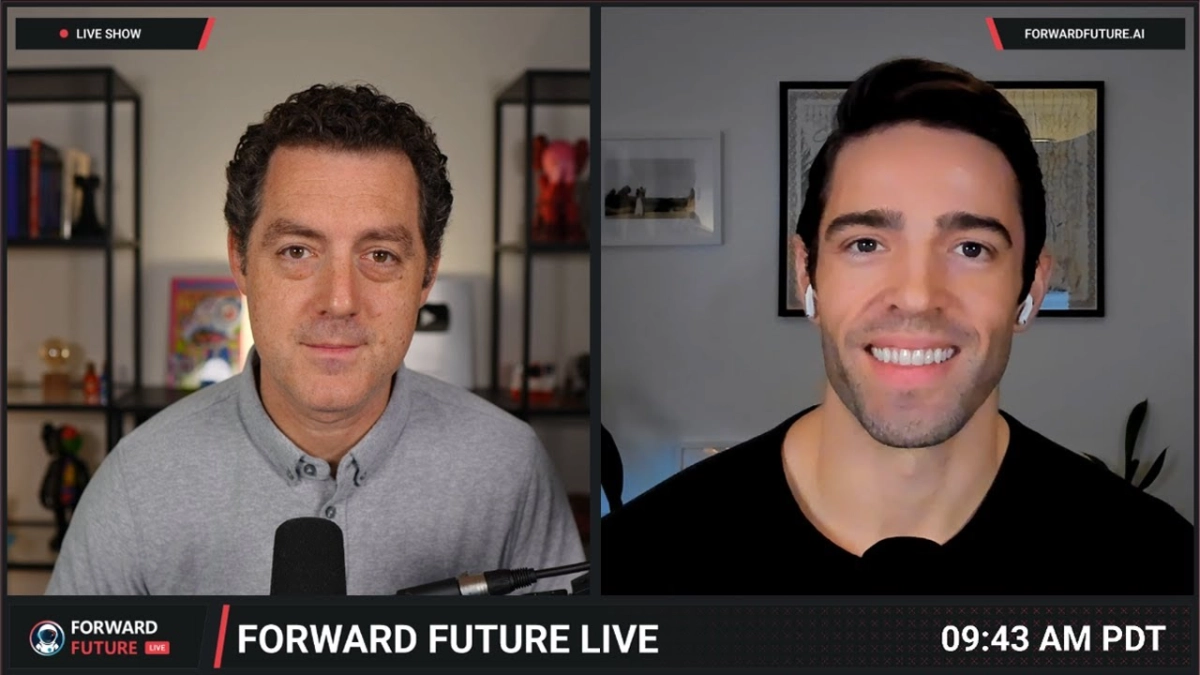
The current trajectory of artificial intelligence, marked by unprecedented scale and emergent capabilities, remains fundamentally rooted in a "brute force era." This stark assessment, offered by Doug O'Laughlin, President of SemiAnalysis, set a pragmatic tone for a recent panel discussion on the future of AI. The conversation, featuring luminaries from Google, DeepMind, and Robinhood, peeled back the layers of hype to reveal the intricate challenges and profound opportunities facing founders, VCs, and tech leaders today.
Matthew Berman, host of Forward Future Live, spoke with Doug O'Laughlin, Koray Kavukcuoglu (Chief AI Architect at Google), Logan Kilpatrick (Group Product Manager at Google DeepMind), and Abhishek Fatehpuria (Vice President of Product at Robinhood) at the Forward Future Live event, delving into the architectural demands, evolutionary leaps, and real-world product integration of advanced AI. Their collective insights painted a picture of an industry grappling with immense computational requirements while simultaneously pushing the boundaries of what AI can achieve across diverse applications.
O'Laughlin elaborated on the foundational issue of scaling, highlighting the astronomical costs associated with both training and inference for today's large language models. This economic reality dictates that while capabilities are expanding, the underlying infrastructure still relies heavily on sheer computational power, driving a relentless demand for more efficient silicon and novel architectural designs. For startups, this implies that competing on raw model size alone is increasingly untenable; innovation in efficiency, rather than just brute-force scale, will be paramount for sustainable growth and differentiation. Without a significant paradigm shift, the barriers to entry for developing truly frontier models remain prohibitively high, concentrating power and resources among a few well-resourced giants. This dynamic shapes investment strategies, favoring those who can extract maximum utility from existing models or pioneer more efficient architectures.
Counterbalancing the hardware-centric view, Koray Kavukcuoglu from Google illuminated the transformative shift from mere "models" to sophisticated "agents." He underscored the accelerating pace at which these AI systems are transcending single-modality tasks, evolving to understand and generate across text, image, audio, and video. "The models are becoming more and more capable, and they're becoming more and more multi-modal," Kavukcuoglu stated, emphasizing that this evolution paves the way for AI to act as an intelligent co-pilot across virtually every professional and personal domain. This vision suggests a future where AI does not just answer queries or generate content, but actively participates in complex workflows, anticipating needs, executing multi-step tasks, and even learning from its environment. This shift from passive tool to active collaborator represents a significant leap in AI's potential impact on productivity and innovation.
The journey from cutting-edge research to tangible, impactful products was a recurring theme, particularly articulated by Logan Kilpatrick of Google DeepMind and Abhishek Fatehpuria of Robinhood. Kilpatrick stressed the critical importance of user feedback in refining AI applications.
He noted that the true test of an AI's utility lies in its interaction with real users, stating, "It's all about getting it into users' hands and iterating." This iterative process, far from being a mere afterthought, is central to discovering emergent behaviors, identifying unforeseen limitations, and ultimately shaping a user experience that is both effective and safe.
Abhishek Fatehpuria provided a crucial perspective from the front lines of consumer product integration at Robinhood. He articulated how AI is not just an add-on feature but a fundamental re-architecture of product experiences, from personalized financial advice to enhanced customer support. "AI is going to change every single product experience," he affirmed, highlighting the profound impact across content generation, risk management, and user engagement. However, he also tempered this enthusiasm



