

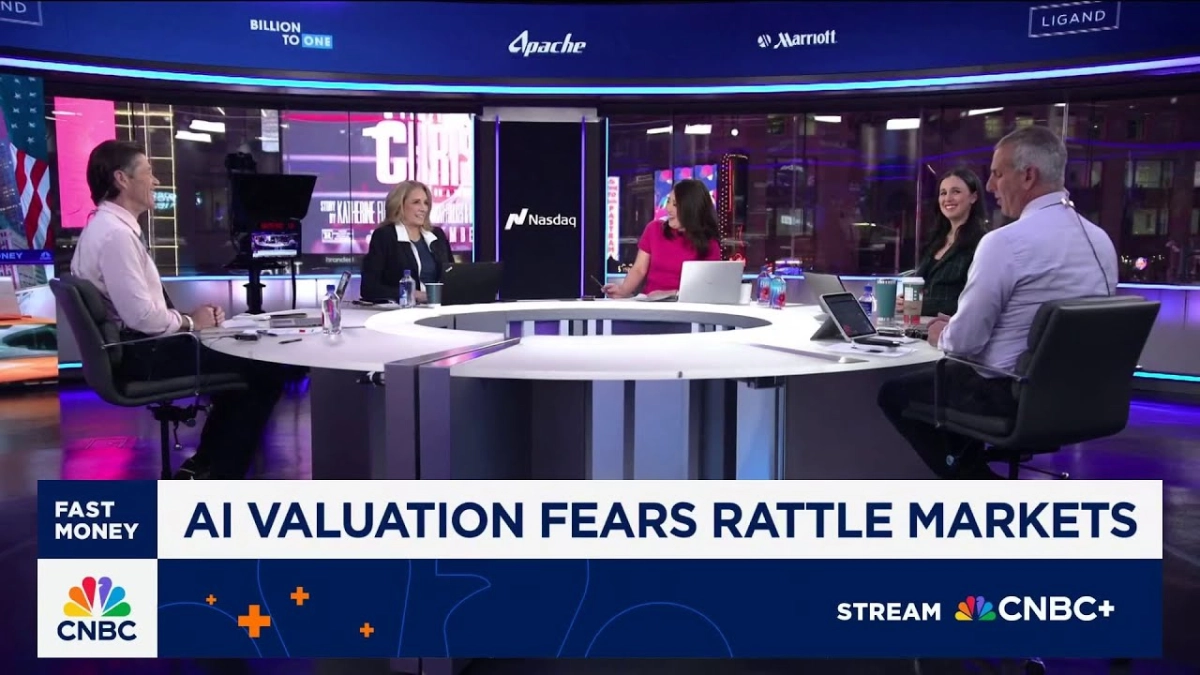
The recent market downturn, fueled by persistent inflation, an uncertain Federal Reserve stance, and signs of a weakening labor market, has brought the elevated valuations of artificial intelligence-driven tech giants under intense scrutiny. A recent CNBC "Fast Money" panel, featuring seasoned traders Guy Adami, Karen Finerman, and Tim Seymour, alongside Payne Capital Management's Courtney Garcia, dissected these prevailing anxieties, questioning whether the long-rewarded "buy the dip" strategy still holds true. The discussion, anchored by host Melody Hahm, explored the confluence of economic data and market psychology that suggests a deeper correction may be on the horizon.
Guy Adami highlighted the Federal Reserve's ongoing concern regarding the labor market, a sentiment reinforced by recent economic indicators. He noted the "hot" ISM services number, which, contrary to hopes of cooling inflation, suggests that "inflation is still a problem." This creates a difficult situation for the Fed, caught between managing inflation and preventing a growth slowdown. Adami observed a tangible shift in market sentiment, citing Bitcoin's underperformance as an indicator of a "risk on, risk off situation" unfolding. He further pointed to significant tech stocks like Oracle, Amazon, and Apple reversing lower, even after strong quarters, suggesting that "good news bads price action" could signal further declines.
Karen Finerman zeroed in on the implications of Oracle's stock "retracing entirely," a move she deemed highly significant. The CBOE Volatility Index (VIX), often called the market's fear gauge, hovering "just under 20 now" remains "very much in no man's land," she stated, indicating that the selling pressure is far from over. Finerman anticipates the VIX could climb higher, signaling a more substantial market sell-off.
Tim Seymour broadened the economic perspective, suggesting a potential pivot in market fears from interest rate hikes to a "growth scare." He pointed to an increasing trend of "white-collar job loss," a phenomenon that directly impacts consumer confidence and spending power. This concern about the consumer, a cornerstone of economic stability, adds another layer of tension to an already volatile market environment, particularly affecting companies exposed to consumer lending and mortgage servicing.
Courtney Garcia provided a crucial valuation context, noting that leading into the week, the S&P 500 was trading "13% above its 200-day moving average." She further emphasized that the Roundhill Magnificent Seven ETF, representing the market's largest and most influential tech companies, was trading at "around 30-30 times forward earnings." Her analysis concluded that "things were overextended," making the current pullback a "pretty normal" and "not unexpected" development. This suggests a rational re-evaluation of asset prices, with investors moving towards a "safety trade" by taking profits and reallocating capital into more secure assets like Treasuries.