

• StartupHub.ai
    StartupHub.aiAI Intelligence
Discover
  • Home
  • Search
  • Trending
  • News
Intelligence
  • Market Analysis
  • Comparison
  • Market Map
Workspace
  • Email Validator
  • Pricing
Company
  • About
  • Editorial
  • Terms
  • Privacy
  • v1.0.0
  1. Home
  2. News
  3. Taho Funding Nets 3 5m To Challenge Kubernetes In The Ai Compute War
Back to News
Funding round

TAHO funding nets $3.5M to challenge Kubernetes in the AI compute war

S
StartupHub Team
Nov 19, 2025 at 11:19 AM4 min read
TAHO funding nets $3.5M to challenge Kubernetes in the AI compute war

The cost of training and running large AI models is rapidly becoming the single biggest bottleneck in the tech industry. Now, a new startup founded by veterans of Meta, Google, and Snap is claiming it has the architectural solution, securing $3.5 million in initial TAHO funding to prove it.

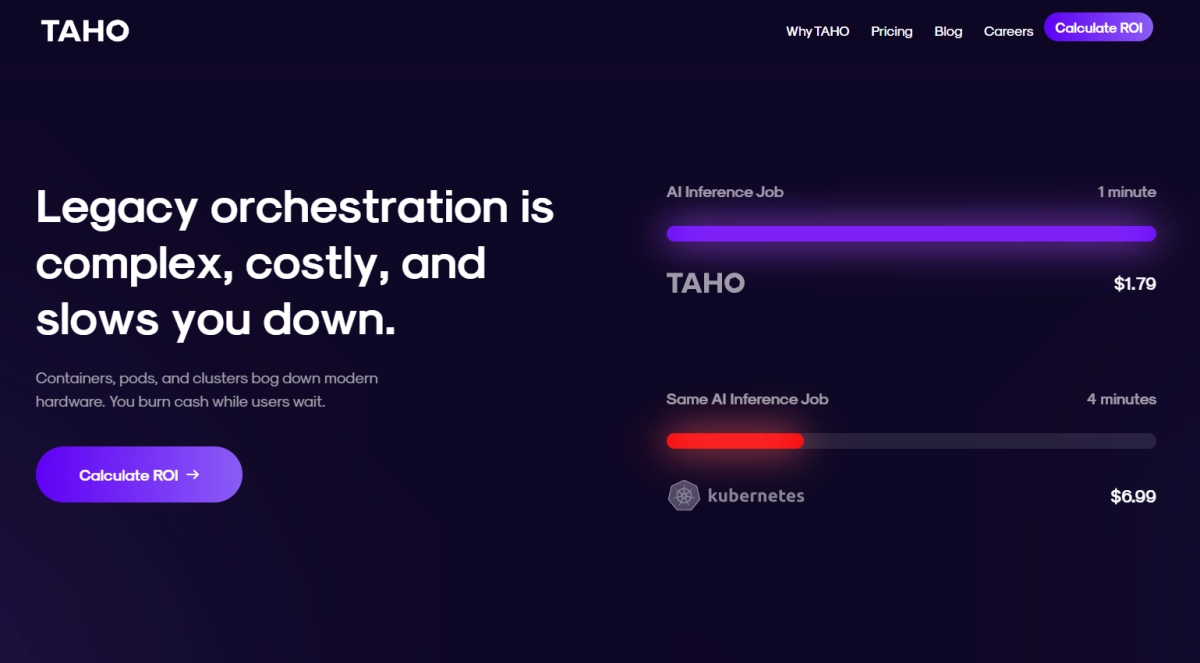
TAHO, based in Venice, Florida, announced the closing of its $3.5 million seed round this week, positioning itself as the necessary performance layer for the exploding demand of AI and high-performance computing (HPC). The company’s core promise is audacious: delivering up to 10 times the performance of current infrastructure while slashing costs by as much as 90%.

This isn't just incremental optimization. TAHO is betting that the existing infrastructure paradigm—specifically, the container orchestration frameworks that dominate cloud computing—is fundamentally ill-suited for the demands of modern machine learning.

“We all see AI workloads are exploding, but infrastructure buildouts cannot keep pace,” said Todd Smith, CEO and Co-Founder of TAHO. “We started TAHO because the world needs a better way to compute that’s universal, faster and affordable enough for every AI-driven company to grow profitably.”

The platform aims to transform a company’s existing cloud resources into a "single intelligent supercomputer." Instead of relying on traditional, rigid orchestration, TAHO uses a tightly interwoven fabric that dynamically shares resources. It decomposes large workloads into discrete tasks, distributes them across available capacity, and reassembles the results in real time. The key differentiator, according to TAHO, is that results persist globally, eliminating redundant work—a massive efficiency gain for iterative AI training.

The timing of this TAHO funding is critical. As the industry grapples with GPU scarcity and the massive energy demands of large language models (LLMs), any solution that promises to extract more efficiency from existing silicon and cloud budgets will attract serious attention.

The Federated Fabric vs. Kubernetes

The underlying technical argument TAHO is making is a direct challenge to the reigning champion of cloud infrastructure: Kubernetes.

Kubernetes, while essential for managing microservices and scaling applications, was not designed with the specific, data-intensive demands of modern AI training in mind. Its container-based orchestration model can introduce overhead and latency when dealing with massive, tightly coupled compute jobs that require rapid data movement and coordination across disparate nodes.

TAHO’s co-founder and CTO, Michal Ashby, a veteran of Meta and Google, argues that this traditional approach is obsolete for the AI era. “Traditional orchestration frameworks weren’t designed for the demands of modern AI and machine learning at scale,” Ashby stated.

Instead, TAHO operates as a federated compute layer with decentralized execution. This federated architecture unifies machines, clusters, and nodes into a single intelligent fabric. By optimizing training, inference, and data movement at this foundational layer, TAHO claims it can bypass the bottlenecks inherent in container-based systems.

If TAHO’s performance claims hold up in real-world deployments, the implications for the AI ecosystem are profound. A 90% cost reduction and 10x speed increase would effectively democratize access to high-performance compute, lowering the barrier to entry for startups currently priced out of the top-tier cloud GPU market. It would also significantly improve the profitability margins for established AI players currently spending billions on infrastructure.

The $3.5 million seed round was led by strategic angel investors and industry insiders, signaling strong conviction in the founding team’s ability to execute on this complex infrastructure vision. The funds will be used to expand the engineering team and accelerate early customer deployments ahead of a planned broad platform availability in 2026.

TAHO’s CEO, Todd Smith, summarized the company’s mission simply: “Our goal is simple — help everyone get more computing out of the cloud and data centers they already use. We’re building the performance layer that makes AI and complex software run faster, cost less, and easier to manage.”

While the tech world has seen countless startups promise to revolutionize cloud infrastructure, the pedigree of the TAHO founding team—drawn from the companies that defined modern compute—suggests this is a challenge worth watching closely. If they can deliver on the promise of a universal, faster, and dramatically more affordable compute fabric, the $3.5 million in TAHO funding will look like a bargain.

#AI
#AI Compute
#Funding
#Kubernetes
#Michal Ashby
#Seed Round
#TAHO
#Todd Smith

AI Daily Digest

Get the most important AI news daily.

GoogleSequoiaOpenAIa16z
+40k readers