

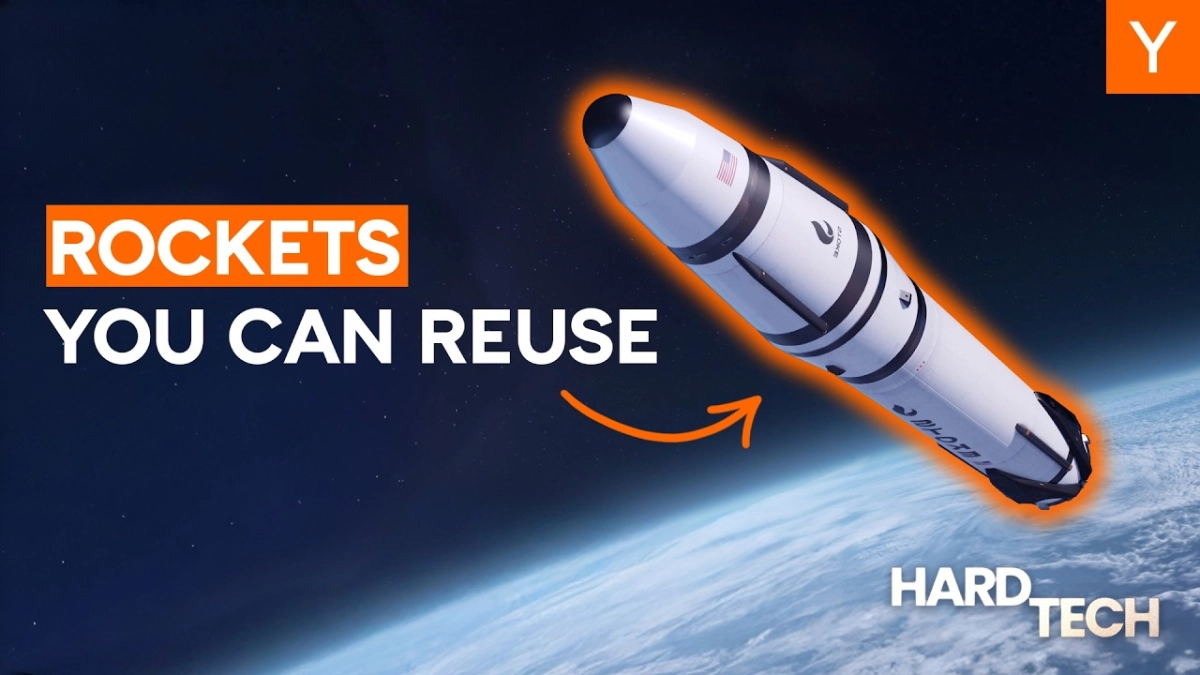
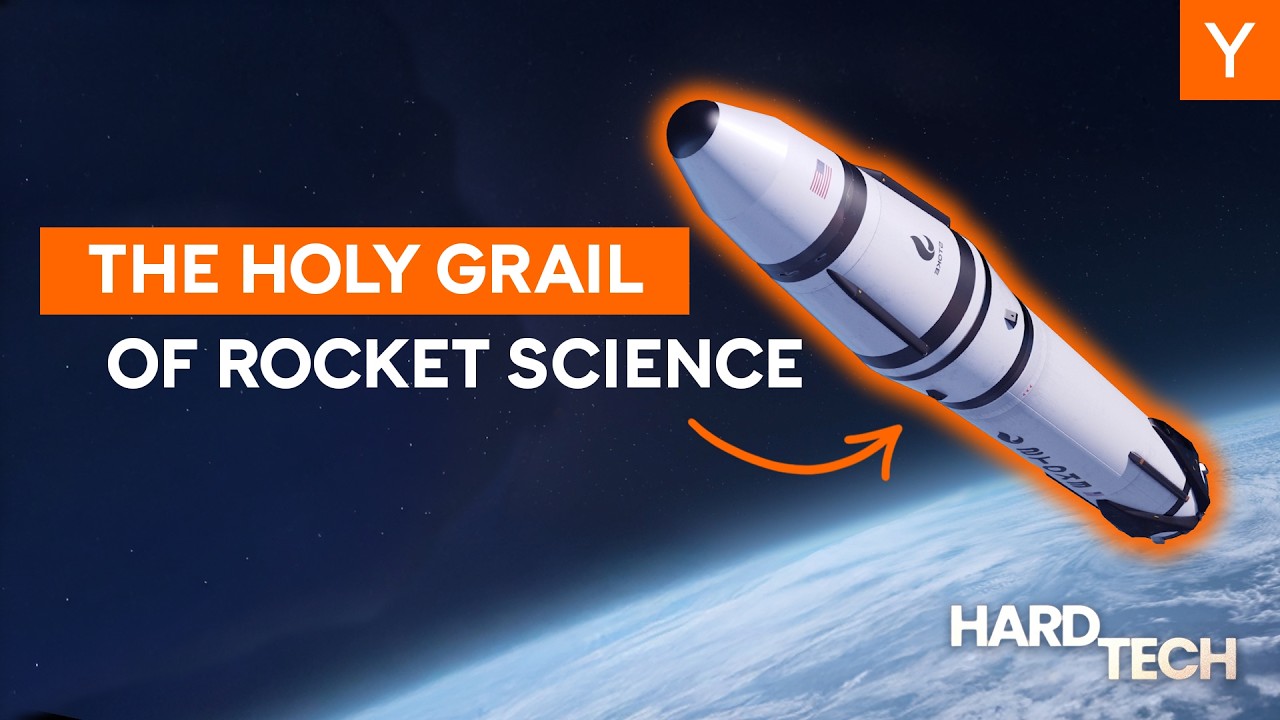
The iteration speed afforded by modern software and AI is not just accelerating digital products; it is fundamentally changing the calculus of "hard tech" industries like aerospace. This radical shift is the core principle behind Stoke Space, a startup tackling the seemingly intractable problem of fully reusable rockets. This commitment to marrying rapid, software-driven iteration with complex physical engineering is key to achieving a feat long considered the Holy Grail of rocketry: the reusable second stage.
In a recent segment of Y Combinator’s Hard Tech series, General Partner Aaron Epstein spoke with Stoke Space co-founders Andy Lapsa (CEO) and Tom Feldman (CTO) about their quest to achieve complete rocket reusability and the engineering philosophy driving their ambitious mission. Lapsa emphasized that the current launch market is constrained by both cost and availability, noting that even with record-setting annual commercial launches, the total number—around 150—is a "drop in the bucket" compared to the demand that would be unleashed by scalable, aircraft-like reusability. "With only 150 potential transactions [commercial launches] and most of them getting taken up by Starlink, there’s just not that much availability," Lapsa stated, confirming that high cost remains a massive barrier to enabling new space verticals.
While the reusability of the first stage has been largely solved by industry leaders, the second stage presents a far greater technical challenge. The upper stage, designed to reach orbital velocity, re-enters the atmosphere at speeds around 17,000 miles per hour. This subjects the vehicle to immense thermal and kinetic stress, leading to temperatures that often incinerate the structure. Existing solutions rely on disposable components, maintaining the high cost and low frequency that plagues the industry.
The challenge of atmospheric reentry for the upper stage is brutal, exposing the capsule to temperatures exceeding 2,700 degrees Fahrenheit. Stoke Space’s Andromeda capsule utilizes a proprietary heat shield that employs cold liquid hydrogen flowing through a heat exchanger, absorbing the extreme thermal load.
This unique thermal management system, coupled with 24 small thrusters, allows the upper stage to execute a controlled, vertical landing back on Earth. This radical approach is central to Stoke’s Nova vehicle, a two-stage-to-orbit rocket designed for rapid turnaround. The first stage functions similarly to other reusable boosters, punching the vehicle out of the atmosphere before returning. The second stage, however, is the differentiating factor, designed to survive the high-speed return from orbit and land gently at a predetermined site.
The decision to pursue this extremely difficult engineering problem required a significant personal leap of faith from the founders. Lapsa admitted that the decision to leave comfortable, high-paying jobs at Blue Origin was "wildly irresponsible," especially given that they both had young children. Feldman echoed this, noting that they gave themselves a "time-bounded scenario" of six months to achieve traction before re-evaluating the leap. They realized that while many companies were discussing revolutionary space ideas in PowerPoint presentations, few were applying the necessary engineering rigor to solve the hardest problems.
To mitigate the immense technical risk and accelerate development, Stoke Space adopted a philosophy of extreme vertical integration, building nearly every critical component—from avionics and electronics to engine parts and structures—in-house at their 168,000 square foot facility in Kent, Washington. This control over the supply chain is essential for achieving the velocity of iteration required in deep tech hardware. Lapsa stressed that iteration speed is the competitive differentiator: "The speed at which you can iterate becomes fundamentally important to your ability to do the hard thing as quick as possible." By controlling manufacturing, they reduced design-to-test cycles from months to mere days, allowing them to fail, learn, and implement changes almost instantly.
Critically, this vertical integration is underpinned by a robust software layer. Building a fully reusable rocket requires continuous data collection, logging, and analysis to predict component failure and schedule maintenance. The company developed its own software tool, Boltline, specifically to manage the complex interplay between design, manufacturing, testing, and flight operations. This system coordinates parts, people, and processes across the entire lifecycle, ensuring compliance and maximizing efficiency. Lapsa highlighted the convergence of engineering and software: "We’re in a moment in time where software can automate a lot of that. I’m really excited about new developments in AI and other things to make it even more seamless for a factory worker to do their job and also log answers to those questions." This software infrastructure is the crucial bridge allowing Stoke to scale from garage-based prototyping to operating complex, FAA-overseen orbital vehicles.
The success of Stoke Space, which has raised approximately $990 million to date, validates the market's belief in the necessity of full reusability. If successful, Stoke Space is poised to transform the space industry by dramatically lowering the cost of access to orbit and enabling a new generation of space-based applications—from asteroid mining concepts to orbital data centers. This hard-won progress, driven by engineering conviction and rapid technological execution, demonstrates that the greatest challenges in physical infrastructure are now being unlocked by deep commitment and powerful software tools.

