


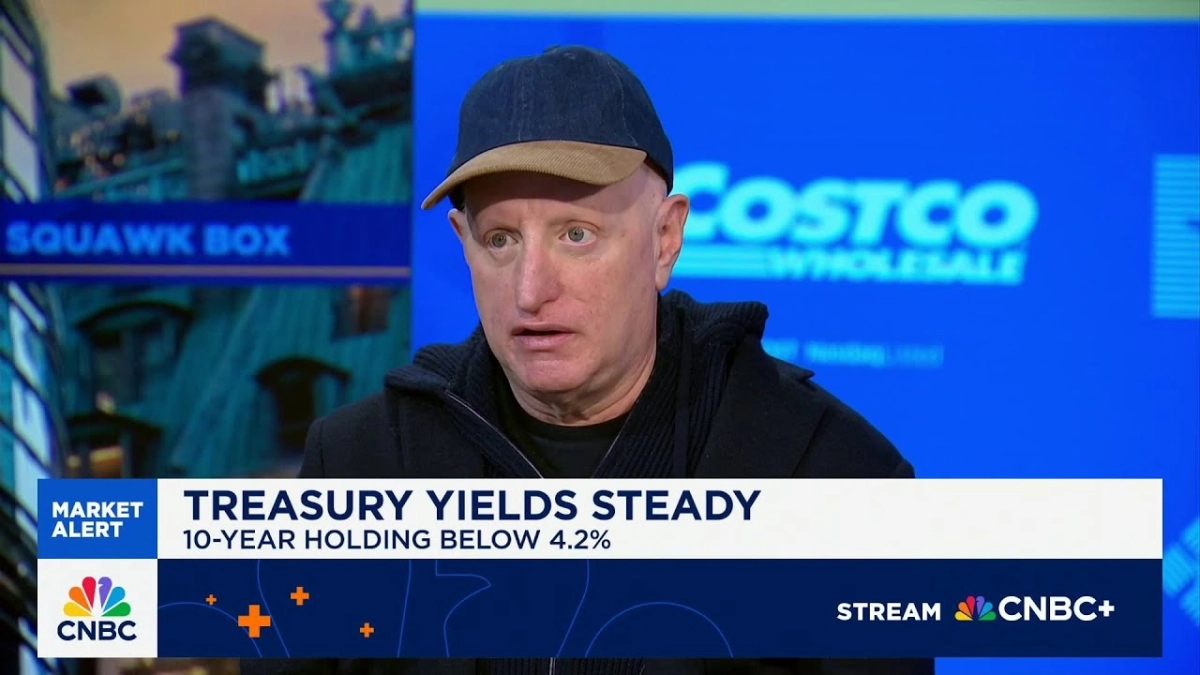
"The big question on AI spending is, what kind of returns and cost savings the massive investments will bring." This statement, from Steve Eisman, former senior portfolio manager at Neuberger Berman, encapsulates the core tension surrounding the current artificial intelligence boom. Eisman spoke with CNBC's "Squawk Box" to discuss his perspective on the markets, particularly the burgeoning AI trade, and his own health.
Eiseman, known for his prescient short calls during the 2008 financial crisis, expressed a nuanced view on the current AI fervor. While acknowledging the transformative potential of AI, he cautioned against an overly optimistic outlook regarding the immediate profitability of large language models (LLMs). He posits that the rapid pace of improvement in LLMs is likely to decelerate. "We won't know the answer for a while, and won't be determined by change in depreciation schedules," Eisman remarked, highlighting the uncertainty in quantifying the returns on these substantial investments.
A key insight from Eisman is his belief that the market is currently overemphasizing the immediate impact of AI. He observes that the debate is too focused on whether AI is a bubble, rather than on the fundamental question of how these technologies will actually deliver value. "I think what people are focusing too much on is the whole debate that's going on is actually much more foundational," he stated. This suggests a need for a more grounded assessment of AI's practical applications and their eventual economic benefits.
Eisman also shared his personal investment strategy amidst this AI-driven market. Despite his reservations about the rapid growth trajectory of some AI stocks, he remains invested in many of them. "I own a lot of these stocks too. I own them all," he admitted, indicating a balanced approach that acknowledges both the risks and the long-term potential. This stance reflects a pragmatic investor who is not abandoning the sector but is keenly aware of the need for careful evaluation.
He drew a parallel to the housing market crisis of 2008, where a foundational assumption proved to be flawed. In that instance, the assumption that housing prices would not decline proved to be incorrect, leading to a systemic collapse. Eisman suggests that a similar dynamic could unfold in the AI space if the assumption that LLMs will continue to scale indefinitely without encountering diminishing returns proves false. "Housing prices can't go down. Once that assumption collapsed, the whole edifice collapsed," he explained. This analogy serves as a stark warning about the potential consequences of unchecked optimism.
Furthermore, Eisman highlighted the work of individuals like Gary Marcus, a professor at NYU and a prominent critic of current AI development, who has been advocating for a more nuanced understanding of AI's limitations. Marcus, who co-founded a company focused on AI, has consistently argued that LLMs, while impressive, are reaching a plateau in their development. Eisman seems to align with this perspective, suggesting that the rapid improvements seen thus far may indeed begin to slow. "Scaling LLMs as they keep scaling will start to lose their efficaciousness," Eisman predicted. This implies that the current strategy of simply increasing model size and data may not yield proportional gains indefinitely.
The market's current enthusiasm for AI, Eisman contends, is largely built on an assumption that has not yet been fully tested. He points to the fact that many companies are investing heavily in AI without a clear, quantifiable return on investment. This speculative fervor, he suggests, could be a precursor to a correction if the expected benefits do not materialize as anticipated. The critical question remains whether the immense capital being poured into AI will translate into tangible cost savings and productivity gains across industries.
Eisman's commentary suggests that while AI is undeniably a powerful force, investors and technologists should temper their expectations regarding the speed and scale of its immediate impact. A more measured approach, focused on the fundamental economics and practical limitations of the technology, is likely to be more prudent.


