
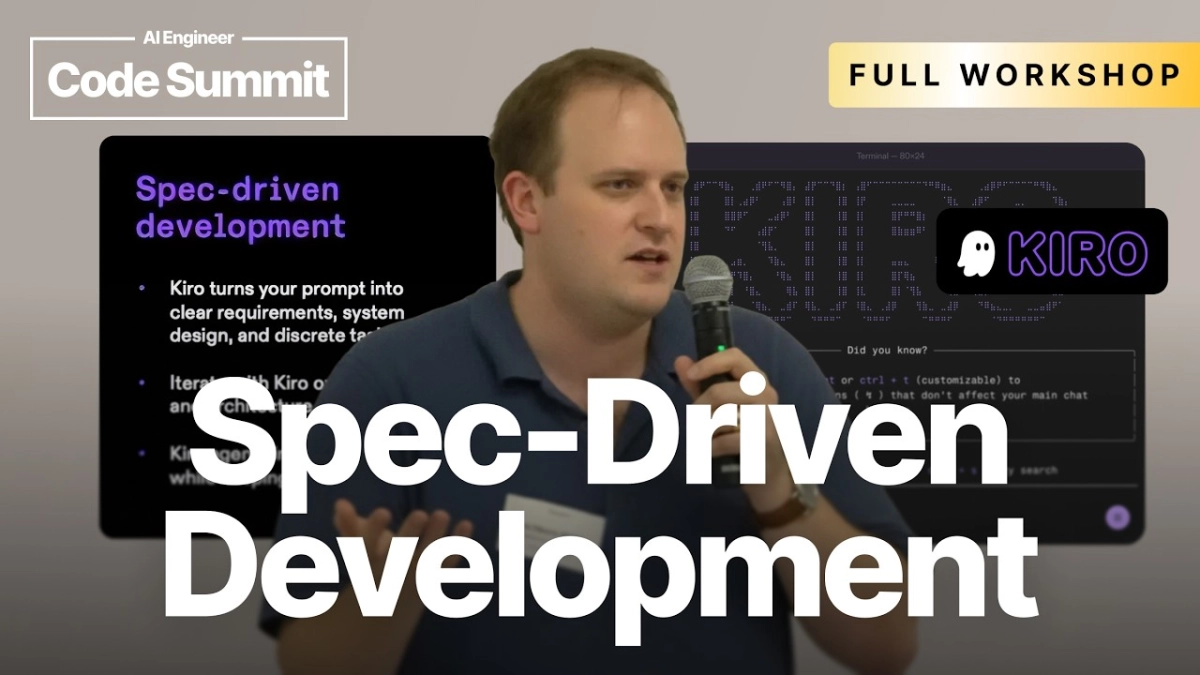
"We have powerful tools, but tools still require honing to work effectively." This foundational statement, highlighted by Al Harris of the Amazon Kiro team, encapsulates the necessary paradigm shift facing engineering leaders utilizing generative AI. The common misconception is that sophisticated AI coding assistants negate the need for rigorous software development practices; the reality, according to Harris, is precisely the opposite. The introduction of powerful code-generating systems merely shifts the point of failure upstream, making the quality of the initial specification the single most critical factor in reliable software delivery.
Harris spoke about the Kiro team's philosophy regarding Spec-Driven Development (SDD) in the age of rapid AI adoption, detailing how investment in the front-end requirements process yields exponential returns in the back-end coding phase. For founders and VCs evaluating AI-centric engineering organizations, the discussion moves away from raw lines of code produced per hour and towards the robustness and clarity of the foundational input documents. The core argument is simple: an AI cannot fix a flawed or ambiguous requirement; it can only instantiate that flaw with frightening efficiency.
The engineering discipline must shift from execution efficiency to definition precision. This is the new bottleneck for high-velocity AI teams.
The Kiro team’s approach champions the specification as the primary, high-leverage artifact. Harris elaborated on the necessity of treating the specification itself as a piece of software—something that must be tested, validated, and version-controlled before a single line of code is committed. This necessitates a formalization of the spec process, moving beyond loose natural language documents toward structured inputs that minimize ambiguity for the underlying AI model. If the goal is reproducible and reliable delivery, the system needs a deterministic input.
This focus on the spec is particularly vital because AI often obscures the need for deep architectural thinking by providing plausible, yet potentially fragile, code solutions quickly. Harris noted that without a rigorous SDD framework, teams can fall into the trap of accepting locally optimized code that fails to integrate cleanly into the broader system architecture. "Spending time up-front to improve the spec process will yield the best approach," Harris asserted, underlining the economic reality that fixing errors in the requirements stage is orders of magnitude cheaper than debugging production code generated from those faulty requirements.
For organizations scaling their AI toolbox, the challenge is not acquiring the latest model, but integrating it into a process that demands clarity. Harris detailed how the Kiro team "sharpens" their tools by building internal methodologies that force precision. This includes developing templates and validation steps that ensure the specification contains all necessary constraints, test cases, and definitions of success before being handed off to an AI assistant. The AI then acts less as a creative partner and more as an exceptionally fast compiler, translating a highly formalized specification into executable code.
One of the central insights Harris provided revolves around the concept of validation, specifically how SDD enables better testing. When the specification is clear and structured, the acceptance criteria are inherently defined within the document itself. This allows teams to leverage AI not just for code generation, but for test case generation and validation against the explicit requirements. This creates a powerful feedback loop: the AI generates the code, and then it or another system validates the output against the same formalized specification. This significantly reduces the cognitive load on human engineers, allowing them to focus on complex systems integration and architectural oversight, rather than tedious code review.
The shift in responsibility for the senior engineer is profound. They move from being expert coders to expert requirement definers. Their value proposition becomes the ability to translate complex business needs into unambiguous, structured specifications that the AI can reliably consume. This demands a mastery of domain language and an understanding of the constraints of the generative models being employed. As Harris explained, the highest returns come not from maximizing AI output speed, but from minimizing the necessary human rework cycles.
This methodology challenges the common startup ethos of "move fast and break things." In high-stakes environments, or for complex enterprise software, reliability trumps velocity. Harris’s commentary serves as a critical reminder that while AI provides unprecedented velocity, that speed is only valuable if the direction is correct. The Kiro team’s experience demonstrates that the integration of AI tools must be accompanied by an increase in engineering discipline, not a relaxation of it. The future of reliable, AI-assisted development hinges on the quality of the specifications we provide, making SDD the essential framework for mastering the AI coding era.



