

SpaceX's Orbital AI Data Center Play

SpaceX aims to build massive AI data centers in orbit, leveraging Starship and Starlink to power future civilization and AI growth.

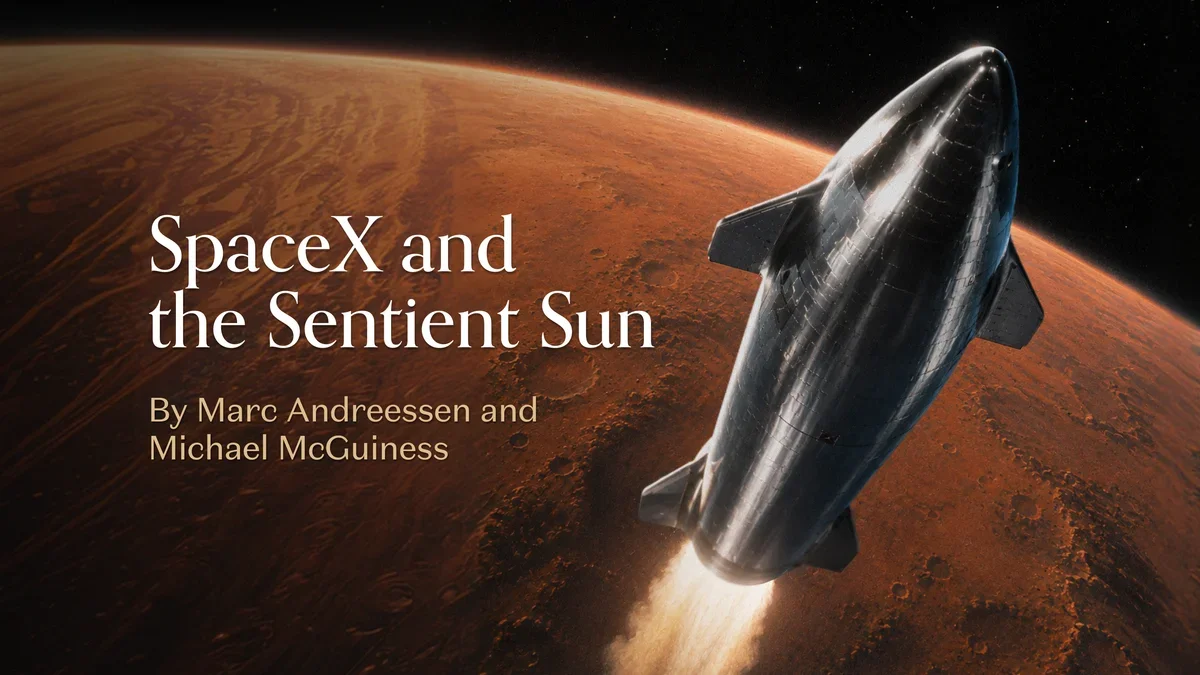
Artist's concept of SpaceX Starship rocket launching into orbit above Earth.
SpaceX's Starship is central to the company's plans for orbital data centers and interplanetary travel.· a16z Blog
Visual TL;DR
Starship & StarlinkCore
SpaceX's key technologies for mass transit and global internet
From the article 5 mentionsSpaceX is building the latter two with Starship and Starlink, respectively, while eyeing space for the former.
Inspired by Iain M. BanksContext
Culture series vision of utopian AI and human coexistence
Massive Energy NeedsDriver
required for fictional utopia and advanced AI development
Musk's Ambitious GoalsDriver
includes $7.5T valuation, Mars colony, and massive orbital data centers
From the articleElon Musk's compensation package at SpaceX hinges on audacious goals: a $7.5 trillion valuation, a million-person Mars colony, and crucially, data centers in space drawing 100 terawatts of power.
Orbital AI Data CentersContext
drawing 100 terawatts, dwarfing Earth's current data center consumption
From the article 3 mentionsThis latter target dwarfs Earth's current data center consumption by over a thousand times.
Multiplanetary HumanityOutcome
SpaceX's founding mission driving these audacious plans
From the articleIt's directly tied to SpaceX's founding mission: making humanity multiplanetary.
Powering Future CivilizationEffect
enabling coexistence of humans and superintelligent AIs
From the articleThis layered approach, from Starlink's cash flow to Falcon 9's launch dominance and Starship's future potential, builds toward the ultimate goal of off-world civilization and advanced AI infrastructure.

Elon Musk's compensation package at SpaceX hinges on audacious goals: a $7.5 trillion valuation, a million-person Mars colony, and crucially, data centers in space drawing 100 terawatts of power. This latter target dwarfs Earth's current data center consumption by over a thousand times.

The board's faith in Musk's predictions, from reusable rockets to a booming satellite internet business, underpins this pay structure. It's directly tied to SpaceX's founding mission: making humanity multiplanetary.

Musk has openly cited Iain M. Banks's Culture series, a utopian vision of humans and superintelligent AIs coexisting, as inspiration. The names of SpaceX's drone ships, 'Of Course I Still Love You,' 'Just Read the Instructions,' and 'A Shortfall of Gravitas', are direct nods to Banks's sentient starships.

Banks's fictional utopia requires immense energy, scaled physical and digital intelligence, and cheap mass transit off-world. SpaceX is building the latter two with Starship and Starlink, respectively, while eyeing space for the former.

Working backward from a self-sustaining Mars city, SpaceX envisions a Moon base with factories and mass drivers to launch AI satellites. This lunar infrastructure could tap into the Moon's resources for solar cells and satellite components.

The core idea behind SpaceX AI data centers in orbit is to tackle AI's energy bottleneck. Orbital solar panels offer significantly more power than terrestrial ones due to the absence of atmospheric interference and day-night cycles.

Musk projects SpaceX will launch more AI compute to orbit annually than Earth's cumulative installed base within five years, a vision that partly motivated the merger with xAI.

Starship, the company's super heavy-lift rocket, is central to this strategy, promising drastically reduced launch costs. The projected cost per kilogram to orbit is $100-500, a fraction of historical figures.

Starlink serves as the financial engine, generating $11.4 billion in revenue in 2025. It began as a way to fill unused rocket capacity and has evolved into a major consumer business.

Falcon 9 rockets remain the workhorse, launching 83% of Earth's orbital mass in 2025 and providing the consistent revenue stream needed to fund these larger ambitions.

This layered approach, from Starlink's cash flow to Falcon 9's launch dominance and Starship's future potential, builds toward the ultimate goal of off-world civilization and advanced AI infrastructure.

© 2026 StartupHub.ai. All rights reserved. You may not republish this article in full without a license. Search engines and AI research tools may crawl and summarize for reference. Bulk reproduction or model training requires a license. See our terms.
Daniel Singer

Written by

Daniel Singer

Editor, StartupHub.ai

Daniel Singer is the editor of StartupHub.ai, a technology expert and thought leader on AI and its applications across sectors, from fintech and healthcare to developer tooling and consumer software. He writes and tests the tools covered here thoroughly and regularly, and built StartupHub.ai to give founders, operators and buyers a clearer read on what they are actually being sold.