

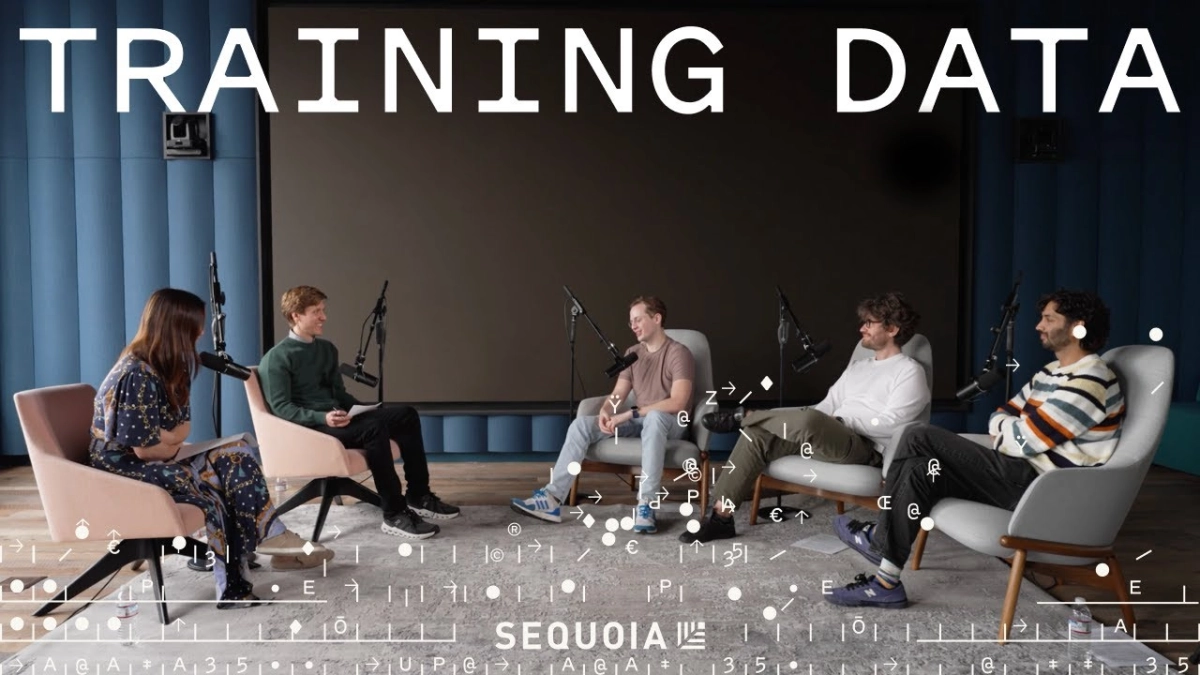
"We’ve hit this kind of like GPT-3.5 moment for video. Let’s make sure the world is kind of aware of what’s possible now, and also start to get society comfortable in figuring out the rules of the road for this kind of longer-term vision." Bill Peebles, head of the OpenAI Sora team, articulated this pivotal juncture during a recent discussion with Konstantine Buhler and Sonya Huang of Sequoia Capital. Joined by fellow Sora team members Thomas Dimson and Rohan Sahai, Peebles unveiled a vision far grander than mere video generation, hinting at a future where AI models evolve into sophisticated world simulators.

The conversation, hosted by Sequoia Capital as part of their "Training Data" series, delved into the technical underpinnings of Sora 2, its transformative potential for creative industries, and the profound societal implications of such powerful generative AI. Peebles, the inventor of the diffusion transformer (DiT) that powers Sora and many other video generation models, laid out the architectural leap that enables Sora’s unprecedented capabilities. Dimson and Sahai, on the product side, elaborated on OpenAI's intentional design philosophy, prioritizing creative inspiration over passive consumption and laying the groundwork for a new creator economy that thoughtfully integrates IP holders.
At its core, Sora 2 represents a significant advancement in the realm of video generation, moving beyond the iterative token-by-token generation of autoregressive transformers. Peebles explained that DiTs, or diffusion transformers, operate differently. Instead of generating tokens sequentially, diffusion models "gradually remov[e] noise, one step at a time," effectively generating the entire video simultaneously. This approach fundamentally addresses a critical challenge in prior video generation systems: the degradation or alteration of quality over time. By processing the entire spacetime continuum of a video at once, DiTs inherently maintain consistency and coherence, leading to properties like object permanence and a nascent understanding of physics.
This technological breakthrough is not merely about aesthetic improvement; it's about building models that grasp the underlying mechanics of reality. Peebles emphasized that Sora considers "spacetime tokens" as its fundamental building blocks, akin to characters in language models. This allows the model to develop an "internal representation of how the world functions." When prompted to generate a basketball player shooting a hoop, Sora 2 won't optimistically guide the ball into the net if the shot is off; it will defer to the laws of physics, causing the ball to rebound off the backboard. This distinction between "model failure" and "agent failure" highlights Sora's emerging intelligence, demonstrating an implicit simulation of real-world physics and agent behavior.
The implications of such "world simulators" extend far beyond entertainment. The team envisions a future where these models could run scientific experiments, accelerate research, and even transform knowledge work. While acknowledging the need for further "step function improvements" in model quality, Peebles expressed confidence that, much like the progression from GPT-1 to GPT-3.5, video models will eventually reach a point where they can reliably simulate complex real-world phenomena. This is not solely a function of scale; it's about fundamental generative modeling research that focuses on building robust internal world models.