


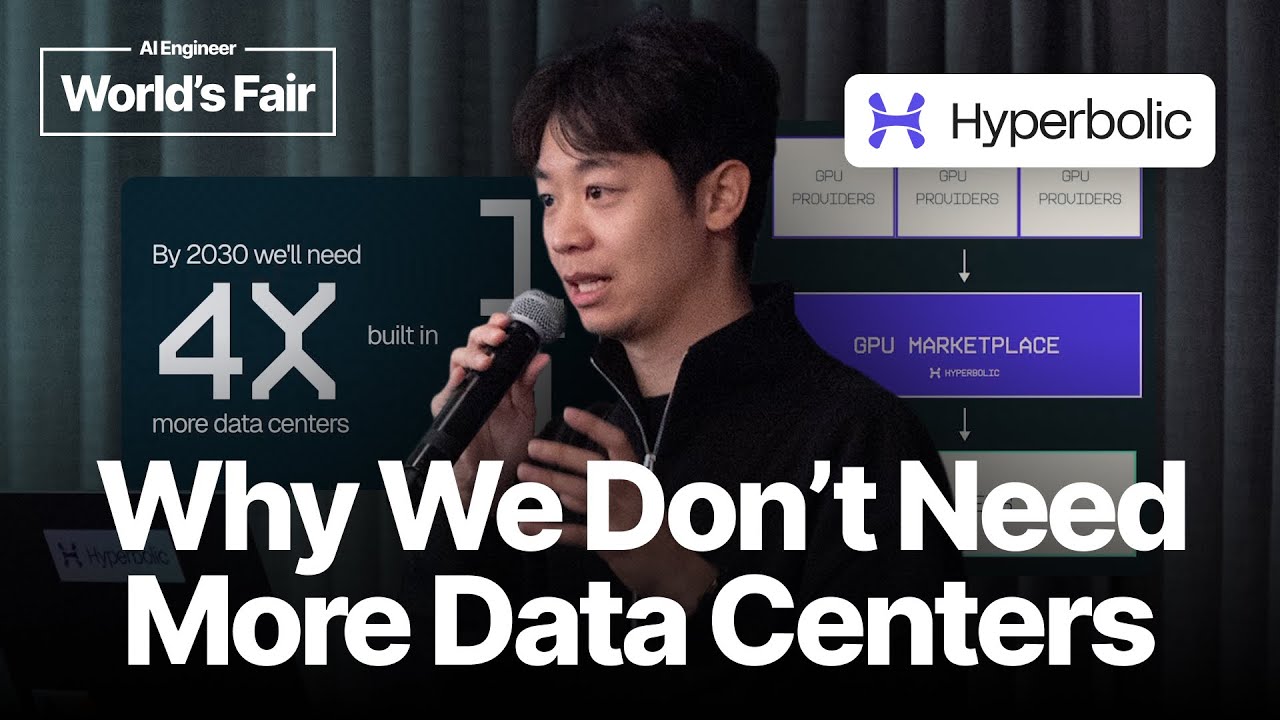
The relentless demand for AI compute capacity has trapped the industry in an unsustainable cycle of building new data centers, a paradigm Dr. Jasper Zhang, CEO and Co-founder of Hyperbolic, argues is fundamentally flawed. Speaking at the AI Engineer World's Fair in San Francisco, Zhang presented a compelling case that the real problem isn't a lack of data centers, but rather the inefficient utilization of existing GPU resources.
Zhang, a mathematical prodigy with a Ph.D. from UC Berkeley and a background at Citadel Securities, highlighted the immense pressure on current infrastructure. Projections indicate that "By 2030, we'll need 4x more data centers built in 1/4 the time." This aggressive expansion comes at a staggering cost, with a single data center like StarGate demanding "more than a billion dollars to build." Beyond the financial burden, the environmental toll is significant, with data centers currently consuming "4% of the total electricity consumption in the U.S. for just GPUs and data centers," contributing "105 million tons of CO2 emissions annually." Even with planned construction, a substantial supply deficit of over 15 GW is anticipated in the U.S. alone by 2030.
The true inefficiency, Zhang posited, lies in underutilized hardware. According to Deloitte, "GPUs sit idle ~80% of the time for enterprises and companies." This idleness, coupled with a fragmented market of over 100 GPU cloud providers, creates a bottleneck for startups and enterprises alike. Companies struggle to find available compute at reasonable prices, while valuable hardware sits dormant.
Hyperbolic’s solution is a GPU marketplace built on a "Global Orchestration Layer" called Hyper-dOS. This distributed operating system, conceptualized as a "Solar System Clustering Model" where Hyperbolic acts as the "Sun Cluster" orchestrating various data center "Planetary Clusters," aims to revolutionize resource allocation. It efficiently matches idle GPU capacity with companies that need compute, transforming GPUs into "commodities" on a dynamic marketplace, thereby negating the immediate need for new data center construction.
The economic benefits are profound. Hyperbolic claims a 50-75% reduction in cost and a 2-4x increase in productivity. Zhang illustrated this with a powerful example: an H100 GPU available on Hyperbolic for just 99 cents per hour, starkly contrasting with Google's on-demand price of $11. A hypothetical use case demonstrated a startup's annual GPU costs plummeting from $43.8 million on a traditional cloud to $6.9 million with Hyperbolic, representing a 6x saving. This isn't merely about cost reduction, but about empowering businesses to achieve "6x" more with the same budget, fostering greater experimentation and innovation. This model also allows companies to monetize their own idle GPUs, further democratizing access to crucial compute power.
The vision is a single, unified platform that supports every AI workload, from burst-heavy training to low-latency online inference and cost-sensitive offline processing. This approach shifts the focus from raw infrastructure build-out to intelligent resource management, making AI development more accessible, sustainable, and efficient for the entire ecosystem.

